
Hire vs Purchase Capital Assets UK: What’s Best for Your Business?
When it comes to acquiring equipment, vehicles, or machinery, UK businesses often face a critical decision: hire vs purchase capital assets UK.
The right choice depends on your cash flow, tax position, and long-term strategy. While both options offer distinct advantages, understanding the accounting and tax implications is essential before committing.
Hire vs Purchase Capital Assets UK: Key Considerations
Whether you’re investing in a van, IT equipment, or plant machinery, the hire vs purchase capital assets UK decision should factor in:
- Upfront cost vs ongoing payments
- Ownership and depreciation
- VAT reclaim rules
- Capital allowances and tax deductibility
Let’s break down the four main acquisition methods and how each affects your accounts and tax return.
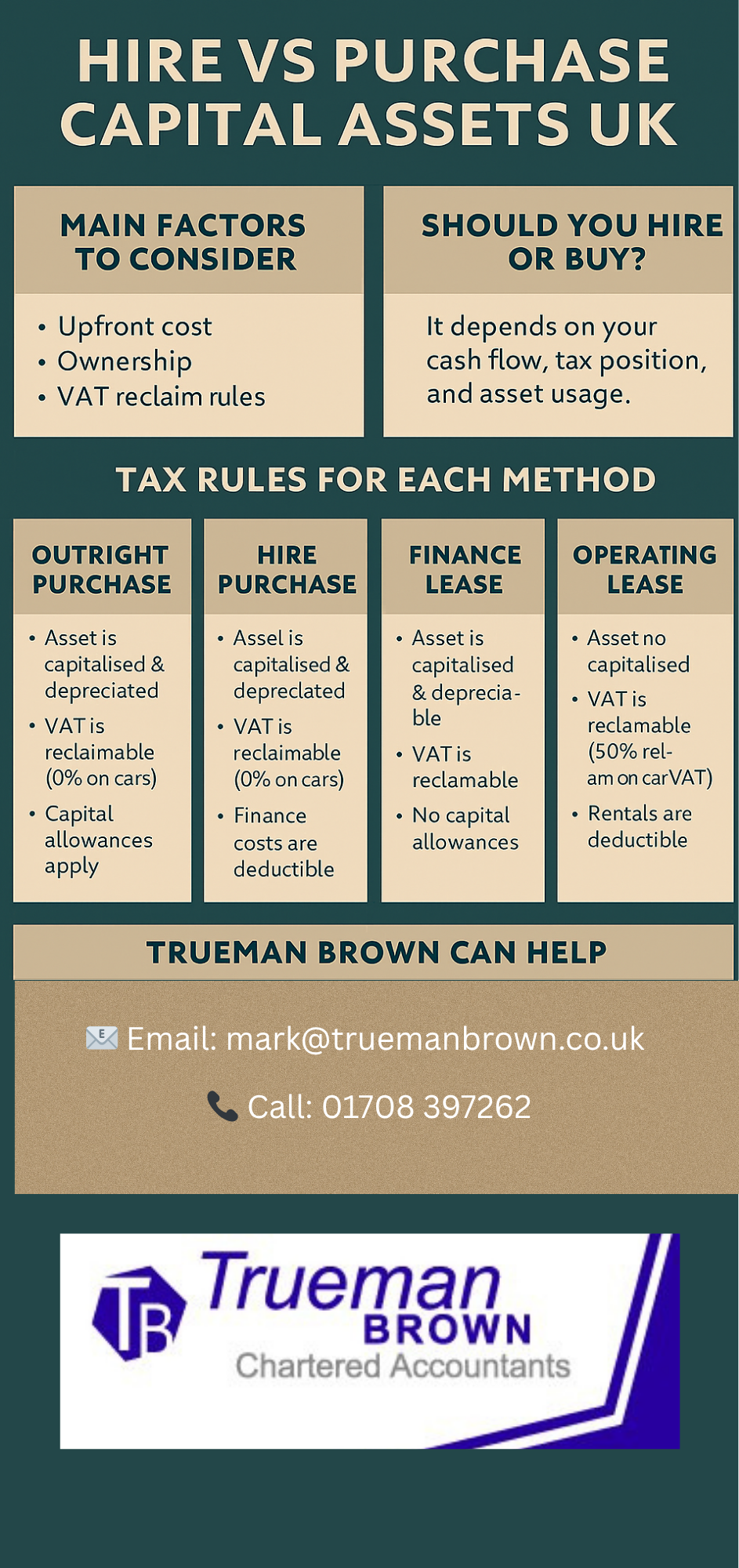
Hire vs purchase capital assets UK- Outright Purchase
Purchasing an asset outright means full ownership from day one—but it also requires a significant upfront investment.
Accounting Treatment:
- Asset is capitalised on the balance sheet
- Depreciated over its useful life
- Depreciation reduces reported profit
VAT Treatment:
- VAT can be reclaimed (except for cars unless used 100% for business or as a taxi/driving school)
Tax Treatment:
- Depreciation is not tax-deductible
- Capital allowances apply instead
- Finance charges are generally allowable
Hire Purchase Agreements
Hire purchase offers a middle ground between leasing and buying.
You pay in instalments and own the asset at the end.
Accounting Treatment:
- Asset is capitalised and depreciated
- Liability recorded for outstanding payments
- Finance charges split and expensed over time
VAT Treatment:
- VAT reclaimable on the initial instalment (with car exceptions as above)
Tax Treatment:
- Same as outright purchase
- Capital allowances apply
- Finance charges deductible
Finance Lease
A finance lease transfers most risks and rewards of ownership to the lessee, even though legal ownership remains with the lessor.
Accounting Treatment:
- Asset capitalised and depreciated
- Lease payments split between finance charge and liability
VAT Treatment:
- VAT reclaimable on all rentals
- For cars: 100% reclaim if used exclusively for business, 50% on finance element if mixed use
Tax Treatment:
- No capital allowances
- Rentals deductible under accruals
- 15% disallowance for cars with CO₂ > 130g/km
Operating Lease
An operating lease is a short-term rental where ownership risks remain with the lessor.
Accounting Treatment:
- Asset not capitalised
- Lease payments expensed directly
VAT Treatment:
- VAT reclaimable on all rentals
- Same car rules as finance lease
Tax Treatment:
- No capital allowances
- Rentals deductible
- 15% disallowance for high-emission vehicles
Trueman Brown Can Help You Decide on hire vs purchase capital assets UK
At Trueman Brown, we help businesses make informed decisions about hire vs purchase capital assets UK. Whether you’re weighing cash flow, tax efficiency, or compliance, we’ll guide you through:
- ✅ Asset acquisition strategy
- ✅ Capital allowance optimisation
- ✅ VAT reclaim eligibility
- ✅ Lease vs purchase modelling
📧 Email: 📞 Call: 01708 397262
Let’s make your next capital investment tax-smart and future-proof.
FAQ: Hire vs Purchase Capital Assets UK
Q: Is it better to hire or purchase capital assets in the UK?
A: It depends on your cash flow, tax position, and asset usage. Hiring may offer flexibility, while purchasing can unlock capital allowances.
Q: Can I reclaim VAT on hired equipment?
A: Yes, VAT is usually reclaimable on rentals. For cars, only 50% of the finance element is reclaimable if used privately.
Q: Do I get capital allowances on leased assets?
A: Only on purchases and hire purchase agreements. Finance and operating leases do not qualify.
Q: What’s the difference between finance lease and operating lease?
A: Finance lease transfers risks and rewards of ownership; operating lease does not.
Q: Can Trueman Brown help with lease vs purchase modelling?
A: Absolutely. We offer tailored advice and financial modelling to support your decision.