
What you need to know about the Employees Benefit Trusts tax scheme
The Employees Benefit Trusts tax scheme (EBTs) has been at the centre of some high-profile disputes.
However, as tax rules change, the risks and compliance requirements have increased substantially.
What is the Employees Benefit Trusts tax scheme?
An Employees Benefit Trust (EBT) is a trust set up by an employer (the “settlor”) — the employer settles assets or funds with trustees, who can then make payments or loans to employees.
In the past, some companies used this arrangement to provide remuneration — effectively disguising salary as trust-distributions or loans.
Under the scheme, those payments were sometimes treated as non-salary (i.e., not subject to PAYE or National Insurance).
The use of EBTs in this way has drawn scrutiny from tax authorities.
Why the authorities have cracked down on EBTs
Over the years, the treatment of EBTs under UK tax law has tightened. EBTs are now viewed with caution because they may fall under “disguised remuneration” rules — meaning that payments from an EBT can be treated as earnings for tax/National Insurance purposes.
In addition, legislation has recently changed to restrict some of the historic tax advantages associated with EBTs.
For instance, under the reforms, certain benefits funded by contributions made to EBTs by “close companies” (i.e. companies under the control of a few individuals) on or after 30 October 2024 may no longer be eligible.
For many that used the Employees Benefit Trusts tax scheme in the past, this means significant risk — and potentially unexpected tax bills — if HMRC (or tax authorities) consider the arrangements to be remuneration rather than genuine loans or trust distributions.
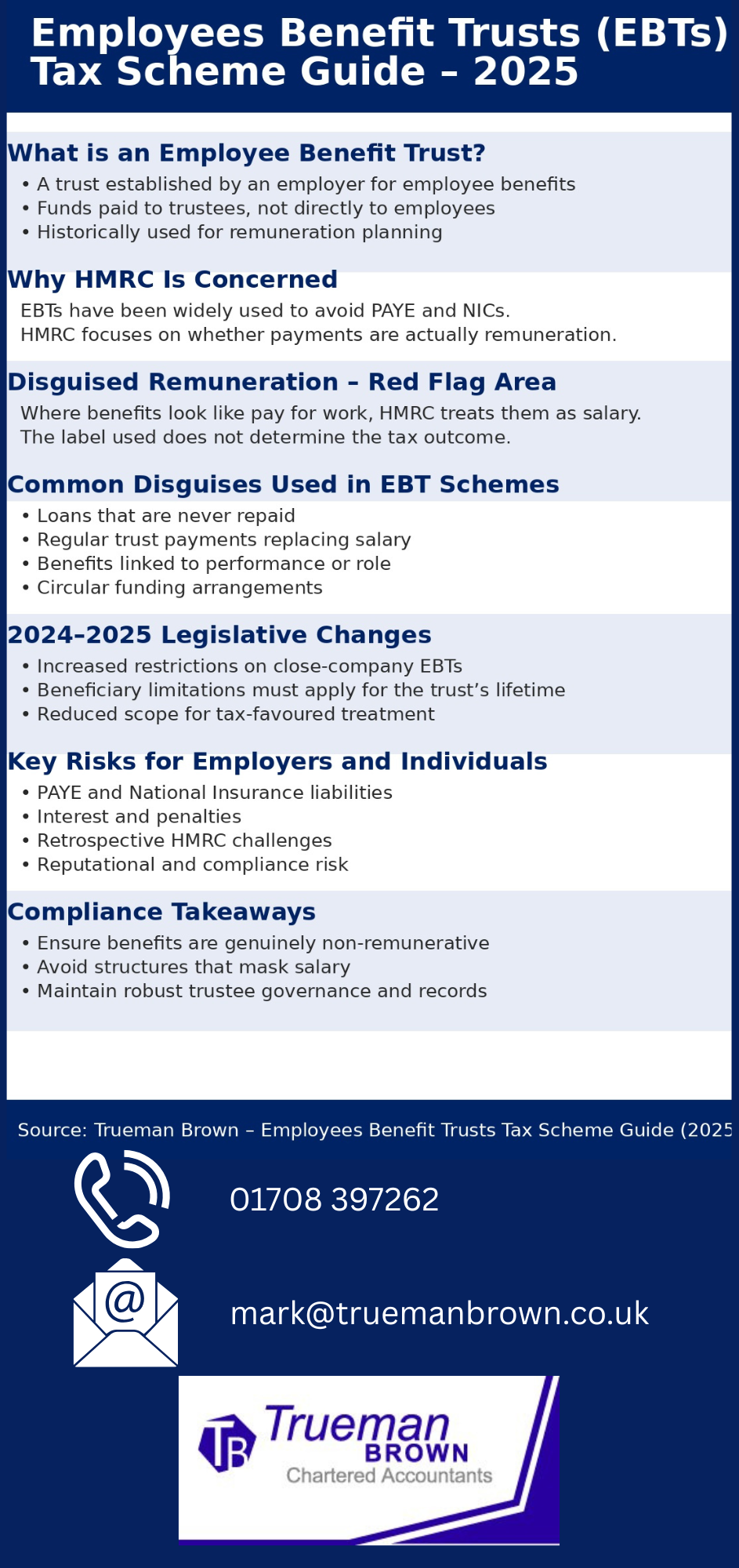
Recent changes under 2024–2025 affecting EBTs and related trusts
The rules governing EBTs (and related entities such as Employee Ownership Trusts, EOTs) have recently been reformed in significant ways:
-
From 30 October 2024, the Inheritance Tax regime for EBTs was updated to ensure the tax treatment better matches the original policy objective of rewarding employees rather than providing tax-minimised distributions.
-
Also from that date, benefits funded by EBTs operated by close companies may no longer qualify under previous rules if the arrangements are considered abusive.
-
As part of the broader reforms to employee-trust tax regimes, the government has confirmed the long-term requirement that restrictions on connected persons benefiting from EBTs must apply for the lifetime of the trust.
These changes reflect a tightening of the compliance environment around the Employees Benefit Trusts tax scheme, aiming to prevent abuse of what were originally intended as employee-benefit mechanisms.
What about related trust schemes — and how do changes to Employee Ownership Trust (EOT) rules affect EBT users?
Many people conflate EBTs with EOTs (Employee Ownership Trusts), a special kind of EBT used for transferring ownership of companies to employees.
While EOTs and EBTs are related, recent reforms have affected both.
Under the 2025 Budget, the tax relief on disposals of shares to an EOT has been drastically reduced: for disposals made on or after 26 November 2025, only 50% of the capital gain on the disposal will be eligible for the favourable CGT relief — a steep fall from the previous 100%.
That change may influence some companies’ decisions on whether to use EOTs or EBTs — but it also underscores the government’s broader tightening of tax-favourable employee-trust regimes.
Importantly, the reforms reinforce that the tax-favourable treatment of trusts is only intended for genuine employee-benefit / employee-ownership scenarios.
If the purpose is solely tax avoidance, there is a far higher risk of challenge by tax authorities.
Key risks if you use the Employees Benefit Trusts tax scheme today
-
Disguised remuneration risk: Payments from or via an EBT may be recharacterised by tax authorities as earnings — meaning PAYE and National Insurance become payable, possibly with penalties if not declared.
-
Loss of tax-favourable treatment: Post-2024 amendments mean certain contributions or benefits may no longer qualify, especially if provided by close companies.
-
Retrospective challenge risk: HMRC has in the past sought to apply tax charges even for historic use of EBTs — particularly where they believe the arrangement was essentially salary disguised as loans.
-
Uncertainty and compliance burden: The evolving legislative landscape around EBTs / EOTs means companies and individuals need to approach trust-based remuneration carefully — and document everything clearly.
Given all these developments, the Employees Benefit Trusts tax scheme is no longer the low-risk strategy it might once have appeared to be.
How Trueman Brown can help with Employees Benefit Trusts
If you’re concerned that your business or past remuneration arrangements may be caught by the new rules — or if you’re exploring use of an EBT (or EOT) going forward — Trueman Brown can guide you through the complexities.
We can:
-
Review the structure of any existing trust arrangements, and assess whether they present a risk under the new rules.
-
Advise on whether future use of trust-based remuneration will be compliant — or whether a different approach would be safer.
-
Assist with preparing and submitting any necessary disclosures or tax returns to reflect correct treatment under current legislation.
If you’d like to discuss your position, please get in touch with us: mark@truemanbrown.co.uk or call 01708 397262.
Frequently Asked Questions about Employees Benefit Trusts (FAQ)
Q: Does using an EBT automatically avoid Income Tax and National Insurance?
A: No. Under current legislation, payments from an Employees Benefit Trust may be recharacterised as earnings — especially if they resemble salary. HMRC can charge PAYE, National Insurance, and even penalties.
Q: Are trust-based schemes still legal under 2025 rules?
A: Yes — but the rules have become much stricter. Benefits funded by EBTs from close companies (on or after 30 October 2024) may be denied favourable tax treatment.
Q: What changed in the 2025 Budget that affects EOTs and EBTs?
A: For disposals of shares to an EOT made on or after 26 November 2025, the CGT relief has been cut from 100% to 50%. That impacts the attractiveness of moving to employee-ownership trusts.
Q: If I previously used an EBT and declared it as “loan,” am I at risk now?
A: Possibly. Even historic trust-loan arrangements may be re-characterised by HMRC as earnings, especially if they were part of remuneration. The risk depends on the facts.
Q: What should I do if I want to use a trust-based remuneration scheme now?
A: Seek specialist advice — make sure the trust is structured properly, that benefits are justifiable as genuine employee benefits, and prepare for detailed documentation and close compliance monitoring.