
When are VAT registration delays a real problem?
If you’re facing significant VAT registration delays, it’s more than just an annoyance—it can impact your invoicing, cash-flow, and customer relationships from day one.
At Trueman Brown we’ve seen businesses stumble when they know their effective date of VAT registration but are still waiting for the formal number to arrive from HM Revenue & Customs (HMRC). In the 2025/26 tax year, with the threshold for registration now £90,000, these issues remain especially relevant.
Understanding the root of VAT registration delays
When you apply for VAT registration, HMRC must issue a VAT number before you can issue full VAT invoices and your customers can reclaim input tax.
But businesses often encounter unexpected waiting times—hence the term vat registration delays. As noted by HMRC guidance, you must register within 30 days of the end of the month in which your taxable turnover exceeded the threshold or you expected to exceed it in the next 30 days.
In our experience at Trueman Brown, causes of vat registration delays include:
-
HMRC verification checks (identity, business structure, trading address)
-
Complex trading structures (e.g., agent arrangements, overseas supplies)
-
High volumes of applications, which slow processing
-
Missing data or incomplete forms that require follow-up
The result? Businesses may have an effective registration date, but lack the actual VAT number.
That means: you should treat supplies as taxable from that date, yet you can’t issue a proper VAT invoice until the number arrives.
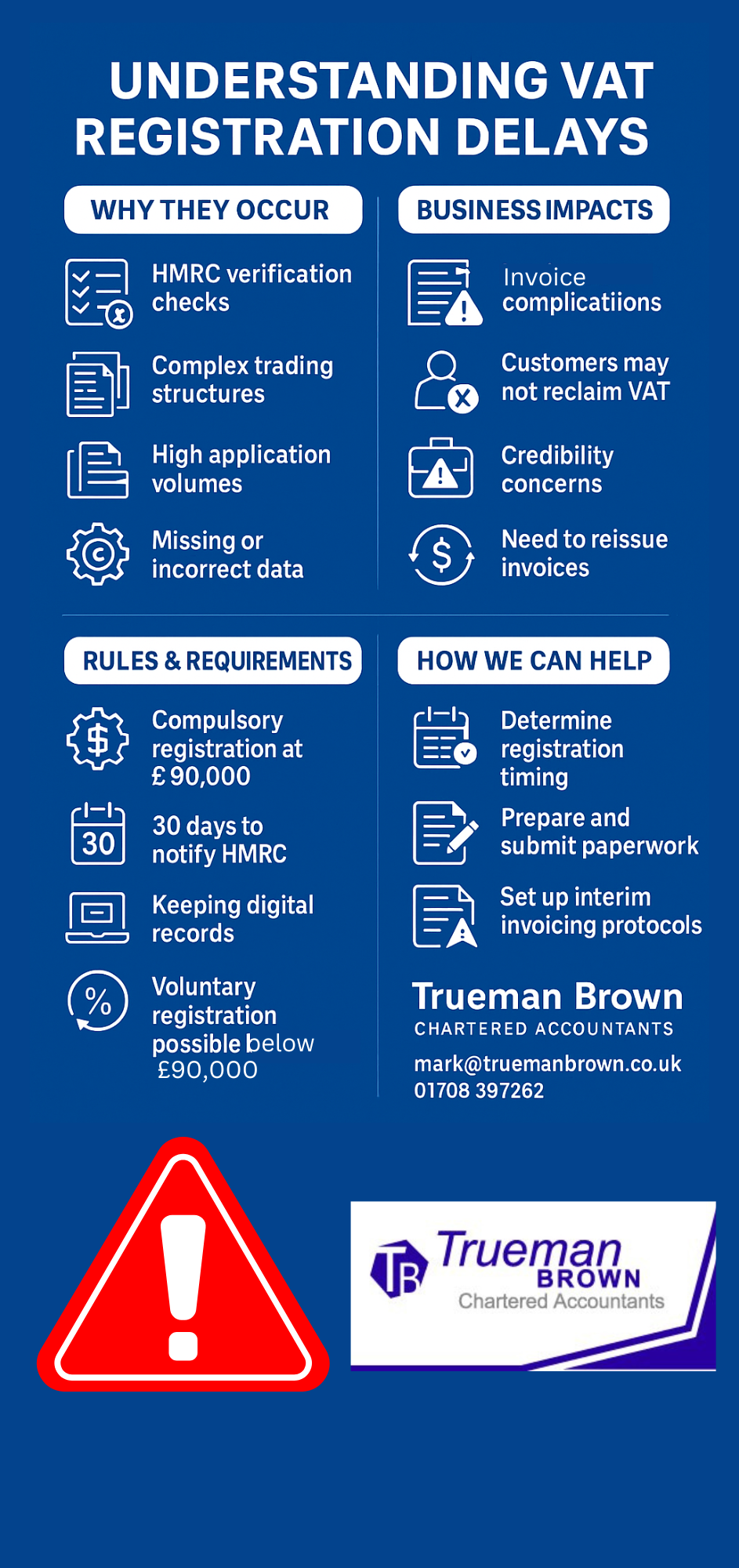
Why VAT registration delays matter to your business
-
Invoicing complications: If you issue invoices before your VAT number arrives, you cannot legitimately show VAT separately. Instead you’ll need to issue invoices stating something like “VAT registration applied for – this is not a VAT invoice”.
-
Customer perception: Key clients may assume you are VAT-registered and able to issue full VAT invoices. If you cannot, it may affect your credibility.
-
Input tax recovery: Until your number is issued and proper VAT invoices are issued, your customers cannot reclaim VAT. That may reduce the attractiveness of your services.
-
Backdating complications: Once the number arrives, you may need to re-issue invoices for the interim period. Again, as the original article observed: “On receipt of the number, all invoices issued … in the interim period … need to be reissued.”
The 2025/26 rule changes you need to be aware of
In the current tax year the key rules around registration have evolved—so make sure your planning reflects them:
-
The compulsory VAT registration threshold continues at £90,000 taxable turnover over any rolling 12-month period.
-
The deregistration threshold sits at £88,000 (below which you may apply to leave the VAT register) for standard supplies.
-
Voluntary registration remains possible even if your taxable turnover is below £90,000—this may help mitigate some risks of VAT registration delays.
-
The standard VAT rate remains 20 %, reduced rate 5 %, zero-rate 0 % for the UK.
-
HMRC now requires digital submissions under the Making Tax Digital (MTD) programme for VAT-registered businesses (i.e., you must keep digital records and submit via compatible software).
-
Although an increase in the threshold (to £100,000) has been mooted for the Autumn Budget 2025, it has not yet been implemented and you must plan based on the current £90,000 figure.
Because of these rules, vat registration delays can have more pronounced consequences: missing the deadline or mis-dating the effective registration date can lead to back VAT, interest and possible penalties.
Practical steps to minimise VAT registration delays impact
-
Apply as soon as you exceed the threshold (or reasonably expect to exceed it in next 30 days). The effective date is set by the rules (often the first day of the second month after you realise you’ve breached).
-
Prepare complete documentation: business bank account details, company registration number (if relevant), evidence of turnover etc.
-
Monitor your turnover on a rolling 12-month basis, not just annual accounts – this helps spot early triggers of registration.
-
Communicate with customers: If your VAT number is pending, issue invoices with wording such as “VAT registration applied for – this is not a VAT invoice” until the number arrives.
-
Be ready to re-issue invoices: Once the number arrives, you may need to re-issue interim invoices so customers can reclaim input VAT.
-
Consider voluntary registration early if you believe VAT registration delays will impact your clients or pricing – and if reclaiming input VAT is important to your business model.
-
Check your accounting software and processes are ready for MTD compliance once you register.
How Trueman Brown can help you navigate VAT registration delays
At Trueman Brown we regularly support clients faced with vat registration delays and guide them through the procedural, timing and administrative challenges. Here’s how we can step in:
-
Review your turnover forecasts and trading structure to determine when you must register for VAT.
-
Prepare and submit the VAT1 application (or VAT1A where applicable) on your behalf.
-
Liaise with HMRC where delays occur, helping to chase registration and minimise disruption.
-
Develop interim invoicing protocols so you remain compliant while awaiting the VAT registration number.
-
Once your number is issued, assist with re-issuing invoices (if needed) and ensure your systems are aligned with Making Tax Digital (MTD) requirements.
-
Provide ongoing support and monitoring, so you stay within compliance, avoid penalties, and manage your VAT position proactively.
If you’d like help now, please contact us: mark@truemanbrown.co.uk or call 01708 397 262.
FAQ — Frequently Asked Questions
Q: What exactly counts towards the VAT threshold so I don’t trigger “vat registration delays”?
A: Your taxable turnover includes the value of everything you sell that is not VAT-exempt or ‘out of scope’. That means standard-rated, reduced-rated and zero-rated supplies (but not fully exempt supplies).
Q: When must I notify HMRC of the need to register for VAT?
A: You must apply for VAT registration within 30 days of the end of the month in which your turnover exceeded £90,000 over the preceding 12 months, or you have reasonable grounds to believe it will exceed within the next 30 days.
Q: What happens if I mis-calculate and register late?
A: If you fail to register when required, HMRC may back-date your registration date, charge you VAT from that date and impose penalties. Robust record-keeping and timely application help avoid this.
Q: Does an application delay from HMRC mean I can continue to issue full VAT invoices?
A: No. You must treat supplies as taxable from your effective registration date, but until you receive your VAT number you cannot issue full VAT invoices. It’s best to issue invoices marked accordingly (“VAT registration applied for – this is not a VAT invoice”) until the number arrives.
Q: Is the £90,000 threshold likely to change soon?
A: At present the threshold is £90,000 for 2025/26. Although an increase to £100,000 has been signalled in the Autumn Budget, this has not yet been legislated. You should continue planning on the current threshold.
Q: What can I do if my turnover only temporarily exceeds the threshold and I’d like to avoid full registration?
A: You may apply for a “registration exception” (via form VAT 5EXC) if you expect your taxable turnover to fall below the deregistration threshold (£88,000) over the next 12 months. However, HMRC will scrutinise this carefully.
If you’d like to discuss how to navigate vat registration delays in your business specifically, contact us at mark@truemanbrown.co.uk or call 01708 397 262.
Recent Comments