
Tax Implications of Company Failure: What Business Owners Need to Know
When a company faces closure, understanding the tax implications of company failure is essential to avoid unexpected liabilities.
With insolvencies rising in 2025, it’s vital for directors to prepare for how tax obligations change once trading stops.
Understanding the Tax Implications of Company Failure
When trade ceases, a company must settle outstanding Corporation Tax liabilities sooner.
Post-cessation expenses—those incurred after trading ends—can still be offset against post-cessation income or, in certain cases, claimed as losses against total income or capital gains.
Managing Loss Relief Efficiently
Losses arising before or during cessation can be used strategically to reduce your tax bill. Relief options include:
-
Offsetting losses against other profits from the same period.
-
Carrying losses back one year.
-
Carrying back final-year losses up to three years on a “last in, first out” basis.
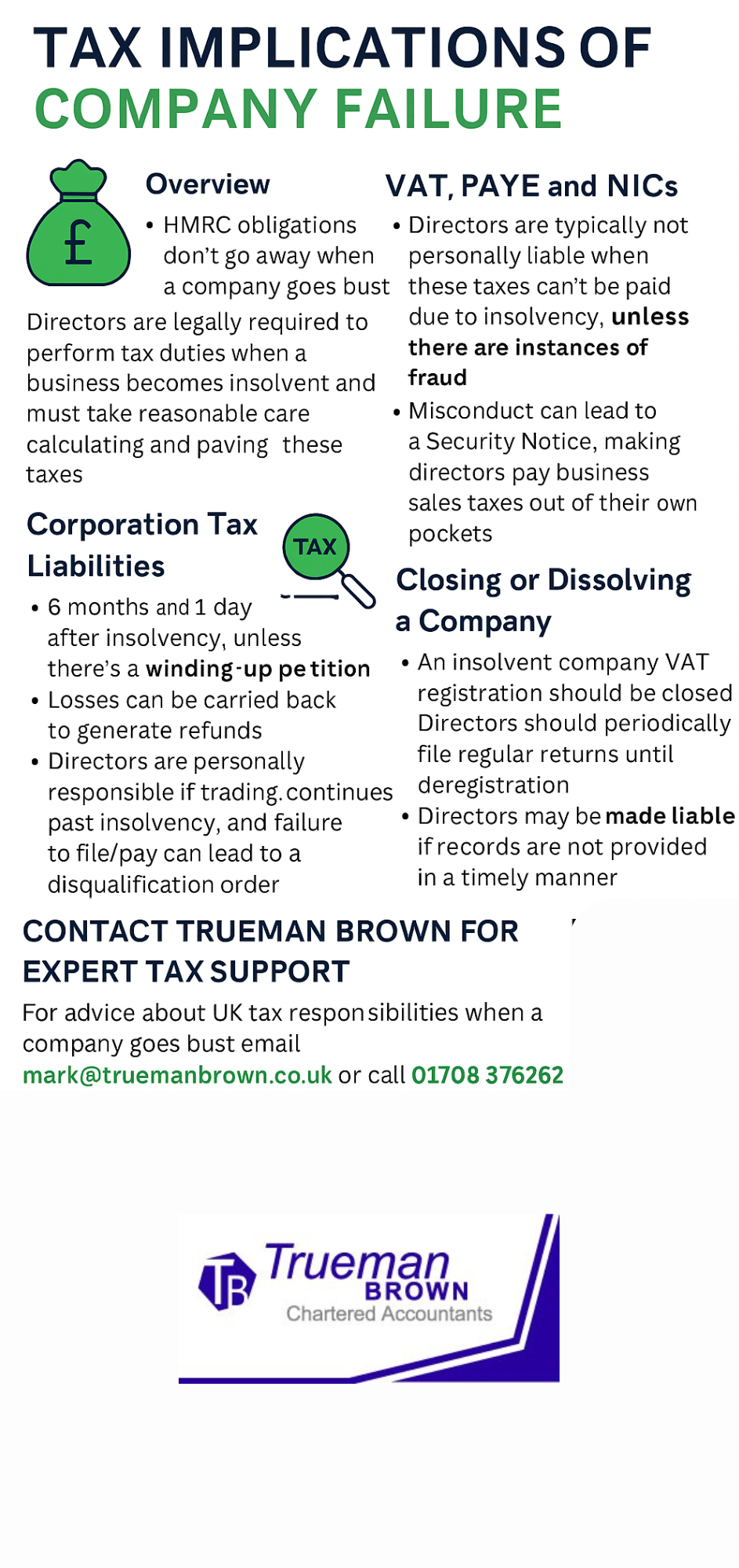
Tax Implications of Company Failure : Capital Gains and Asset Sales
The tax implications of company failure extend to asset disposals. Selling property, equipment, or other assets may trigger capital gains.
Selling assets before cessation allows losses to be offset, reducing tax exposure.
Alternatively, a company may distribute assets “in-specie” (as dividends), which triggers personal tax at the shareholder’s marginal dividend rate.
Handling Distributions Correctly
Directors must avoid preferential payments such as loan repayments.
Once all debts are cleared, any remaining funds can be distributed to shareholders.
If distributions exceed £25,000, they will be taxed as dividends unless the company formally liquidates—qualifying for 10% Business Asset Disposal Relief (BADR) if criteria are met.
Updated 2025 Rules to Consider
From April 2025:
-
The dividend allowance is reduced to £500.
-
HMRC continues to review transactions made within two years of liquidation to prevent undervalued transfers.
-
BADR conditions now emphasize “genuine trading cessation” before relief is granted.
How Trueman Brown Can Help You With The Tax Implications of Company Failure
At Trueman Brown Chartered Accountants, we specialise in helping business owners navigate the tax implications of company failure.
Our experienced team ensures compliance while maximising relief opportunities during difficult transitions.
We can help with:
-
Loss relief and capital gains management
-
Liquidation planning and compliance
-
Tax-efficient exit strategies
📧 mark@truemanbrown.co.uk
📞 01708 397262
Frequently Asked Questions (FAQ)
1. What taxes must be paid when a company fails?
Corporation Tax on final profits, VAT, PAYE, and possible Capital Gains Tax if assets are sold.
2. Can I claim relief on post-cessation expenses?
Yes, but only if they directly relate to the business’s final activities and meet HMRC’s requirements.
3. What happens if I sell company assets below market value?
HMRC may challenge the valuation, and insolvency practitioners can reverse undervalued sales.
4. How can Trueman Brown help me close my company tax-efficiently?
We’ll handle all filings, structure distributions to minimise tax, and liaise with HMRC to ensure compliance.
Recent Comments