
Are Rent Deposits Taxable for Landlords in 2025/26?
When letting out a property, many landlords and property investors ask: are rent deposits taxable?
In simple terms, whether a rent deposit is treated as taxable income depends on what happens to it at the end of the tenancy and how HMRC defines income.
Unlike rental income that you receive regularly from tenants, rent deposits are normally not taxable unless retained by the landlord to cover costs or damage.
Understanding how HM Revenue & Customs treats rent deposits is vital for any landlord, particularly in the current 2025/26 tax year where property income rules remain key to good compliance.
What Counts as Rental Income vs. Rent Deposits?
The basic principle in UK property tax is that rental income — the amount you receive as payment for letting a property — is taxable and must be included on your Self Assessment tax return.
However, rent deposits are treated differently:
-
Security deposits that are returned in full to tenants are not taxable — because they were never income.
-
If you retain any amount of a rent deposit to cover damage, cleaning or other tenant costs, that amount is taxable as part of your rental business income.
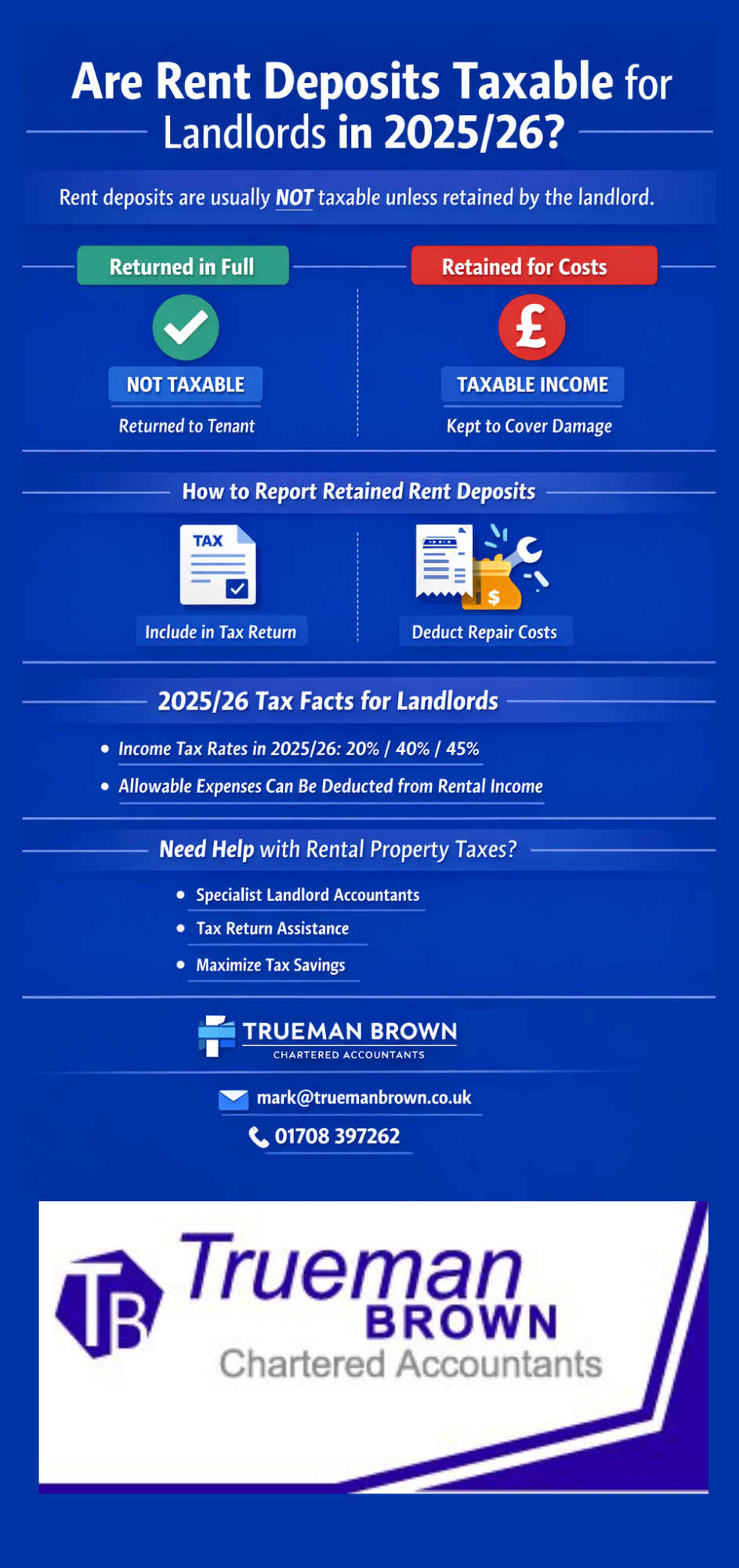
In practice, this means only the portion of a deposit you keep at the end of a tenancy (for example, to pay for repairs) becomes income for tax purposes, while the rest returned to the tenant does not count.
How Do You Report the Taxable Part of Rent Deposits?
When completing your rental income tax return, any retained rent deposit should be reported as part of your property rental income for the period in which the decision to retain it is made — not when the deposit was initially taken.
This means you must:
-
Include the retained amount on your Self Assessment tax return for the correct tax year.
Keeping accurate records of the deposit agreement, receipts for repairs, and communication with the tenant will help ensure your calculation is robust if HMRC ever queries it.
Rent Deposits and Other 2025/26 Tax Rules Every Landlord Should Know
It’s not just rent deposits you need to understand — all rental income and allowable expenses must be correctly accounted for in the 2025/26 tax year:
Rental Income & Tax Rates
-
Landlords must include all rental income in their Self Assessment return.
-
Property rental profits are taxed at standard income tax rates — 20% for basic-rate taxpayers, 40% for higher-rate, and 45% for additional-rate taxpayers in 2025/26.
-
From April 2027, new separate property income tax rates will apply (22%, 42%, 47%), but these do not affect 2025/26 filings yet.
Allowable Expenses vs. Rent Deposit
-
You can deduct allowable expenses (repairs, insurance, management fees) from rental income before tax.
-
Only amounts kept from a rent deposit that are not refunded count as rental income; returned parts are not income at all.
How Trueman Brown Can Help with Rent Deposits and Property Tax
If you’re unsure how to treat rent deposits in your accounts or how other landlord tax rules affect you, Trueman Brown Chartered Accountants can help you confidently navigate your obligations for 2025/26 and beyond.
Here’s how we support landlords:
-
📌 Accurate treatment of rent deposits in your taxable rental income.
-
📌 Preparation and submission of your Self Assessment tax return.
-
📌 Identifying and claiming all allowable expenses and reliefs to reduce your tax liability correctly.
-
📌 Expert advice on changing rules, including the upcoming property income tax rate changes from 2027.
📧 Email us at mark@truemanbrown.co.uk
📞 Call 01708 397262 to discuss your rental property tax needs.
Frequently Asked Questions (FAQ)
Q: Is a rent deposit itself taxable when taken from a tenant?
A: No — a rent deposit which is fully returned at the end of a tenancy is not income, and therefore not taxable. Only amounts retained to cover costs count as taxable rental income.
Q: Do I pay tax on the part of a deposit I use for repairs?
A: Yes. If you retain part of a rent deposit to cover damage or cleaning, that retained amount must be included as income.
Q: When do I report retained deposit income?
A: Report it in the tax year in which the decision to retain part of the deposit is taken — this isn’t necessarily the year the tenancy started.
Q: How do upcoming tax rule changes affect rent deposit treatment?
A: The fundamental treatment of rent deposits remains unchanged for 2025/26. However, broader changes in property income tax rates set for April 2027 may affect overall tax liabilities in future years.
Q: Can I offset the costs I incur (e.g., cleaning) when I keep a deposit?
A: Yes — you deduct the actual costs you pay from the retained deposit amount when calculating taxable profit.
Recent Comments