
Will tax on electric charging points be an issue?
As more businesses install workplace EV charge points, it’s worth understanding the tax on electric charging points and how it applies when an employer provides charging facilities for employees.
If you’re considering installing or reimbursing the cost of a charging point for employees, you’ll want clarity on whether there is a taxable benefit, how allowances work, and how the rules apply for 2025/26.
Workplace charging: what the rules say on tax on electric charging points
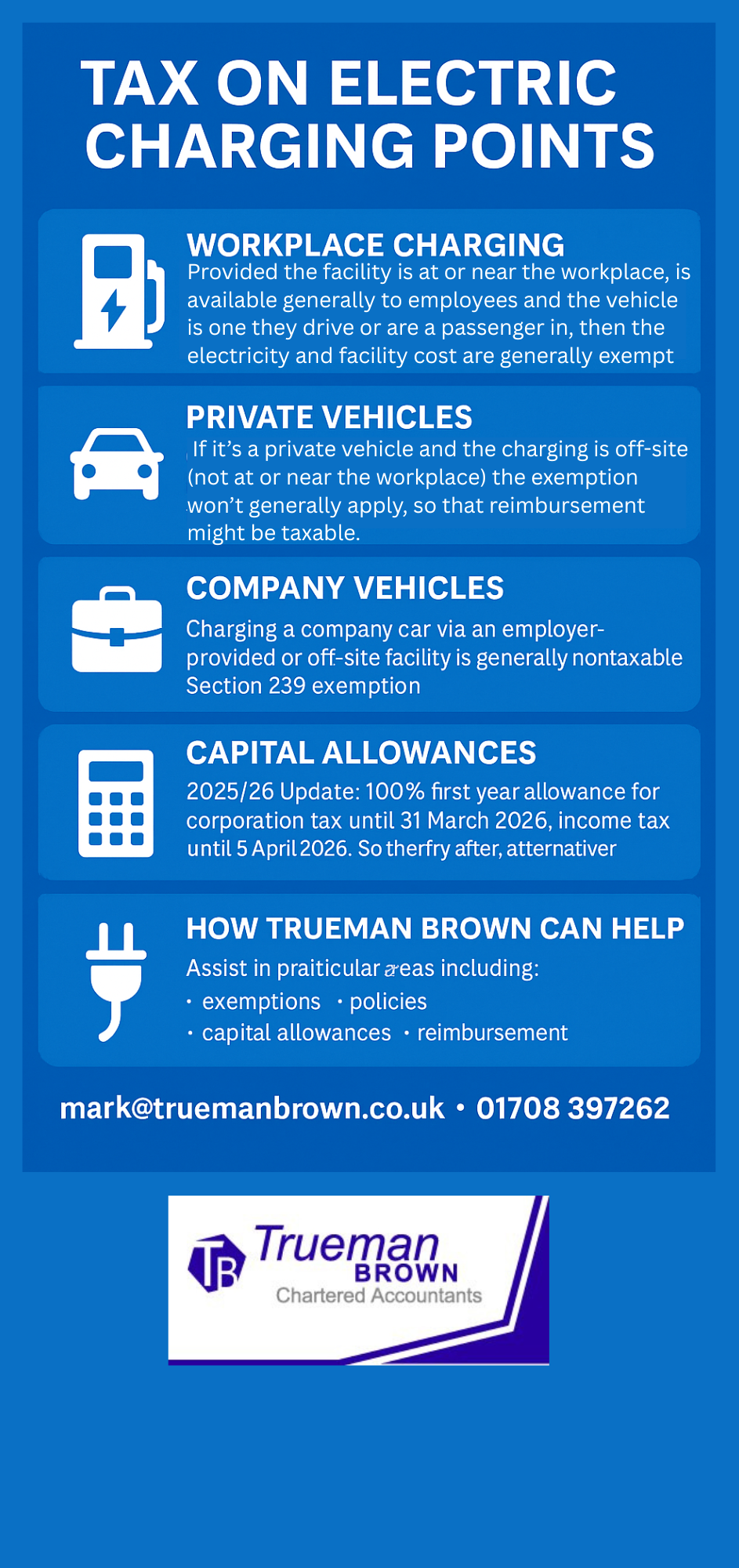
When an employer provides a charging station at or near the place of work and allows employees to charge their own vehicles, the tax on electric charging points can often be zero.
Specifically, the provision of electricity by the employer in these circumstances is exempt from a benefit-in-kind (BiK) charge, because electricity is not treated as “fuel” for the purposes of the car fuel benefit charge.
The exemption typically covers:
-
the cost of the electricity used for charging the vehicle;
-
the employer’s cost of providing the charging facilities; and
-
any connected services directly related to the charging facility.
However, the exemption only applies if certain conditions are met:
-
the charging facility must be provided at or near the employee’s place of work;
-
charging must be available generally to all employees at that workplace (or a cohort of employees in the workplace) if they wish to use it;
-
the vehicle being charged must be one in which the employee is the driver or a passenger.
So, if your business provides a workplace charging point, you may avoid a taxable benefit. But let’s look at some of the caveats and other situations for completeness.
Private vehicles and the tax on electric charging points at work
Even if an employee is charging their own private vehicle (rather than a company car) via the employer-provided facility, the exemption can still apply.
If the facility is at or near the workplace, it is available to all employees, and the vehicle is one the employee drives or is a passenger in, then the benefit may still be non-taxable.
It’s important to note though: if an employer reimburses the cost of charging a private vehicle off-site (for example at a public charging station or at the employee’s home) that is not at or near the workplace, the exemption may not apply.
In such cases, personalised reimbursements might trigger a taxable benefit or need to be accounted for as earnings.
Company vehicles and the tax on electric charging points
If an employer provides a charging point or reimburses electricity for a company car, the tax on electric charging points is again generally favourable.
Because electricity is not treated as fuel for car fuel benefit rules, there is no fuel benefit charge when charging a company car via an employer-provided facility or reimbursement (subject to conditions).
For example, if an employee is supplied with a company EV and the employer pays for installation of a charger at the employee’s home (or provides the electricity) solely for the company car, then there is no taxable benefit, provided the cost can be linked solely to the charging of the car.
Capital allowances, grants and the tax on electric charging points (2025/26 update)
When you install a charging point, the tax on electric charging points also involves capital allowance and grant-treatment aspects. Key points for the 2025/26 tax year:
-
Businesses can claim a First Year Allowance (FYA) of 100% on expenditure on charging-point equipment, for corporation tax purposes, but the availability has been extended only until 31 March 2026 for corporation tax and 5 April 2026 for income tax businesses.
-
After that date, the enhanced allowance may not be available and you’ll need to rely on standard annual investment allowance or full expensing (for companies).
-
As of the 2025/26 tax year, the benefit-in-kind (BiK) rate for electric company cars is 3% (up from 2% in 2024/25) and will increase by 1 percentage point per year up to 5% in 2027/28, then by 2 % per year until capping at 9% in 2029/30.
-
From April 2025, the Vehicle Excise Duty (VED) regime changes: newly registered electric cars will no longer be fully exempt—cars registered from 1 April 2025 will pay standard VED (with lowest first-year rate as low as £10) and the “expensive car supplement” may apply to zero emission cars costing over £40,000 list price.
So, if you’re installing or reimbursing charging points, it’s worth reviewing the deadlines for allowances and ensuring you meet the conditions.
Off-site charging and burdens of tax on electric charging points
One area that often gives rise to confusion is charging away from the workplace: either at home, at a public charger, or reimbursing employees for such usage. The tax on electric charging points in these cases needs careful consideration:
-
If an employer reimburses or pays directly for charging at a location away from the workplace (and it relates to a private vehicle), that may trigger a taxable benefit or earnings, unless handled correctly.
-
The exemption for the provision of electricity by the employer at a workplace does not cover reimbursements for charging a private vehicle off-site.
-
Employers should keep records to show that reimbursements relate solely to company cars, if applicable, to rely on the s 239 exemption
How Trueman Brown can help you
If you’re navigating the rules around tax on electric charging points, including installation, reimbursement policies, benefit-in-kind implications and capital allowances, the team at Trueman Brown are here to assist.
We can help you:
-
Confirm whether the charging facilities you provide qualify for the exemption and avoid unintended taxable benefits.
-
Advise on the capital allowances you can claim for charging point installation and link them correctly into your corporation or income tax position for 2025/26.
-
Review your reimbursement policies for home, workplace or public charging and help you set up compliant practices.
-
Support you in modelling the impact of providing company cars, charging facilities and allowances, ensuring you remain tax-efficient and compliant.
For tailored advice, contact us at mark@truemanbrown.co.uk or call 01708 397262.
We serve businesses in Romford and the surrounding area and specialise in tax, accounting and advisory services for SME clients.
Frequently Asked Questions (FAQ)
Q1: If I install a charging point at my business’s car park for employees, will that trigger a taxable benefit?
A1: Provided the facility is at or near the workplace, is available generally to employees and the vehicle is one they drive or are a passenger in, then the electricity and facility cost are generally exempt from benefit-in-kind. The “tax on electric charging points” in this scenario is effectively nil.
Q2: What if an employee charges their own vehicle at the workplace – does that change things?
A2: No – as long as the facility meets the workplace criteria and is available to employees generally, the same exemption applies even if the vehicle is the employee’s private car.
Q3: What if I reimburse an employee for charging their vehicle at home or at a public charger?
A3: This is more complex. If it’s a private vehicle and the charging is off-site (not at or near the workplace) the exemption won’t generally apply, so that reimbursement might be taxable. If it’s a company car and the reimbursement relates solely to charging that car, there may be relief under s 239.
Q4: Are there capital allowances for installing charging points?
A4: Yes. For the 2025/26 tax year you can claim 100% first-year allowances on charging-point equipment if the expenditure is incurred before 31 March 2026 (corporation tax) or 5 April 2026 (income tax). After that you’ll revert to standard allowances.
Q5: Do the rules change soon?
A5: Yes. As noted, the first-year allowance for charging points has a deadline in March/April 2026. Also, the BiK rate for electric company cars will increase from 3% in 2025/26 to 4% in 2026/27 and 5% in 2027/28. The VED regime also changes from April 2025. It’s important to plan ahead.
Q6: What should I do next if I’m thinking of installing charging points or reimbursing charging for employees?
A6: Engage with your accountant or tax adviser, ensure the charging point installation meets the “at or near workplace” test, make sure the policy on availability is documented, and check how any home or public-charging reimbursements will be treated. We can assist you with all of this at Trueman Brown.
Recent Comments