
Sole Trader or Limited Company: Which is Right for Your Business?
Deciding between operating as a sole trader or limited company is one of the most important early choices for small business owners and the self-employed.
Your business structure affects how much tax you pay, how much paperwork you must complete, your legal liability, and how clients view you.
With tax and reporting rules updated for the 2025/26 UK tax year, it’s vital to understand the differences before you start or change your business structure.
What Does “Sole Trader or Limited Company” Mean?
If you operate as a sole trader, you and your business are legally the same person.
All profits are personal income and are taxed through your Self Assessment return, including Income Tax and National Insurance Contributions (NICs).
A limited company is a separate legal entity.
It pays Corporation Tax on profits (between 19% and 25% depending on profit levels), and you can draw income as a combination of salary and dividends — potentially offering tax efficiency at higher profit levels.
Tax Responsibilities: Sole Trader or Limited Company
When considering sole trader or limited company status, taxation is often front of mind:
-
Sole traders pay Income Tax on profits above the personal allowance and Class 2/4 NICs.
-
Limited companies pay Corporation Tax on profits, and directors pay tax and NICs on salaries but can take dividends taxed at different rates.
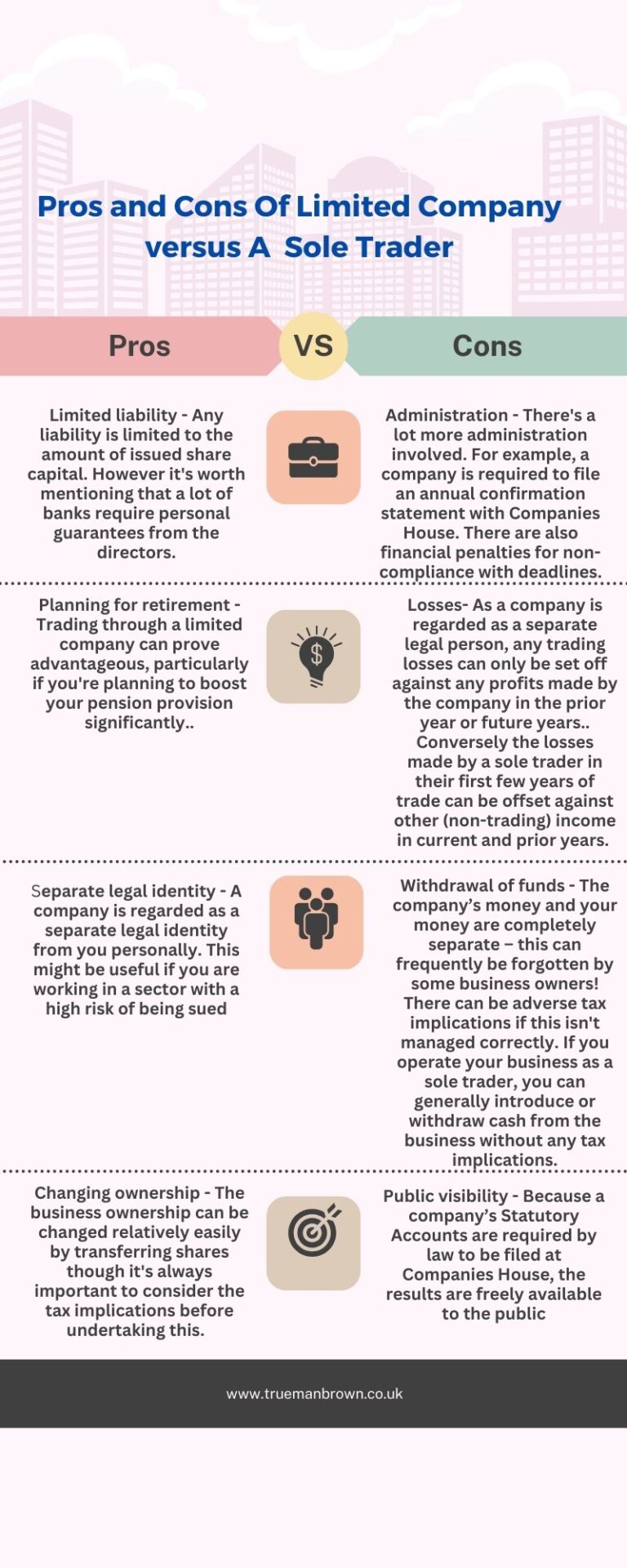
For many smaller businesses under around £40,000–£50,000 profit, a sole trader can be simpler and cost-effective. If profits grow, incorporation may offer tax advantages.
Liability & Legal Protection for Sole Traders vs Limited Companies
A key structural difference in the sole trader or limited company decision is liability:
-
As a sole trader, you are personally liable for all business debts and legal claims.
-
A limited company offers limited liability, separating your personal assets from those of the business.
This legal protection can become critical as your business grows or takes on larger contracts.
Administration, Reporting & Compliance
Beyond tax and liability, consider the regulatory side of sole trader or limited company structures:
-
Sole traders submit an annual Self Assessment and keep basic records.
-
Limited companies must file annual accounts, a Corporation Tax return, and statutory information with Companies House — which increases compliance and reporting.
New HMRC rules such as Making Tax Digital for Income Tax are rolling out in 2025/26 and may affect both structures, particularly with quarterly reporting for VAT-registered businesses.
How to Decide: Sole Trader or Limited Company?
There is no one-size-fits-all answer to sole trader or limited company — it depends on:
-
Expected profits and tax efficiency goals
-
Appetite for administrative and compliance duties
-
Desired legal protection and business growth plan
-
Whether you intend to take on employees or external finance
Speaking to an accountant can make the decision clearer.
Recent Comments