
An Introduction to the Badges of Trade — What They Mean for You
Understanding whether your activities are a “trade” — and not just a hobby or investment — is vital for UK tax and accounting purposes.
The key tests HMRC uses to make this determination are called the badges of trade.
These are a set of criteria developed through case law that help decide if what you’re doing amounts to trading, which in turn affects whether you pay Income Tax, Corporation Tax or Capital Gains Tax on the profits.
HMRC does not provide a rigid statutory definition of trading, so the badges of trade are applied in a holistic way rather than relying on any single test.
What Are the Badges of Trade?
There’s no exhaustive list in statute, but HMRC and UK courts have identified a series of indicators that — taken together — point towards trading activity.
These badges of trade include factors like:
-
Profit-seeking motive — Did you enter into the activity intending to make a profit?
-
Number of transactions — Are you making repeated or regular sales?
-
Nature of the asset — Are the items sold typically bought for resale rather than for personal use?
- Changes to the asset — Were items repaired, improved or modified to increase their value?
-
Method of sale — Is the way you sell similar to that of a trading business?
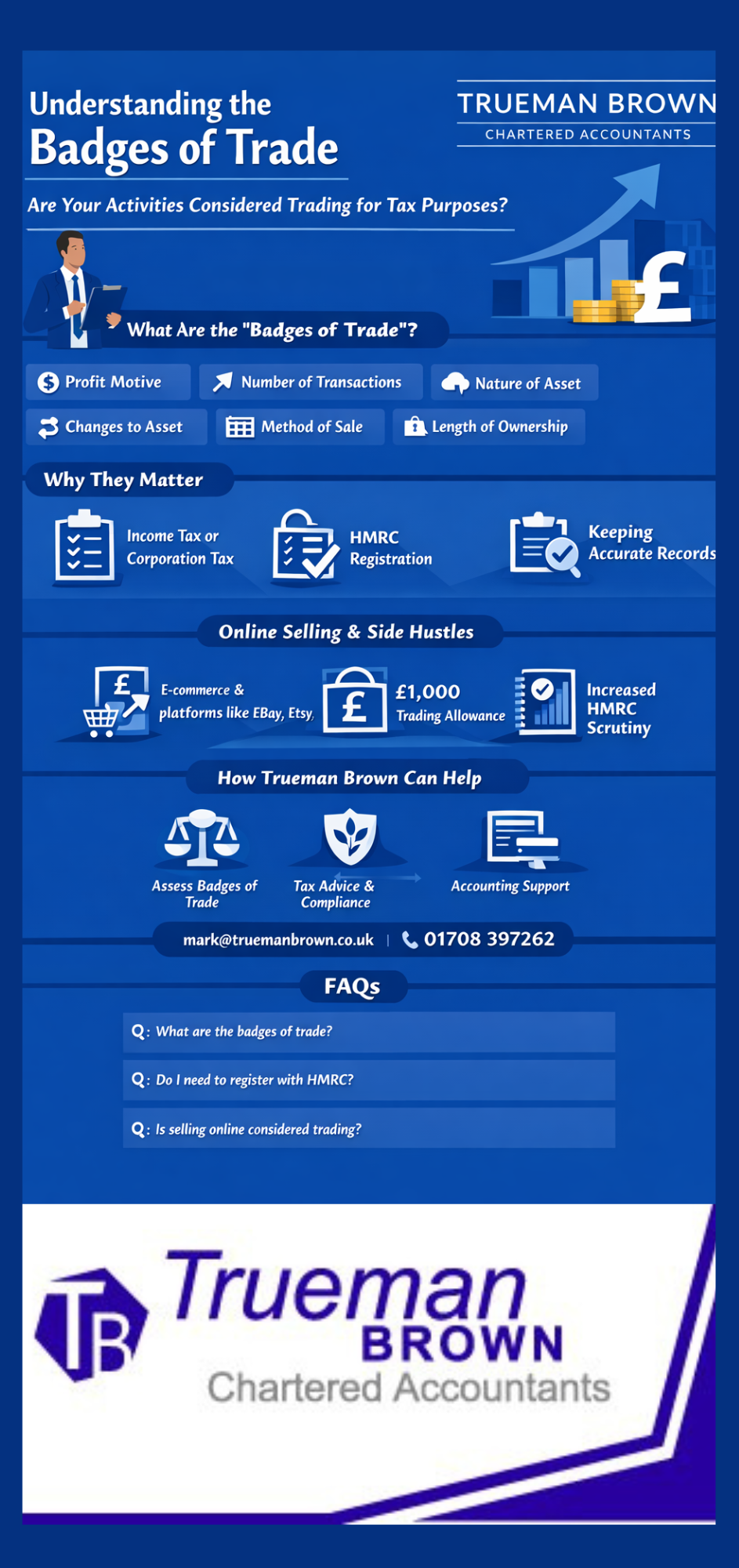
Other badges also include the source of finance, interval between purchase and sale, method of acquisition and the existence of similar trading transactions or interests.
Each badge of trade contributes to the overall picture; none alone is dispositive.
HMRC and the courts look at all relevant factors together to decide whether you’re trading.
Why the Badges of Trade Matter for Your Tax Position
If your activities meet enough of the badges of trade, HMRC is likely to classify you as carrying on a trade. That means:
-
You may need to register with HMRC as self-employed or set up a company.
-
You could be liable to pay Income Tax or Corporation Tax on profits.
-
You must keep accurate records and, where applicable, report under Making Tax Digital (MTD) requirements.
Failing to account for trading income correctly — or misclassifying activities that meet the badges of trade — can lead to penalties, interest on unpaid tax and compliance issues.
Badges of Trade in the Age of Online Selling & Side Hustles
The rise of e-commerce platforms and the UK’s trading allowance means many people now need to consider whether their online sales cross the boundary into trading. For example:
-
Casual or hobby sales may remain non-trading if they lack key badges of trade.
-
Regular selling on platforms like eBay, Etsy or Amazon is more likely to hit several badges of trade, especially if there’s a profit motive and frequency of transactions.
-
Income above the £1,000 trading allowance must be reported, and you’ll need to determine whether your activity is classified as trading.
In 2025/26, HMRC continues to enhance data-sharing and digital reporting, making it even more important to understand how the badges of trade apply in practice.
How Trueman Brown Can Help
If you’re unsure whether your activity meets the badges of trade and what tax treatment applies, Trueman Brown is here to help.
As trusted Chartered Accountants in South Ockendon, we specialise in advising small businesses and individual traders on tax compliance, business structuring and record-keeping.
Whether you are selling goods online, starting a side hustle, or managing property sales, we can:
-
advise on your HMRC registration and tax obligations,
-
help prepare accurate accounts and tax returns, and
-
guide you through record-keeping requirements under current UK regulations.
📞 Call us on 01708 397262
📧 Email: mark@truemanbrown.co.uk
Getting professional advice early can save you from costly mistakes and ensure you stay HMRC-compliant in 2025/26 and beyond.
Frequently Asked Questions
Q: What exactly are the badges of trade?
A: They are a set of factors used by HMRC and the courts to assess whether an activity should be treated as a trade for tax purposes, such as profit motive, transaction frequency, and nature of assets.
Q: Do all badges have to be present to be trading?
A: No — HMRC looks at the overall picture. One or more badges can be sufficient, depending on the circumstances.
Q: Is selling a few personal items online considered trading?
A: Not usually — unless the selling pattern, profit motive and other badges of trade indicate a commercial activity.
Q: Does meeting the badges of trade mean I must register with HMRC?
A: If HMRC considers your activity a trade and your income exceeds the trading allowance, you will likely need to register and file accounts and tax returns.
Q: Are the badges of trade legally binding?
A: They are not statutory rules but are established through case law and HMRC practice. Each case is judged on its facts.
Q: Can property sales trigger badges of trade?
A: Yes — frequent buying and selling property for profit may meet several badges of trade and be treated as trading.
Recent Comments