
CIS Tax Trap Contractors: What Every Builder Needs to Know in 2025/26
If you’re a contractor or subcontractor working in construction, the phrase “CIS tax trap contractors” should sound some alarm bells.
The Construction Industry Scheme (CIS) continues to be a key area where mistakes can be costly — and in 2025/26 the rules are tighter than ever.
Whether you’re paying others or being paid yourself, you need to know how the traps form, how to avoid them — and how to turn compliance into a strength.
What is the CIS tax trap contractors frequently fall into?
Sub-contractors and contractors often stumble by assuming that once they’re registered they’re automatically safe.
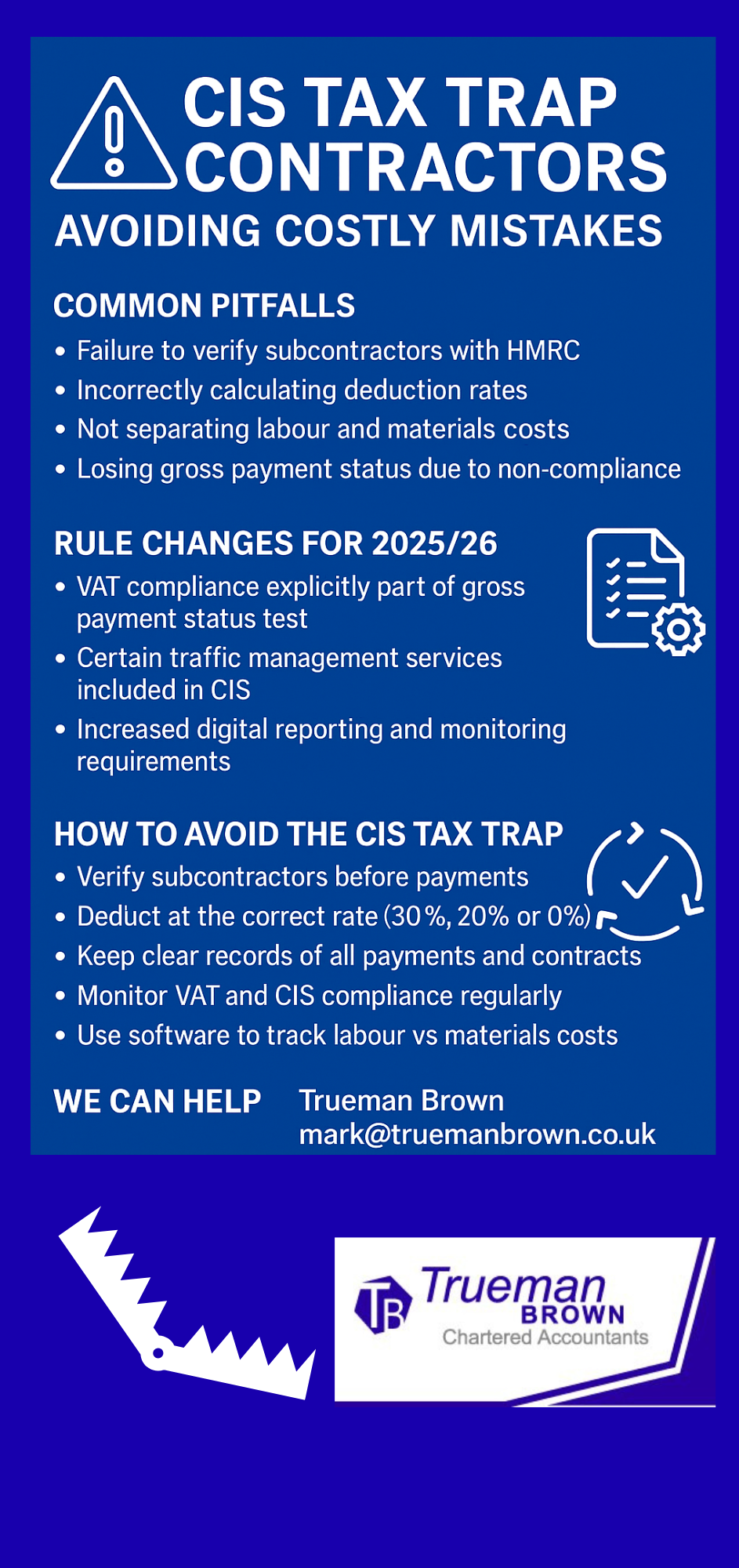
But the CIS tax trap contractors fall into includes:
-
Failing to verify subcontractors properly before making payments.
-
Paying someone under the scheme who should actually be operating differently (or vice-versa).
-
Treating every payment as outside the scheme when it’s not.
- And crucially for 2025/26: missing new rule changes (which we’ll explore) that increase risk.
Why the “CIS tax trap contractors” scenario is still so common
Many contractors in the UK don’t realise they may be operating under the scheme without realising it.
For example:
-
A business classed as a “deemed contractor” because they have spent over £3 million on construction operations in the last twelve months.
-
A subcontractor who loses their gross payment status and then has tax deducted at source — impacting cash-flow.
-
Payments which include both labour and materials: if you don’t separate those properly, you might deduct at the wrong rate.
These slip-ups are exactly what the term CIS tax trap contractors is meant to warn about.
Key rule changes for 2025/26 that raise the risk of the CIS tax trap contractors must avoid
Here are some of the recent updates you need to know:
-
From March 2025, certain traffic management services (like setting up temporary lights/barriers for a roadworks contract) may fall within CIS when previously they might not.
-
The compliance test for gross payment status has been strengthened for 2025/26: now VAT compliance is explicitly part of it. You must have up-to-date VAT returns and payments if you claim or maintain gross payment status.
-
The “deemed contractor” rule remains: if your construction spend exceeds £3 million in a rolling 12-month period you may be required to operate as a contractor and apply CIS on payments.
-
With the push for digital reporting and enforcement: even if you think you’re compliant, HMRC expects more real-time monitoring — so slipping behind could land you in the trap.
Common pitfalls: how the “CIS tax trap contractors” plays out in real life
1. Failure to verify subcontractors
If you’re the contractor and you pay someone without verifying their status under CIS, you could face incorrect deductions or, worse, HMRC claims you should have operated the scheme when you didn’t.
2. Wrong deduction rate
You must deduct at the correct rate: generally 20% if the subcontractor is registered, 30% if they’re unregistered, and nil if they have gross payment status. Getting this wrong is a classic CIS tax trap contractors fall into.
3. Mis-treating materials vs labour
If your payment includes materials you’ve supplied (or the subcontractor has purchased) and you don’t split the labour element properly, you might over-deduct or under-deduct.
The rules emphasise that only direct-incurred materials by the subcontractor can reduce the deduction basis.
4. Sudden shift to contractor status
Say a business spends over £3 million on construction operations in a year — if they haven’t identified this and operated as a contractor, they can be caught out.
That’s a major CIS tax trap contractors need to watch.
5. Ignoring gross payment status compliance
Having gross payment status is great for cash-flow, but if you fail any compliance tests (e.g., VAT issues, late tax returns) HMRC can withdraw it — meaning the deduction rate could change and you’ll be exposed.
How to build your defence against the CIS tax trap contractors scenario
-
-
Ensure you keep separate records for labour vs materials in every contract.
-
Verify every subcontractor before payment. Use the HMRC verification service.
-
Monitor whether you might be a “deemed contractor”. Review your construction expenditure monthly if you’re near the £3 million threshold.
-
If you have gross payment status, stay on top of VAT, tax returns, CIS monthly returns and any other obligations. Non-compliance can cost.
-
Use software or systems that record payments and deductions clearly: with the 2025/26 digital push, being able to prove your records matters.
-
Be aware: contract arrangements which look like “one contractor takes on work then outsources to someone else under the same invoice” can be caught by the scheme.
-
How Trueman Brown can help you
If you suspect you might be at risk of falling into the CIS tax trap contractors face, we can step in and help you navigate this complex area.
At Trueman Brown we specialise in construction-sector compliance and tax planning.
We will:
-
Review your contract structures and verify you are applying CIS correctly.
-
Advise whether you may be deemed a contractor (or subcontractor) and help you meet your obligations.
-
Assist you in applying for or maintaining gross payment status, ensuring you meet the updated 2025/26 compliance tests.
-
Help you implement the right systems to separate labour/materials, manage records and reduce risk of HMRC penalties.
If you’d like to discuss this, contact us: Email: mark@truemanbrown.co.uk | Phone: 01708 397 262
FAQ
Q1: What happens if I ignore the CIS rules and fall into the “CIS tax trap contractors” scenario?
A: If you fail to apply CIS correctly, you may face penalties, higher deduction rates, or HMRC may treat you as a contractor and demand proper returns and payments. The costs can be significant.
Q2: Does the £3 million “deemed contractor” threshold still apply?
A: Yes. If your construction-related spend in the previous 12 months exceeds £3 million, you may be classed as a contractor under CIS and must operate the scheme.
Q3: If I have gross payment status, can I relax about compliance?
A: No. In fact, for 2025/26 HMRC is placing more emphasis on compliance checks (VAT, tax returns etc). Losing gross payment status could push you straight into the trap of higher deduction rates.
Q4: Do materials I supply count under CIS deductions?
A: Only if the subcontractor directly incurs the cost of materials to fulfil their contract. If you or the contractor provide them, the labour part remains subject to CIS deduction.
Q5: Has the deduction rate changed?
A: The general rates remain: 20% for registered subcontractors, 30% for unregistered, nil for subcontractors with gross payment status. The real change is the enforcement and compliance around these rates — which means the “CIS tax trap contractors” is more about process than headline rate change.
Recent Comments