
Can you change a will after death — using a deed of variation
At Trueman Brown we often advise that while you cannot rewrite a person’s Will once they’ve died, you can change who actually benefits — by using a deed of variation.
A deed of variation gives beneficiaries the opportunity to redirect all or part of their inheritance, potentially reducing tax or ensuring the estate is distributed more fairly.
What is a deed of variation — and why it matters
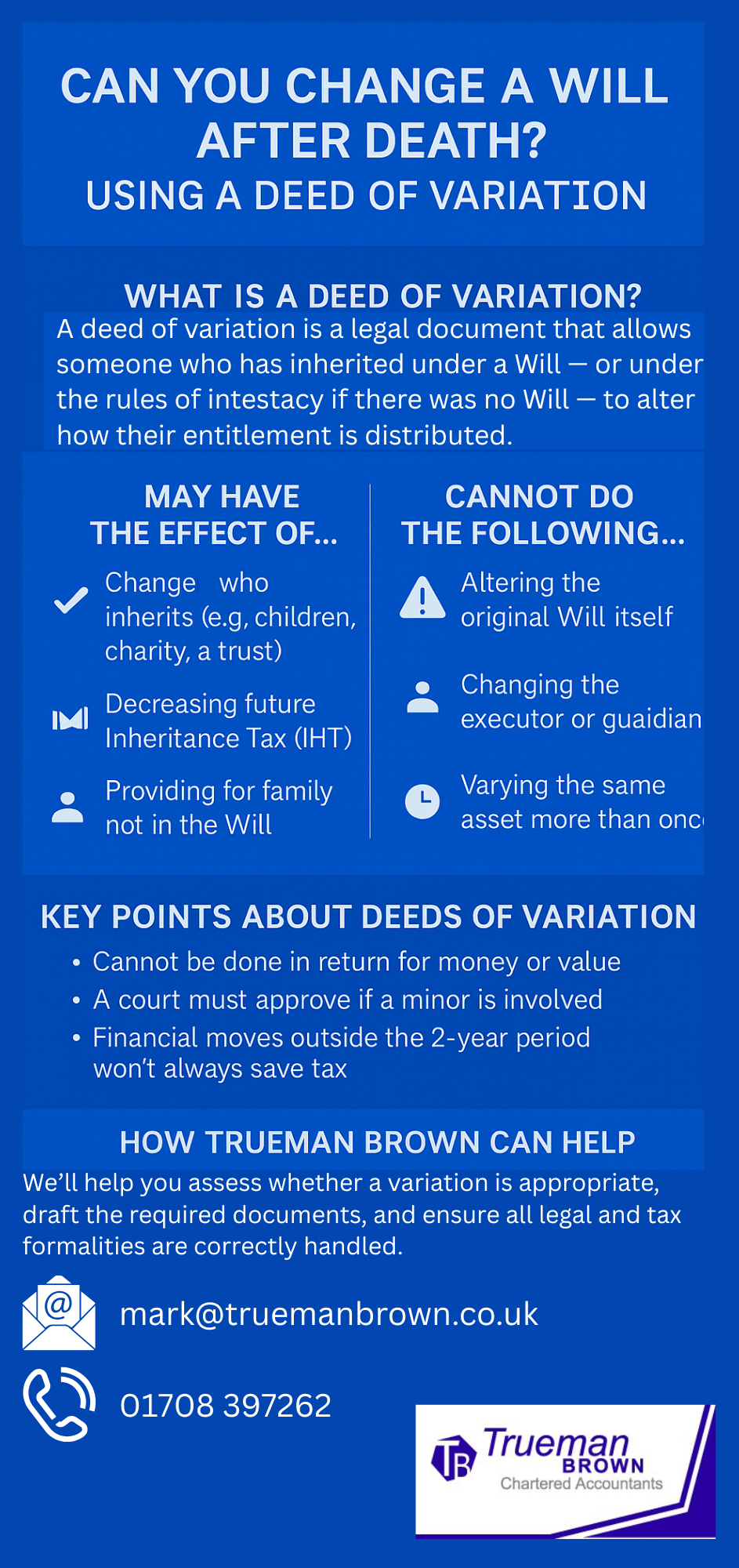
A deed of variation (also sometimes called a “deed of family arrangement” or “instrument of variation”) is a legal document that allows someone who has inherited under a Will — or under the rules of intestacy if there was no Will — to alter how their entitlement is distributed.
Rather than rewriting the original Will, the deed redirects the benefit: for example, you may choose to pass your inheritance to another person (such as a child or grandchild), donate part to charity, or place assets into a trust.
This tool is widely used not only to reflect changed family circumstances (e.g., a new dependent, stepchildren, or grandchildren) but also for good tax planning.
When can you use a deed of variation — the time-limit and formalities
-
A deed of variation must be made in writing.
-
It needs to be signed by all beneficiaries whose share would be reduced by the change — and any new beneficiaries should also sign.
-
If there is a beneficiary under 18 or someone lacking mental capacity, court (or deputy) approval may be required.
-
The deed of variation must generally be completed within two years of the date of death to benefit from favourable tax treatment.
-
It must include a statement that beneficiaries elect for relevant statutory provisions to apply (so that the variation is treated as if it were part of the original Will).
-
The variation must not be “in return for money or money’s worth.
Once signed, a deed of variation is irrevocable — you cannot undo it.
What can a deed of variation achieve — typical uses and limitations
✅ What you can do with a deed of variation
-
Redirect part or all of your inheritance to someone else (e.g., children, grandchildren, step-family, a long-term partner) or into a trust.
-
Provide for beneficiaries who were omitted, under-provided, or born after the Will was written.
-
Donate part of the estate to charity. This can reduce the overall tax liability of the estate.
-
Reduce future Inheritance Tax (IHT) liability: assets passed via a deed of variation — with the correct declarations — are treated as if they were inherited directly from the deceased. That can help keep the value of your own estate below IHT thresholds or benefit from spousal exemption or other reliefs.
-
In some cases, assets can be transferred into a trust — helping with long-term planning, for example for grandchildren or vulnerable relatives.
⚠️ What you cannot do with a deed of variation
-
You cannot rewrite or change the terms of the original Will — you can only redirect what you personally inherit.
-
You cannot change who the executors or guardians are — the deed of variation cannot alter that.
-
You cannot vary the same asset twice: once a deed of variation has been used for one part of the inheritance, it cannot be used to vary that same entitlement again.
-
If a minor or someone lacking capacity gains or loses under the variation, a court or deputy must give approval.
-
If the variation increases the IHT or CGT due, you must send a copy to HM Revenue & Customs (HMRC) within six months.
Why a deed of variation remains important in 2025/26 — and what’s changed
The legal tool of the deed of variation remains fully available in 2025, and no major changes have been made under the recent budget or tax legislation that remove this possibility.
Indeed, following the most recent Autumn Statement 2025, there is no indication that the government plans to abolish or restrict deeds of variation.
Given continuing pressure on estates and potential inheritance tax liabilities, a deed of variation can still be a powerful, flexible tool for tax planning, fair redistribution, or accommodating changed family circumstances.
However, it remains essential to act within the two-year window after the date of death — especially if tax benefits are a motive.
Outside that window, any transfer may still be possible but will be treated as a gift from the beneficiary, which can have different tax consequences.
How Trueman Brown can help you
If you’re considering using a deed of variation — or simply want to understand if it could help you or your family — the team at Trueman Brown can guide you through the process.
We’ll help you assess whether a variation is appropriate, draft the required documents, and ensure all legal and tax formalities are correctly handled.
For advice or to get started, contact us at mark@truemanbrown.co.uk or call 01708 397262.
FAQ
Q: Does a deed of variation actually change the Will?
A: No. A deed does not rewrite the original Will. Instead, it redirects how your share of the estate is passed on. The original Will remains unchanged.
Q: Who can enter into a deed of variation?
A: Only beneficiaries under the Will, or those who would inherit under the intestacy rules (if there was no Will), can use a deed of variation. If more than one beneficiary is involved, all beneficiaries affected by the intended variation must sign the deed.
Q: How much time do I have to apply for a deed of variation?
A: Usually, you must complete the deed within two years of the date of the deceased’s death if you want favorable tax treatment (for IHT and Capital Gains Tax).
Q: Can I change executors or guardians of minors under a deed of variation?
A: No. A deed of variation cannot change appointed executors or guardians. It only changes beneficiaries’ entitlements.
Q: Does using a deed of variation always reduce tax?
A: Not necessarily — while many use it to reduce IHT or avoid future tax liabilities, the effect depends on how the variation is structured (who receives the assets, whether it’s a lifetime gift, etc.). A poorly considered variation could even increase tax.
Q: Do I need a solicitor to use a deed of variation?
A: Technically, beneficiaries can draft their own deed. However, professional advice is strongly recommended — especially where tax, trusts, minors, or multiple beneficiaries are involved — to avoid mistakes or unintended consequences.
Recent Comments