
Financing an Investment Property
When you’re looking at financing an investment property, it’s essential to explore how you’ll fund the purchase and what tax reliefs may apply.
Whether you’re borrowing personally, using limited company structures or a mix of both, the vehicles you use will directly impact your tax position.
In this article, we cover how to approach financing an investment property, the tax implications for personal versus corporate borrowing, the changes introduced for the 2025/26 tax year, and how we at Trueman Brown can help you navigate these issues effectively.
Personal Borrowings When Financing an Investment Property
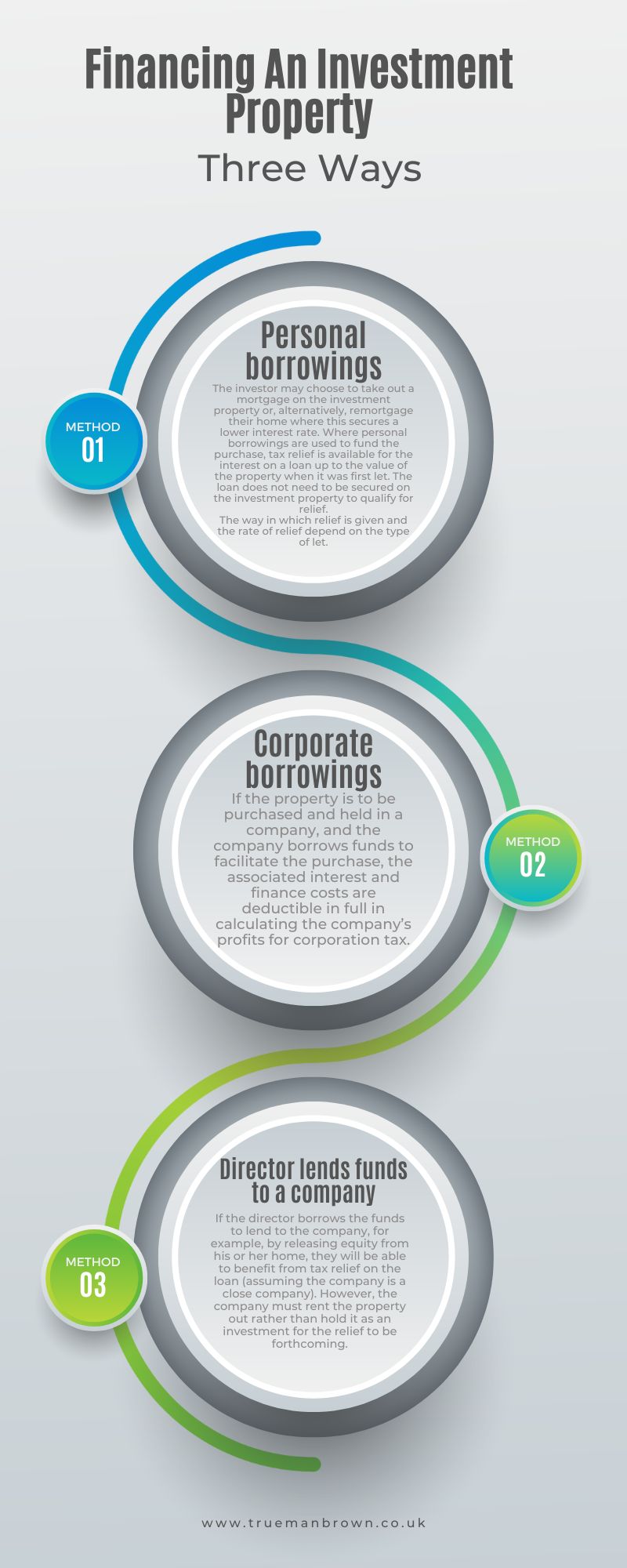
If you decide to fund the purchase of the investment property via personal borrowing (for example, taking out a mortgage in your own name or remortgaging your home to raise funds), you will be subject to the tax rules that apply to individuals.
When financing an investment property personally:
-
The interest and finance costs on a loan to purchase a residential let cannot be deducted in computing your taxable rental profit. Instead, you receive a tax credit at the basic rate (20 %) of the interest and finance costs.
-
For the 2025/26 tax year, these rules remain in place.
-
If your let is commercial (non-residential) rather than purely residential, you may still be able to deduct the interest and finance costs in full.
Example – Personal Borrowing
Suppose you let a residential property, your rental income is £12,000 and interest and finance costs are £4,000. Under the rules for 2025/26:
-
You calculate rental profit on the full rental income less allowable expenses excluding the interest.
-
You then receive a tax credit of 20 % of your £4,000 interest = £800.
-
Whilst this is better than nothing, it is less favourable for higher-rate taxpayers compared to the previous regime where full deduction was possible.
Things to watch
-
High levels of borrowing increase taxable rental profits (since interest is no longer deductible in full) which may push you into a higher tax band.
-
Ensure you keep meticulous records of interest, apportionment (if borrowing covers more than one property or partly personal) and rental income.
-
If your borrowing covers both residential and commercial elements of a property, apportionment is essential.
Corporate Borrowings and Financing an Investment Property
If instead you hold the investment property via a company (for example a limited company), and the company borrows to purchase the property or you lend funds to the company, the tax treatment of finance costs is different.
Company borrows
When the company takes out the loan to finance the purchase of the investment property:
-
The interest and finance costs are fully deductible in computing company profits subject to corporation tax.
-
This means the borrowing costs reduce the company’s taxable profit, offering a more favourable position compared to personal borrowing.
Director lends funds to the company
Another structure is for a director or individual to introduce funds into the company, which the company uses to acquire the investment property. The company may pay the director interest on the loan:
-
That interest remains deductible for corporation tax purposes.
-
The director will have to account for tax on the interest received (less savings allowance) and the company deducts basic rate tax via CT61.
Why this matters when financing an investment property
-
For individuals financing an investment property via personal borrowing, the tax cost is higher (interest relief restricted to 20% tax credit) whereas a company-owned property may allow full deduction of interest.
-
Many landlords have evaluated whether moving properties into a company structure is beneficial — however, this is not a decision to rush: the borrowing costs, stamp duty, tax on extraction of profits, and future disposal tax must all be considered.
Key Changes for 2025/26 That Impact Financing an Investment Property
When financing an investment property, you must take account of recent rule changes that affect tax reliefs and the treatment of property income. Notably for tax year 2025/26:
-
The special regime for furnished holiday lets (FHLs) has been abolished from 6 April 2025. That means many FHLs now face the same tax treatment as standard residential lets: full interest deduction is no longer available for individuals, instead only the 20 % credit applies.
-
New capital allowances for plant & machinery in FHLs have been restricted from 2025/26: no new capital allowances.
-
Mortgage interest tax relief (for individual landlords of residential lets) remains at a 20 % tax credit of finance costs for the foreseeable 2025/26 year.
-
Losses from FHLs may now be offset more flexibly for individuals against other property income or for companies against other income, post-April 2025.
Implication: If you are financing an investment property, particularly via borrowing, the structure and type of letting (residential vs commercial vs FHL) are more important than ever in determining the tax efficiency of your financing.
Practical Steps Before Financing an Investment Property
-
Review your borrowing levels: high interest means larger tax-adjusted profits for individual landlords.
-
Compare personal versus company ownership: while company ownership may offer more favourable interest deduction, costs of incorporation, stamp duty, and profits extraction must be weighed.
-
If you plan to finance an investment property via personal borrowing, ensure you understand the 20 % tax credit limitation and the impact on your tax band.
-
If part of the borrowing is shared between multiple properties or mixed commercial/residential use, ensure apportionment is properly documented.
-
For any FHL or short-let scenario, review the impact of the abolition of the FHL regime for 2025/26 and whether a company structure might be advantageous.
-
Keep detailed records of all finance charges, dates, apportionment, letting strategy and structure — as HM Revenue & Customs (HMRC) are increasingly scrutinising landlord financing and relief claims.
How Trueman Brown Can Help with Financing an Investment Property
If you’re considering financing an investment property and want to make sure you’re structuring the borrowing, ownership and tax reliefs correctly, we at Trueman Brown can help.
Get in touch with us:
📧 mark@truemanbrown.co.uk
📞 01708 397262
We can assist you by:
-
Reviewing your proposed financing structure and advising on whether personal or company ownership is most tax-efficient.
-
Modelling the impact of financing an investment property under the 2025/26 tax year rules (including the 20 % interest tax credit, FHL changes and capital allowances).
-
Advising on the optimal borrowing level and timing of acquisition to reduce tax risk.
-
Ensuring compliance with record-keeping and disclosure requirements to avoid HMRC penalties.
-
Supporting you with your annual landlord tax return, ensuring finance costs are correctly treated and reliefs claimed properly.
Don’t leave your financing structure to chance — call us now at 01708 397262 or email mark@truemanbrown.co.uk and let us help ensure your financing an investment property plan is tax-efficient, compliant and aligned with your long-term goals.
FAQ – Financing an Investment Property
Q: What does “financing an investment property” mean?
A: It refers to the methods and funding of acquiring a property to let out (an investment property) — typically via borrowing (mortgage, personal loan), remortgage of an existing property, or via a company structure. The funding route influences the tax treatment of finance costs.
Q: As an individual landlord financing an investment property, can I deduct all my mortgage interest?
A: No — for residential lets by individuals, full deduction of interest is not allowed. Instead you get a tax credit of 20 % of the interest and finance costs you pay.
Q: If I own the property via a limited company, does the interest relief change when financing an investment property?
A: Yes — if the company borrows, the interest and finance costs are generally fully deductible for corporation tax purposes. This can make financing an investment property via a company more tax efficient — though you must consider all the other implications (stamp duty, extracting profits, tax on sale) before restructuring.
Q: What changed in 2025/26 that affects financing an investment property?
A: Key changes include: the abolition of the FHL regime from 6 April 2025 (meaning many holiday lets now follow standard residential let rules); no new capital allowances for plant & machinery in FHLs; the continuation of the 20 % tax credit for interest for individual residential landlords.
Q: How should I proceed if I’m about to purchase and finance an investment property?
A: Before you finalise the purchase and finance: review the ownership structure, consider whether you should finance personally or via a company, assess the level of borrowing and its tax impact, and engage a specialist accountant to model your tax position under the 2025/26 rules.
Q: What about commercial property or mixed-use property when financing an investment property?
A: For commercial lets the rules are more favourable — interest and finance costs are typically fully deductible, even for individual landlords. For mixed-use you’ll need to apportion between the commercial and residential elements correctly.
Q: What are the risks if I get the financing structure wrong?
A: Possible risks include paying more tax than necessary due to higher taxable profits, not being able to claim full reliefs, incurring penalties for incorrect tax returns or record-keeping, and being caught out by the changes in relief regimes (especially post-April 2025). HMRC is increasingly active in landlord investigations.
Q: How can Trueman Brown support me?
A: We can help you evaluate your financing approach for your investment property, advise on the most tax-efficient structure, assist with modelling and compliance, prepare and submit your tax returns correctly, and monitor ongoing rule changes so you remain ahead of the game.
Recent Comments