
How to Extract Money from a Loss-Making Company – Directors’ Salary or Bonus?
When you’re looking at how to extract money from a loss-making company, the decision between paying yourself a salary, a bonus, or some other form of distribution becomes especially important.
If your company is not currently showing profits (or has accumulated losses) then typical dividend extraction is off the table, and you need to consider other means to access funds in a tax-efficient and compliant manner.
Understanding the starting point: loss-making company and director remuneration
In a company with losses or no retained profits, the usual route of paying dividends is not available.
So the question of how to extract money from a loss-making company focuses on salary and bonus payments to directors (or employees) and the tax, National Insurance (NI) and corporation tax implications of those payments.
Paying a director’s salary – one way of how to extract money from a loss-making company
A regular salary paid to a director is treated as employment income and taxed under PAYE and NI rules.
It is also deductible for corporation tax, so even in a loss-making company a salary may help reduce future tax liability once the company becomes profitable.
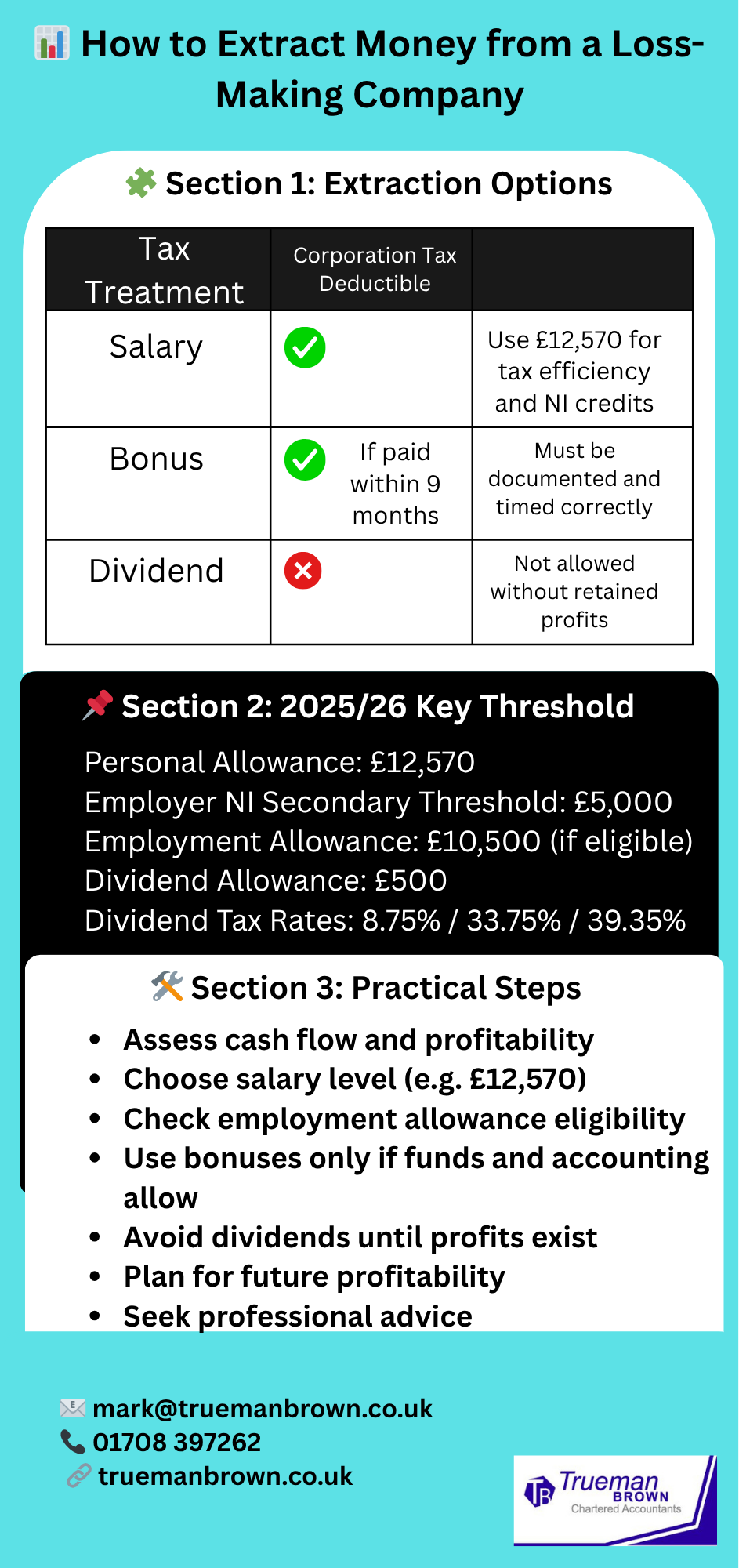
-
For the 2025/26 tax year:
-
The personal allowance remains £12,570.
-
The employer NI secondary threshold is now just £5,000.
-
The employment allowance is increased to £10,500 for eligible employers.
-
Many advisers suggest a salary around £12,570 for directors in 2025/26 as one of the most tax-efficient routes.
So paying a modest salary may help you access cash from a company that is loss-making (or marginally profitable) and also maintain NI records to secure state pension credits.
Bonus payments – another route for how to extract money from a loss-making company
A bonus is treated as employment income and is subject to PAYE and NI.
-
-
For corporation tax purposes, a bonus must be paid (or there must be an obligation to pay it) and it must be paid within nine months of the accounting period end for deduction.
However, in a loss-making company that doesn’t have distributable profits, paying a large bonus may not make sense because the company is already in a loss position and may lack cash.
-
Also there is still employer NI to factor in (15 % on salary/bonus above the threshold for 2025/26) if the company doesn’t qualify for employment allowance.
Thus, when exploring how to extract money from a loss-making company, a bonus must be weighed carefully: it may not be deductible for corporation tax if the company cannot meet the payment criteria, and it still generates personal tax/NI charges.
Dividend and profit extraction – what if the company remains loss-making?
In a loss-making company you cannot declare dividends because there are no retained profits.
Therefore the usual strategy of combining a modest salary with dividends is not available.
You must rely on salary or bonus (or other distributions such as loan accounts, though those bring additional risks).
In effect, when thinking about how to extract money from a loss-making company, you are limited to employer deductions or loan/return of capital strategies (which must be carefully planned).
Remember that dividends come with a dividend allowance of only £500 for 2025/26.
Also dividends are not deductible for corporation tax, so they are not an option for loss-making companies seeking deductions.
Key tax and NI thresholds to consider for 2025/26
When planning how to extract money from a loss-making company, you must understand the thresholds and rates for the 2025/26 tax year:
-
Personal Allowance: £12,570.
-
Employer NI secondary threshold: £5,000.
-
Employment Allowance (for eligible employers): up to £10,500.
-
Dividend allowance: £500.
-
Dividend tax rates above allowance: 8.75% basic, 33.75% higher, 39.35% additional.
These thresholds inform decisions about whether paying a salary, bonus or other extraction method is efficient.
Practical steps: implementing a strategy for how to extract money from a loss-making company
-
Assess cash-flow and profitability – if your company is making a loss currently, paying large salaries/bonuses may worsen that position or delay repayment of losses.
-
Decide on salary level – for 2025/26 many advisers recommend a director salary of around £12,570, assuming the company can fund it and you want to maintain NI credits.
-
Check employment allowance eligibility – if your company qualifies, you may offset employer NI up to £10,500. This improves extraction cost-effectiveness.
-
Consider bonus only if funds allow and proper accounting is in place – ensure the obligation is documented and payment will be made within nine months of year-end to secure corporation tax deductibility.
-
Avoid dividends until there are profits and distributable reserves – you cannot use dividends in a loss-making company for extraction without creating legal issues.
-
Plan for future profits – if you expect the company to turn profitable, building up salary/bonus mechanisms now may assist with smoother extraction once profits arise.
-
Seek professional advice – even though the mechanics may seem straightforward, the interplay of corporation tax, NI, PAYE, and company law means you should get tailored advice.
-
How Trueman Brown can help you with how to extract money from a loss-making company
If you’re wondering exactly how to extract money from a loss-making company, our team at Trueman Brown are here to guide you.
Whether it’s choosing the right salary level, structuring a bonus, ensuring correct timing and accounting entries, or reviewing eligibility for employment allowance, we can help.
Contact us at mark@truemanbrown.co.uk or call us on 01708 397262, and we’ll work with you to craft a strategy that aligns with your company’s current position and future ambitions.
Frequently Asked Questions (FAQ)
Q1: Can I pay myself a dividend if my company is loss-making?
A: No — dividends must be paid out of distributable profits. If your company is showing losses or has no retained profits then issuing dividends could breach company law.
Q2: Why might I pay a salary rather than a bonus when thinking about how to extract money from a loss-making company?
A: A salary may provide certainty of NI credits (for state pension), and is deductible for corporation tax as an expense. A bonus may incur employer NI and must meet specific timing and accounting rules to be deductible.
Q3: What is the employment allowance and how does it impact extraction strategies?
A: For 2025/26 the employment allowance is up to £10,500 for eligible employers. If your company qualifies, this can offset employer NI and make paying a salary or bonus more cost-effective.
Q4: What happens if I pay a bonus but don’t record the obligation correctly or don’t pay within nine months of year end?
A: The corporation tax deduction may be lost (or delayed until payment actually occurs) which could increase your tax cost.
Q5: Should I always aim for the salary of £12,570 in 2025/26?
A: It is a commonly cited salary for many small owner-managed companies because it uses the personal allowance and minimises employee NI, but it may trigger employer NI. If the company is loss-making and cannot absorb employer NI costs, a lower salary (e.g., the £5,000 secondary threshold) may be considered.
Q6: How does paying myself via a loan account compare when extracting from a loss-making company?
A: Loan accounts can allow extraction of funds temporarily, but they carry risks (e.g., beneficial loan tax charges, company‐law implications, and can affect future profit distributions). They are beyond the scope of this blog—please seek specialist advice.
Recent Comments