
Jointly Owned Property Tax — What You Need to Know
Whether you’re married, in a civil partnership, or co-own with someone else, how you split rental income can significantly impact your tax bill — so it pays to be informed.
Who pays tax when the property is jointly owned
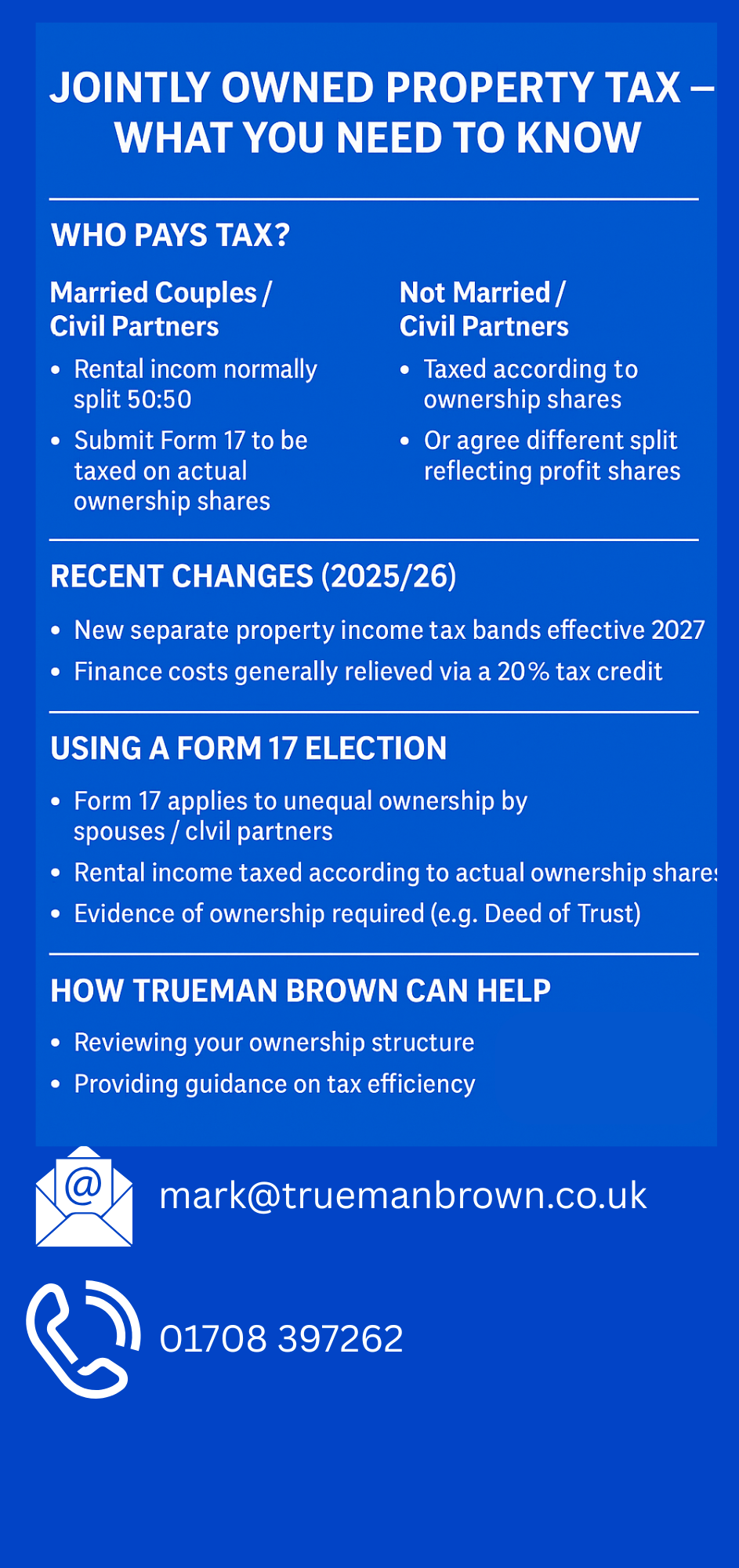
Married couples and civil partners
For couples who own a property jointly, the default position for jointly owned property tax is that rental income is split 50:50, regardless of the actual underlying share in the property.
For instance, if a married couple owns a flat — 70% in one name and 30% in the other — and lets it out, HMRC will treat the rental income as equally shared (50:50) unless a special election is made via Form 17.
By filing Form 17 (with valid evidence of unequal beneficial ownership), you can ask for the rental income to be taxed according to actual ownership — rather than the default 50:50 split.
Married couples and civil partners
For couples who own a property jointly, the default position for jointly owned property tax is that rental income is split 50:50, regardless of the actual underlying share in the property.
For instance, if a married couple owns a flat — 70% in one name and 30% in the other — and lets it out, HMRC will treat the rental income as equally shared (50:50) unless a special election is made via Form 17.
By filing Form 17 (with valid evidence of unequal beneficial ownership), you can ask for the rental income to be taxed according to actual ownership — rather than the default 50:50 split.
Joint owners not married or in a civil partnership
If the property is jointly owned by individuals who are not married or in a civil partnership, the rental income is typically taxed in proportion to each person’s ownership share.
In such cases, the co-owners can also agree a different split of profits (and losses) for tax purposes — but any agreed allocation must reflect the actual allocation of rental profits.
How income tax works on rental profits in 2025/26
Under jointly owned property tax rules, rental profits are taxed as part of your income.
You calculate net rental income by taking the total rent received and deducting allowable expenses (such as maintenance, repairs, letting agent fees, etc.).
Since April 2020, mortgage interest and other finance costs cannot be fully deducted from rental income. Instead, landlords receive a 20% tax credit on such finance costs.
Furthermore, recent changes announced in the Autumn Budget 2025 mean that the government is reshaping how property, savings, and dividend income is taxed.
From 2027 onwards, property income — including rental profits — will have its own separate income-tax bands.
Although the new tax bands only come into force from April 2027, the announcement is relevant now because it may affect long-term planning for jointly owned rental properties under the “jointly owned property tax” banner.
When you might want to use a Form 17 for jointly owned property tax benefits
If you and a spouse or civil partner own a rental property in unequal shares, it can be worth considering a Form 17 election. Submitting a valid Form 17 — along with evidence of the true beneficial ownership (often via a legal Deed of Trust) — allows the rental income to be taxed in line with actual ownership rather than the default 50:50 split.
This can be particularly beneficial if one partner is a lower-rate taxpayer and the other is higher-rate — allowing more income to be taxed at lower rates.
Bear in mind: without a valid Form 17 and supporting evidence, HMRC will treat rental income as evenly shared, even if you own the property in unequal shares.
What’s changed recently (2025/26) for jointly owned property tax
-
The Autumn Budget 2025 announced that property income will in future have a separate tax band system — i.e., landlords’ rental income will be taxed under a dedicated “property income” rate rather than being lumped in with other income types.
-
Finance cost relief (e.g. mortgage interest relief) remains limited: instead of deducting mortgage interest from rental income, landlords currently receive a 20% tax credit on finance costs.
-
For jointly owned property — whether by couples or non-spouses — the fundamental rules on splitting rental income remain unchanged, but planning ahead matters, especially given the upcoming changes to property income taxation.
How Trueman Brown can help
If you’re uncertain about how jointly owned property tax affects you — or want to explore whether a different income-split (e.g. via Form 17) could save you tax — Trueman Brown is here to help.
Email us at mark@truemanbrown.co.uk or call 01708 397262 to discuss your circumstances.
We can review your ownership structure, income profile and guide you on the most tax-efficient route for 2025/26 and beyond.
Frequently Asked Questions (FAQ)
Q: What happens if I don’t submit Form 17 but I own the property 70:30 with my spouse?
A: By default, HMRC will treat your rental income as split 50:50 — so each person is taxed on half, regardless of underlying ownership.
Q: Can I choose any rental income split if we’re not married?
A: Yes — if you own a property jointly with someone you’re not married to, rental income is usually taxed according to actual ownership. You can also agree a different split, provided that the income allocation reflects actual agreed-out rental profits.
Q: Are mortgage interest and finance costs still deductible against rental income?
A: No — since April 2020, mortgage interest and other finance costs cannot be deducted in full. Instead, you get a 20% tax credit on such costs.
Q: Will the upcoming tax-rate changes affect my jointly owned rental property now?
A: The new separate property income tax bands take effect from April 2027. However, these changes mean that now is a good time to review your property ownership and income-split structure — especially if you want long-term tax efficiency under jointly owned property tax rules.
Q: What should I do if I want to change the income split for tax purposes?
A: For married couples / civil partners: if ownership is unequal, you’d need to complete Form 17 (with evidence of beneficial ownership, e.g. a Deed of Trust). For non-spouses, ensure your agreed rental income allocation is documented and reflects actual rental profit shares.
Recent Comments