
Take advantage of the Rent-a-room scheme
If you have a spare furnished room in your home, the Rent-a-room scheme could be a smart way to earn extra, tax-efficient income.
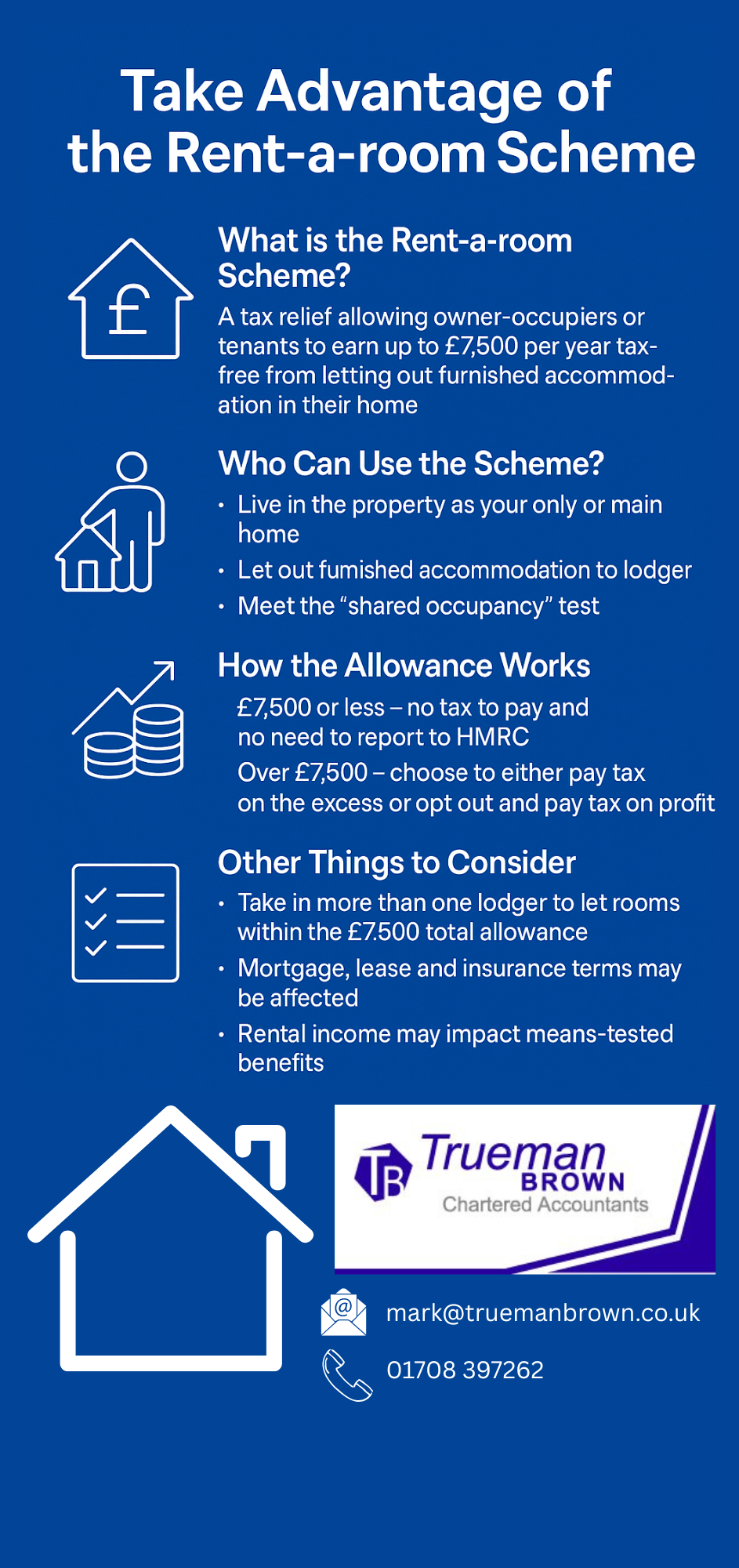
Under the current rules for the 2025/26 tax year you can earn up to £7,500 tax-free by letting a furnished room in your main home.
What is the Rent-a-room relief?
The Rent-a-room relief is a government-approved scheme that allows owner-occupiers or tenants who let furnished accommodation in their only or main residence to receive rental income up to a tax-free threshold.
For the 2025/26 tax year the threshold is £7,500 for one person.
If the income is shared between two or more people then the threshold is £3,750 each.
Who can use the Rent-a-room scheme?
You can use the Rent-a-room scheme if you:
-
live in the property as your only or main home, and
-
let out furnished accommodation (or rooms) to a lodger in that home, and
-
meet the “shared occupancy” test (you and the lodger share living accommodation, e.g. kitchen or bathroom).
You do not qualify if:
-
the room is unfurnished; or
-
the letting constitutes a business (for example a self-contained flat or separate dwelling); or
-
the accommodation is not part of your main residence.
You can be a homeowner or a tenant provided your lease allows sub-letting.
How the Rent-a-room allowance works
Under the Rent-a-room scheme, if your gross rental receipts from the furnished letting are within the allowance, you’re automatically exempt from tax and you don’t need to tell HM Revenue & Customs.
If your receipts exceed the threshold (£7,500 for sole recipient; £3,750 each where shared) then you have two routes:
-
Opt in to the scheme and pay tax on the amount above the threshold, or
-
Opt out and instead treat the letting as standard property income (i.e., deduct allowable expenses and pay tax on profit).
When the Rent-a-room income exceeds the threshold
If your annual income from letting (under the Rent-a-room scheme) goes beyond the tax-free allowance, you’ll need to complete a Self Assessment tax return.
You will then decide which method suits you: either pay tax only on the excess above the allowance (but claim no expenses), or pay tax on net profit (income minus expenses). It may be better to opt out if your expenses are large.
Other practical considerations for Rent-a-room let-tings
Before you take on a lodger under the Rent-a-room scheme, remember:
-
Check with your mortgage lender and home insurer if you own your home, or with your landlord if you’re a tenant.
-
Be aware that your rental income may affect means-tested benefits such as Universal Credit, or housing benefit.
-
You remain responsible for council tax, unless your local rules differ; the lodger doesn’t automatically pay it.
-
You can rent more than one room under the scheme but the £7,500 limit applies to total income from all rooms.
Why it still makes sense in 2025/26
In the current economic climate the Rent-a-room scheme remains one of the simplest tax-efficient ways to generate additional income.
With the threshold remaining at £7,500 (for single claim) this tax-free amount is significant for many homeowners or tenants with spare space.
Because you don’t claim expenses if you opt in, the administration is minimal — something many prefer over full property income accounting.
How Trueman Brown can help you
If you’re considering letting a room under the Rent-a-room scheme and you’d like expert assistance, we at Trueman Brown are here for you.
Whether it’s checking your eligibility, advising on whether to opt in or out, dealing with Self Assessment or ensuring you maximise the benefit, we’re ready to support you.
Please contact:
📩 mark@truemanbrown.co.uk
📞 01708 397262
We’d be pleased to talk through your circumstances and ensure the Rent-a-room relief is working for you.
Frequently Asked Questions (FAQ)
Q1: Can I use the Rent-a-room scheme if I rent the property myself?
Yes – provided your lease allows sub-letting, you live in the property as your main home and you let furnished accommodation under the scheme.
Q2: Do I need to furnish the room?
Yes — one of the conditions of the Rent-a-room scheme is that the accommodation must be furnished. If it’s unfurnished you cannot use the relief.
Q3: Do I have to register for the scheme or inform HMRC if income is under the threshold?
No — if your income from the letting is at or below the tax-free allowance (£7,500 or £3,750 each) then the relief is automatic and you don’t need to inform HMRC.
Q4: What happens if I have expenses larger than the allowance?
If your allowable expenses exceed the tax-free threshold then the standard property income route (i.e., opt-out) may be more beneficial than staying in the Rent-a-room scheme. In that case you should compare which gives the lower tax bill.
Q5: Can I still use the Rent-a-room scheme for short-term lets (e.g., via platforms such as Airbnb)?
Possibly — as long as the accommodation is part of your only or main home, furnished, and the letting meets the occupancy requirements. However if the unit is a separate dwelling (with its own kitchen/bathroom) then you may not qualify.
Q6: What are the key deadlines?
If your income exceeds the threshold and you need to submit a tax return or claim relief, the usual Self Assessment deadlines apply. The tax year runs from 6 April 2025 to 5 April 2026.
Recent Comments