
Making Tax Digital Software – What You Need to Know for 2025/26
The UK government’s push for digital tax compliance means that using making tax digital software is now more important than ever.
If you’re a VAT-registered business, self-employed individual, landlord or agent, you should be aware of the current rules, how using proper software helps you comply and how to prepare for future deadlines.
What is making tax digital software?
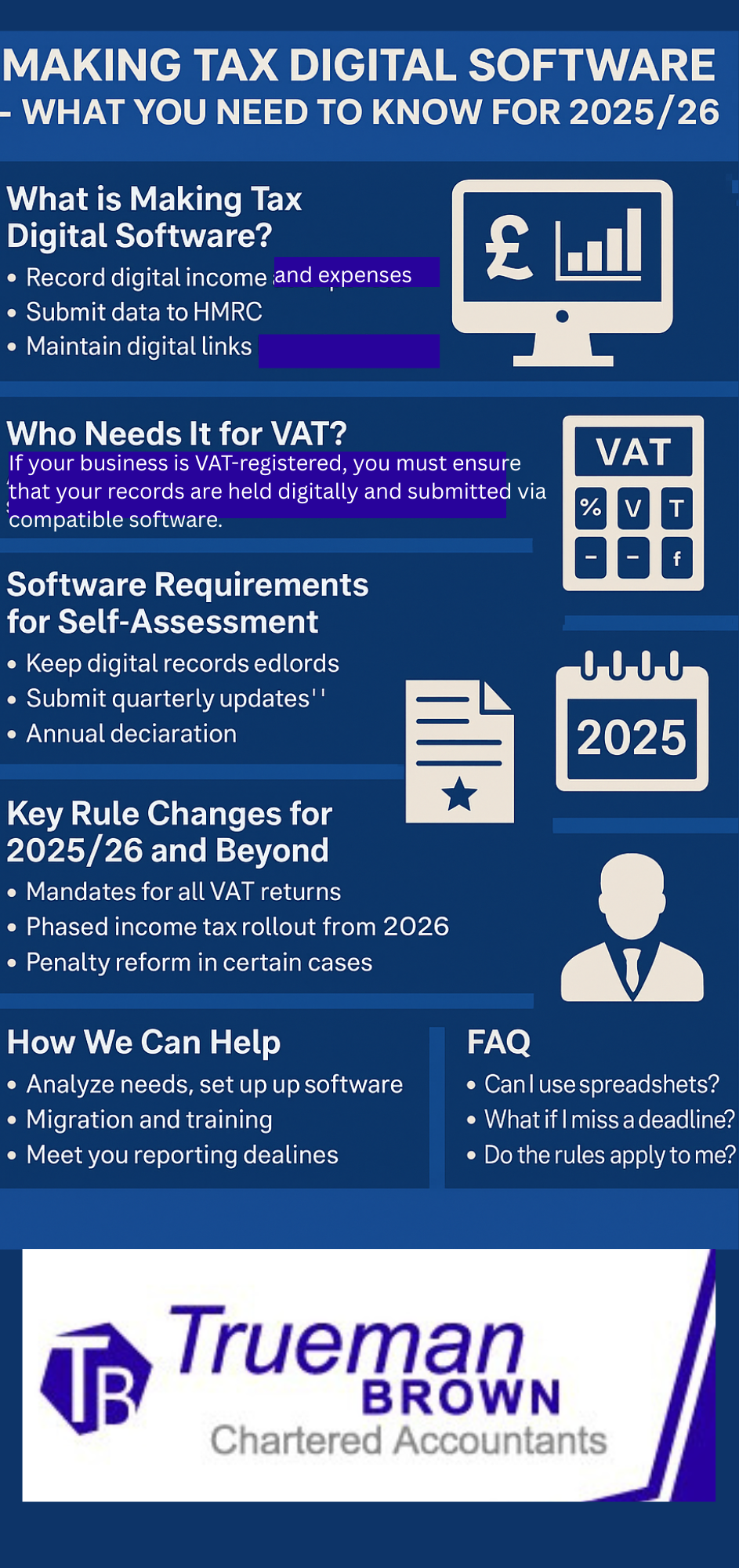
The term making tax digital software refers to accounting or bookkeeping tools that are compatible with the requirements of the Making Tax Digital (MTD) initiative. These tools must be capable of:
-
Recording digital records of income, expenses, supplies and VAT.
-
Submitting data to HM Revenue & Customs (HMRC) via its API or directly through authorised links.
-
Maintaining digital links between software applications (spreadsheets, bridging software, full accounting packages) where more than one product is used.
For VAT, this has been mandatory for many businesses since April 2019.
For the forthcoming MTD for Income Tax Self-Assessment (ITSA) regime, the requirement to use making tax digital software will apply from April 2026 (initially) for certain taxpayers.
Who needs making tax digital software for VAT?
If your business is VAT-registered, you must ensure that your records are held digitally and submitted via compatible software.
Originally the threshold was based on turnover above £85,000.
Key update for 2025/26: From April 2025, the rules have been extended so that all VAT-registered businesses must use making tax digital software and submit digitally, regardless of turnover.
This means even those previously exempt due to lower turnover must now comply.
In practice:
-
Keep digital records of sales, purchases, VAT paid and VAT charged.
-
Use approved software or a combination of tools with digital links (bridging software).
-
Submit VAT returns through the software, not via the old HMRC VAT Online service.
What about self-employed and landlords (making tax digital software for ITSA)?
The next major phase of the MTD programme concerns individuals and landlords who pay self-assessment tax.
When the time arrives you’ll also need to use making tax digital software, not just for VAT but for income tax reporting.
Current rollout plan:
-
From 6 April 2026: sole traders and landlords whose qualifying income (self-employment + property) is over £50,000 will need to use making tax digital software.
-
From 6 April 2027: threshold falls to £30,000.
-
From 6 April 2028: threshold further drops to £20,000.
So, if you’re coming up to those levels of income from self-employment or property, you must prep your making tax digital software in advance.
What you’ll need to do:
-
Ensure digital records are kept of every income and expense claimable. The software must deal with the relevant categories for sole-trader or landlord income.
-
Submit quarterly updates of your income/expenses to HMRC—not just an annual return.
-
At year-end you’ll still submit a final declaration (much like a tax return) via making tax digital software.
-
If you drop below the threshold for three successive tax years you may apply for exemption from the obligation.
Choosing the right making tax digital software
Here are some tips for selecting software that meets your needs:
-
Confirm the software is listed on HMRC’s “Find software that’s compatible with making tax digital” list.
-
It must be able to record digital records, maintain digital links, and submit data via HMRC API or authorised channel.
-
Consider whether you will use full accounting software (e.g., for multiple business functions) or a spreadsheet/bridging software combination.
-
Ensure it handles your specific needs: VAT, self-employment, property income/losses, maybe construction industry scheme (CIS) if applicable.
-
Make sure the vendor supports updates and changes (especially with evolving rules like those for 2025/26) and offers training or support.
Key rule changes for 2025/26 and beyond
Here’s a summary of the most relevant rule changes which impact the use of making tax digital software:
-
As mentioned, from April 2025 all VAT-registered businesses must use digital software for VAT returns, regardless of turnover.
-
For MTD for ITSA (making tax digital software for income tax): the phased rollout begins with the £50,000 threshold in April 2026, then £30,000 in 2027, and £20,000 in 2028.
-
Penalty regime is being reformed: digital record-keeping and timely submission via making tax digital software will increasingly be enforced.
-
Exemptions: For those who are digitally excluded (e.g., due to disability, location or religious reasons) there are still provisions to apply for an exemption.
These changes mean that now is a good time to review your systems, choose your software, and train your team (or yourself) so you’re ready.
Recent Comments