
Mansion Tax: What the High Value Council Tax Surcharge Means for Homeowners
The proposed mansion tax, formally known as the High Value Council Tax Surcharge (HVCTS), represents a significant change to how high-value residential property is taxed in England.
Although the charge will not take effect until April 2028, developments during 2025/26 mean that homeowners with valuable property should already be preparing for the impact of the tax and its interaction with the wider council tax system.
The tax is designed as an annual levy on residential properties worth more than £2 million, shifting the focus of local taxation firmly onto property value rather than household income or usage of local services.
What Is the Mansion Tax?
The tax is a recurring annual charge payable by the owner of a residential property valued above £2 million (based on 2026 values).
Unlike standard council tax, which is paid by the occupier, the mansion tax liability rests with the property owner, regardless of who lives in the home.
Social housing is excluded, but most other residential property types are potentially within scope.
The charge will be administered by local authorities alongside existing council tax bills.
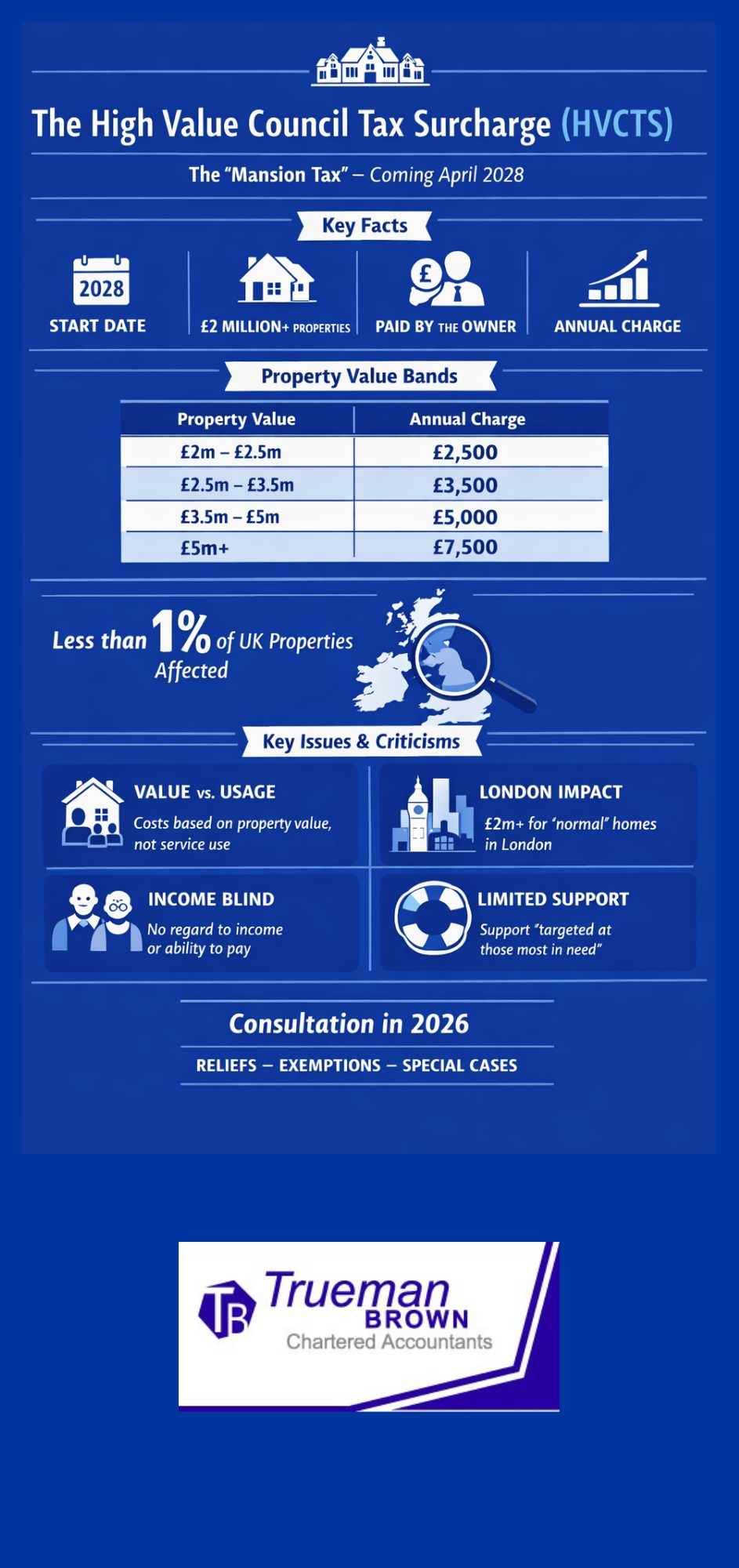
Mansion Tax Bands and Charges Explained
Under the tax proposals, qualifying properties will be placed into new value-based bands.
These bands are separate from the existing council tax bands, which are still based on 1991 property values.
| Property Value | Annual Mansion Tax Charge |
|---|---|
| £2m – £2.5m | £2,500 |
| £2.5m – £3.5m | £3,500 |
| £3.5m – £5m | £5,000 |
| £5m+ | £7,500 |
From 2029/30, tax charges will rise annually in line with CPI inflation.
How the Mansion Tax Fits into Council Tax Reform
Council tax has remained largely unchanged since its introduction in 1993. The mansion tax is therefore viewed by many as the first step in broader property tax reform.
However, the tax taxes asset value, not service usage.
Two people living in a £2 million property may use no more local services than a larger family in a lower-value home, yet face a significantly higher annual charge.
This raises ongoing questions about fairness and proportionality within the council tax system.
The London Effect and the Mansion Tax
One of the most controversial aspects of the tax is its impact on homeowners in London and the South East.
In many areas, relatively modest family homes now exceed the £2 million threshold.
A three-bedroom semi-detached house may be caught by the tax simply due to regional house price inflation, not because it resembles a “mansion” in any meaningful sense.
Income-Blind Charges and Long-Term Homeowners
The tax takes no account of:
-
Household income
-
Mortgage levels or equity
-
Original purchase price
This creates challenges for asset-rich but cash-poor owners, particularly elderly homeowners who may have lived in their property for decades.
While the government has committed to a support scheme, assistance will be “targeted”, suggesting relief may be limited and means-tested.
Mansion Tax Developments for 2025/26
For the 2025/26 tax year, there are no changes to existing council tax rules, but important groundwork for the mansion tax is underway:
-
A targeted valuation exercise by the Valuation Office Agency is expected to begin identifying £2m+ properties
-
Draft proposals confirm CPI indexation of future mansion tax charges
-
A full government consultation is scheduled for early 2026, covering exemptions, reliefs and enforcement
Homeowners should therefore treat 2025/26 as a planning year rather than a quiet year.
How Trueman Brown Can Help
Preparing for the tax is not just about understanding the charge itself.
It also involves reviewing ownership structures, future affordability, succession planning and potential reliefs.
Trueman Brown can help you:
-
Assess whether your property is likely to fall within the tax scope
-
Review ownership structures (including trusts and companies)
-
Plan for cash-flow implications and support scheme eligibility
-
Prepare for valuations and future challenges
📧 Email: mark@truemanbrown.co.uk
📞 Phone: 01708 397262
Early advice can make a significant difference when the mansion tax comes into force.
FAQs
What is the mansion tax?
The mansion tax is an annual charge on residential properties worth more than £2 million, payable by the owner.
When does the mansion tax start?
The charge is due to begin in April 2028, with preparatory steps taking place during 2025/26.
Will the mansion tax apply to ordinary homes?
Yes. In high-value areas, many standard family homes may exceed the £2 million threshold.
Are there exemptions from the mansion tax?
Social housing is excluded, and further reliefs and exemptions will be consulted on in 2026.
Will the mansion tax increase over time?
Yes. From 2029/30, charges will rise annually in line with CPI.
Recent Comments