
Making a negligible value claim on worthless assets
When one of your assets has dropped to a value of essentially nothing, it may be possible to make a negligible value claim and thereby realise an allowable loss for tax purposes.
That is, if an asset you own has become worthless (or its value is negligible) while you still hold it, you can treat it as though you have disposed of it for tax purposes, even though you haven’t sold it.
What is a negligible value claim?
A negligible value claim is a claim you submit to HM Revenue & Customs (HMRC) when an asset you still own has become so low in value that it is essentially worthless.
This allows you to treat it as though you have sold and immediately reacquired the asset at the (negligible) value for the purposes of calculating a loss.
There is no formal statutory definition of “negligible value,” but HMRC’s guidance states that it normally means the asset is worth “next to nothing”.
When can you make a negligible value claim?
You can make a negligible value claim when:
-
you still own the asset at the time you make the claim;
-
the asset has become of negligible value while you owned it (i.e., it was not already negligible when you acquired it).
In short: the decline in value must have occurred during your period of ownership.
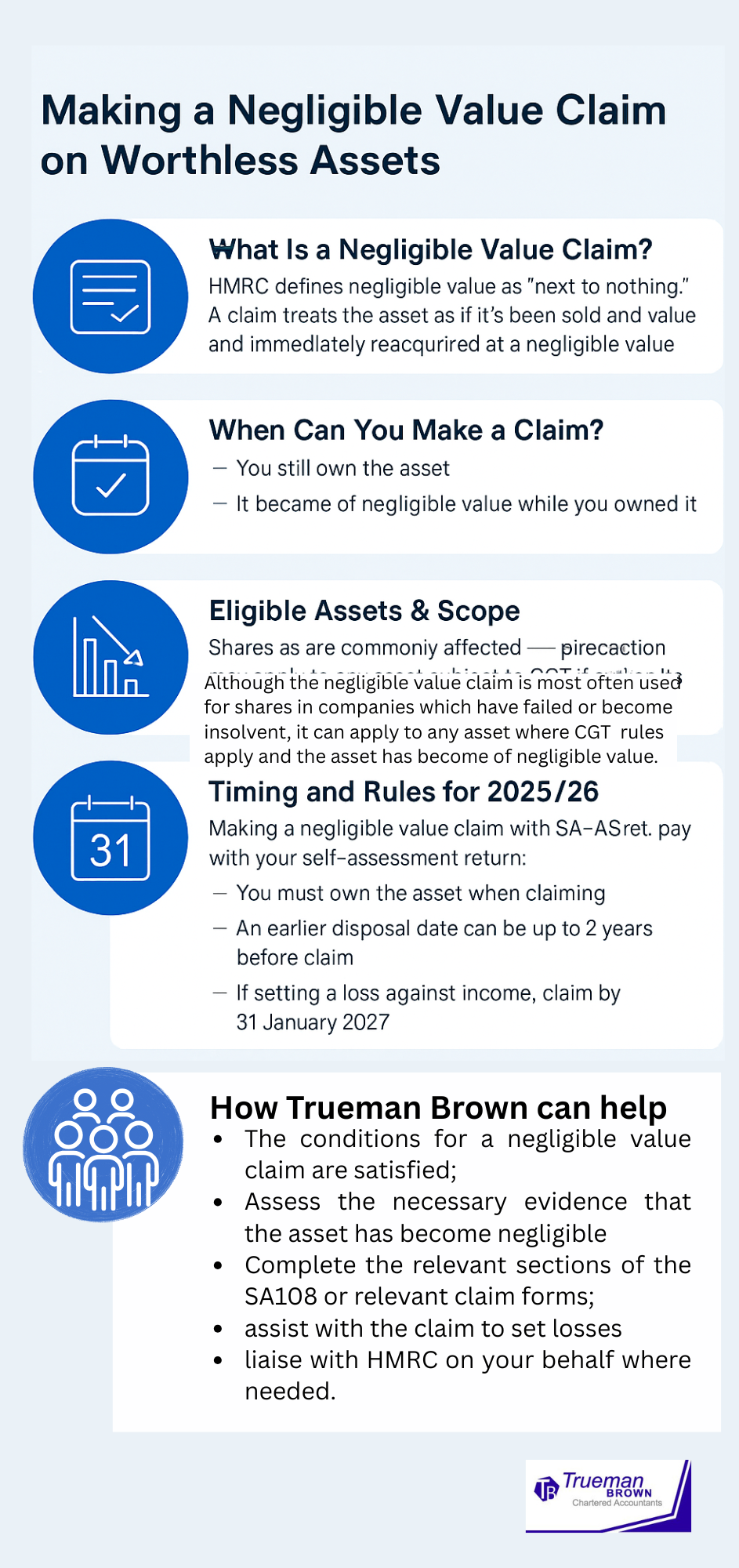
Scope & eligible assets for a negligible value claim
Although the negligible value claim is most often used for shares in companies which have failed or become insolvent, it can apply to any asset where CGT (capital gains tax) rules apply and the asset has become of negligible value.
For previously quoted companies there is a published list of shares which HMRC has accepted as of negligible value.
In the case of shares you have subscribed for in a qualifying trading company, there may also be income-tax relief via the associated loss — this is covered in helpsheet HS 286.
The effect of making a negligible value claim
When a negligible value claim is accepted:
-
You are treated as though you have disposed of the asset at the time of the claim (or a date you choose under certain conditions) for the value you nominated (usually nil or near nil).
-
You are treated as having immediately reacquired the asset at that value.
-
A loss then arises from the deemed disposal, which may be allowable for CGT purposes (or if the shares qualify for special relief, possibly set against income).
Timing and tax-return details for 2025/26
For the tax year 2024/25 (returning by 31 January 2026) and beyond, current guidance confirms that you can make a negligible value claim with your self‐assessment return.
In particular:
-
You must still own the asset when the claim is made.
-
If you specify an earlier date for the deemed disposal, it can be up to two years before the start of the tax year in which you make the claim (subject to conditions).
-
If you want to claim to set the resulting loss against income (for qualifying shares), the deadline is one year after 31 January following the year in which the loss arose.
-
When completing your SA108 (Capital Gains Tax summary) pages for 2024/25, box 41 is used for losses set against income, and the code “NVC” is used in boxes 8/20/28/36 for the claim.
Key considerations before making a negligible value claim
-
Ensure you’ve documented evidence showing the asset has become negligible (for example, company accounts, liquidation/insolvency papers, market valuations).
-
Make sure the asset was not already negligible when you acquired it — otherwise the claim will fail.
-
Consider the consequences of immediately reacquiring the asset at nil value — if it later increases in value, you may lose the benefit of a higher base cost.
-
If you are also seeking to set the loss against income (rather than just gains), confirm the company meets the “qualifying trading company” conditions and you subscribed for the shares (rather than bought them) — see HS 286.
How Trueman Brown can help with your negligible value claim
If you think you may have an asset which qualifies for a negligible value claim, then Trueman Brown can guide you through the process from start to finish. We will:
-
review your asset holdings and determine whether the conditions for a negligible value claim are satisfied;
-
help you gather and assess the necessary evidence that the asset has become negligible while under your ownership;
-
advise on the best date for the deemed disposal and reacquisition, and complete the relevant sections of the SA108 or relevant claim forms;
-
assist with the claim to set losses against income (if applicable) or against capital gains;
-
liaise with HMRC on your behalf where needed.
If you’d like to discuss your circumstances, please get in touch: mark@truemanbrown.co.uk or call 01708 397262.
FAQ
Q1: What exactly counts as “negligible value”?
There is no precise definition. HMRC’s view is that the asset must be worth “next to nothing” — essentially nil or so low that it is of no commercial value.
Q2: Can I make a negligible value claim if I’ve already sold the asset?
No. One of the key conditions is that you must still own the asset at the time the claim is made. If it has been sold, then you would instead treat it as a disposal rather than making a negligible value claim.
Q3: How far back can the deemed disposal date go?
You may specify an earlier date (up to two years before the start of the tax year in which you make the claim) provided at that date the asset had become negligible and you met the ownership condition.
Q4: What reliefs are available once the negligible value claim is accepted?
Primarily the deemed disposal gives rise to an allowable capital loss, which you can set against gains. For shares subscribed in a qualifying trading company, you may also be able to set the loss against your income (subject to conditions and limits) via HS 286.
Q5: Are there deadlines I should know about?
Yes. While the negligible value claim itself may be made with your tax return, if you want to set the resulting loss against income you must claim within one year of 31 January following the tax year in which the loss arose.
Q6: What if I buy more of the same shares after making a negligible value claim?
You should be aware that the deemed reacquisition establishes a new base cost (often nil or minimal). If you later purchase more shares, you need to keep clear records of what relates to the old holding and the new purchase, as this may affect how future gains/losses are calculated.
If you’d like a detailed review of whether you qualify for a negligible value claim (or simply want to explore whether it’s appropriate in your situation), feel free to contact us at mark@truemanbrown.co.uk or call 01708 397262. We’re here to help.
Recent Comments