
Selling Your Home and Claiming Relief for a Private Principal Residence
When you come to sell a property that has been your private principal residence, it’s essential to understand how the relief known as Private Residence Relief (PRR) operates, and what changes apply for the 2025/26 tax year.
If your home qualifies as your only or main residence for the relevant period, you may be able to avoid or reduce a charge to Capital Gains Tax (CGT).
What is a Private Principal Residence?
A private principal residence is the dwelling which you regard as your only or main home.
If you own more than one property, you may need to make a nomination to designate which one is your main home for tax purposes.
The relief applies when a property has been your only or main home over the period of ownership (or part thereof) and meets the other criteria.
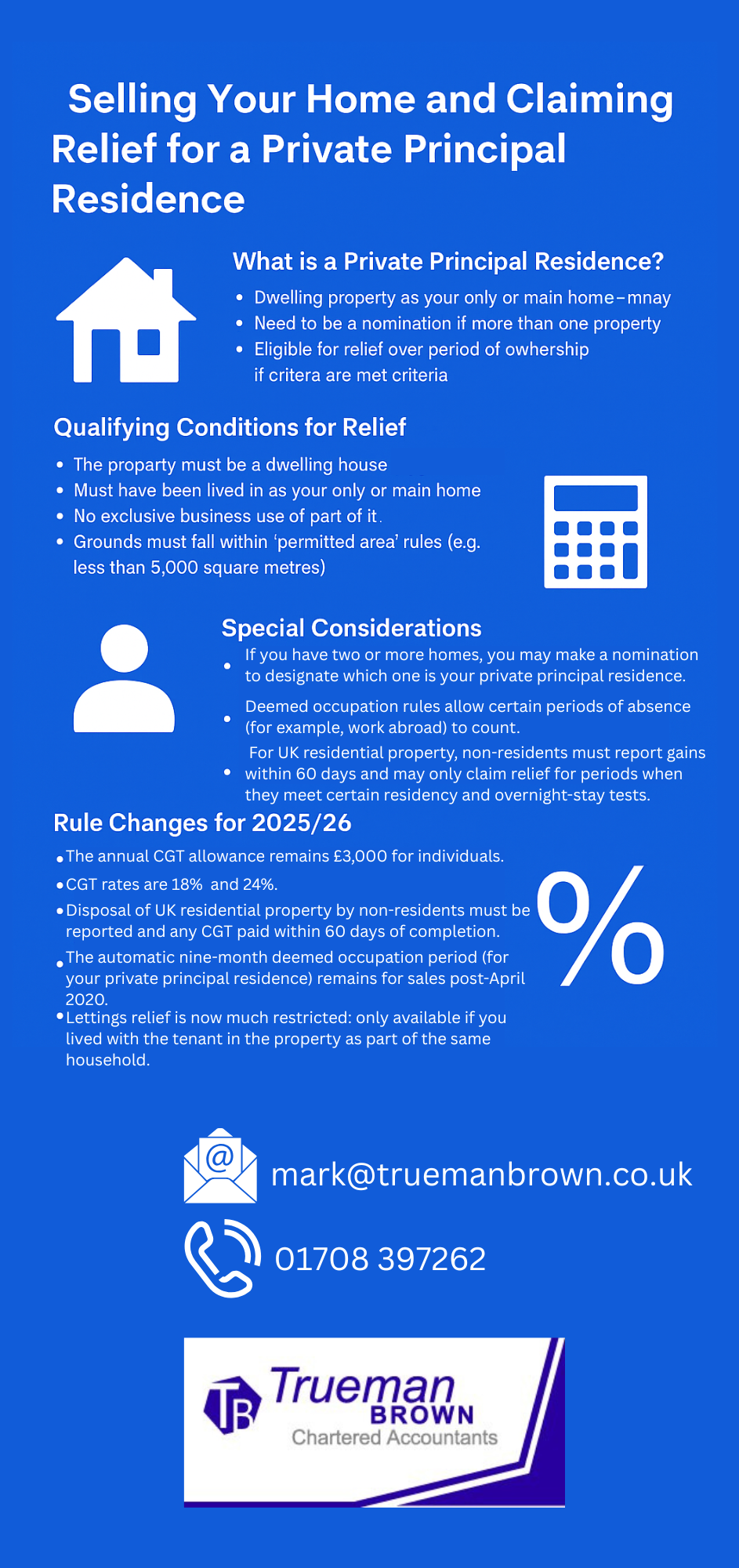
Qualifying Conditions for Relief on a Private Principal Residence
To benefit from relief for your private principal residence, you must satisfy several key conditions:
-
The property must be a dwelling house (or part of one) which you owned.
-
You must have lived in it as your only or main home.
-
There must not have been exclusive business use of part of it (though occasional home-working doesn’t automatically disqualify).
If you meet all of these, then gains on disposing of your private principal residence may be fully exempt from CGT.
How Relief is Calculated for a Private Principal Residence
When the property has been your private principal residence for the whole period of ownership, full relief is typically available. But if you did not live in it for the entire period, you may still get partial relief. The calculation is generally:
-
The portion of the gain attributable to the time you lived in it as your main home, plus
-
The last nine months of ownership (which are treated as deemed occupation) for UK disposals post-April 2020.
For example: if you owned a property for 10 years, and lived in it as your main home for 6 years, you could get relief for 6 years plus the last nine months, meaning relief for about 6.75 years out of 10.
Special Considerations: Nomination, Absences and Non-Residents
Nomination of your Private Principal Residence
If you have two or more homes, you may make a nomination to designate which one is your private principal residence.
The nomination must typically be made within two years of your change of residence status.
Absences from your Home
Even if you have been absent from your home for employment or other reasons, it may still count as your private principal residence for relief purposes.
Deemed occupation rules allow certain periods of absence (for example, work abroad) to count.
Non-UK Residents and Overseas Homes
From 6 April 2015, if you are non-resident or the property is overseas, special conditions apply for the relief on a private principal residence.
For UK residential property, non-residents must report gains within 60 days and may only claim relief for periods when they meet certain residency and overnight-stay tests.
Rule Changes for 2025/26 Relating to a Private Principal Residence
Here are key updates and reminders for the 2025/26 tax year when you’re dealing with your private principal residence:
-
The annual CGT allowance (the annual exempt amount) remains at just £3,000 for individuals.
-
For residential property disposals, CGT rates are 18% for basic-rate taxpayers and 24% for higher/additional-rate taxpayers.
-
Disposal of UK residential property by non-residents must be reported and any CGT paid within 60 days of completion.
-
The automatic nine-month deemed occupation period (for your private principal residence) remains for sales post-April 2020.
-
Lettings relief is now much restricted: only available if you lived with the tenant in the property as part of the same household. This affects the amount of relief if your “main home” was also let out.
Given these changes, the importance of treating a residence as your private principal residence, maintaining clear records of occupation, and acting sooner rather than later is heightened.
How Trueman Brown Can Help You with Your Private Principal Residence Planning
If you’re considering disposing of your private principal residence, or need advice on whether your property qualifies as such, our team at Trueman Brown can help.
We can assist you with:
-
Analysing your residence history and occupation records against relief-criteria
-
Optimising timing of sale or nomination of residence to maximise relief
-
Handling the CGT calculation, preparing the return, and ensuring compliance with the 60-day filing window (where relevant)
-
Advising on the partial relief scenarios (where you did not live in the property for the full period)
For help, contact us at mark@truemanbrown.co.uk or call 01708 397262.
FAQ – Private Principal Residence & CGT
Q1. What exactly counts as my “main home” for relief purposes?
Your “main home” or private principal residence is the house in which you live habitually, where your personal ties (family, utilities, electoral roll, mail) are strongest. Even if you move out temporarily, as long as you intend it to remain your main home, relief may apply.
Q2. If I let part of my home, does that lose all relief for my private principal residence?
Not necessarily. You will still have relief for the portion of the property you occupied as your main home, but you’ll need to apportion any gain to reflect the letting portion. Lettings relief is now very restricted.
Q3. If I build a new house on inherited land and live in it as my only home, can it still qualify as my private principal residence?
Yes – provided the building qualifies as a dwelling house, you occupy it as your main residence, and you meet the ownership/occupation tests. Recent tribunal decisions suggest the “period of ownership” may focus on the dwelling itself rather than the land.
Q4. How long do I need to live in the property to claim relief as my private principal residence?
There is no fixed minimum period of occupation, but HMRC and tribunals look for evidence of “living” in the property (sleeping, eating, leisure) and intention to treat it as your main home.
Q5. What happens if I’m non-resident and sell a property that was my UK main home?
If you are non-resident and sell UK residential property, you must report and pay any CGT within 60 days, and you can only claim relief for the periods you met the residence/stay criteria for the property to be your private principal residence.
Q6. Can I lose relief if I buy a home purely to make a gain?
Yes – if the purchase or expenditure indicates the property was acquired wholly or partly with the aim of realising a gain (rather than as a home), relief may be denied on that basis for your “private principal residence”.
Recent Comments