
Why business incorporation matters when you’re starting out
When you decide to launch a new venture, choosing the right approach is crucial—particularly when it comes to business incorporation.
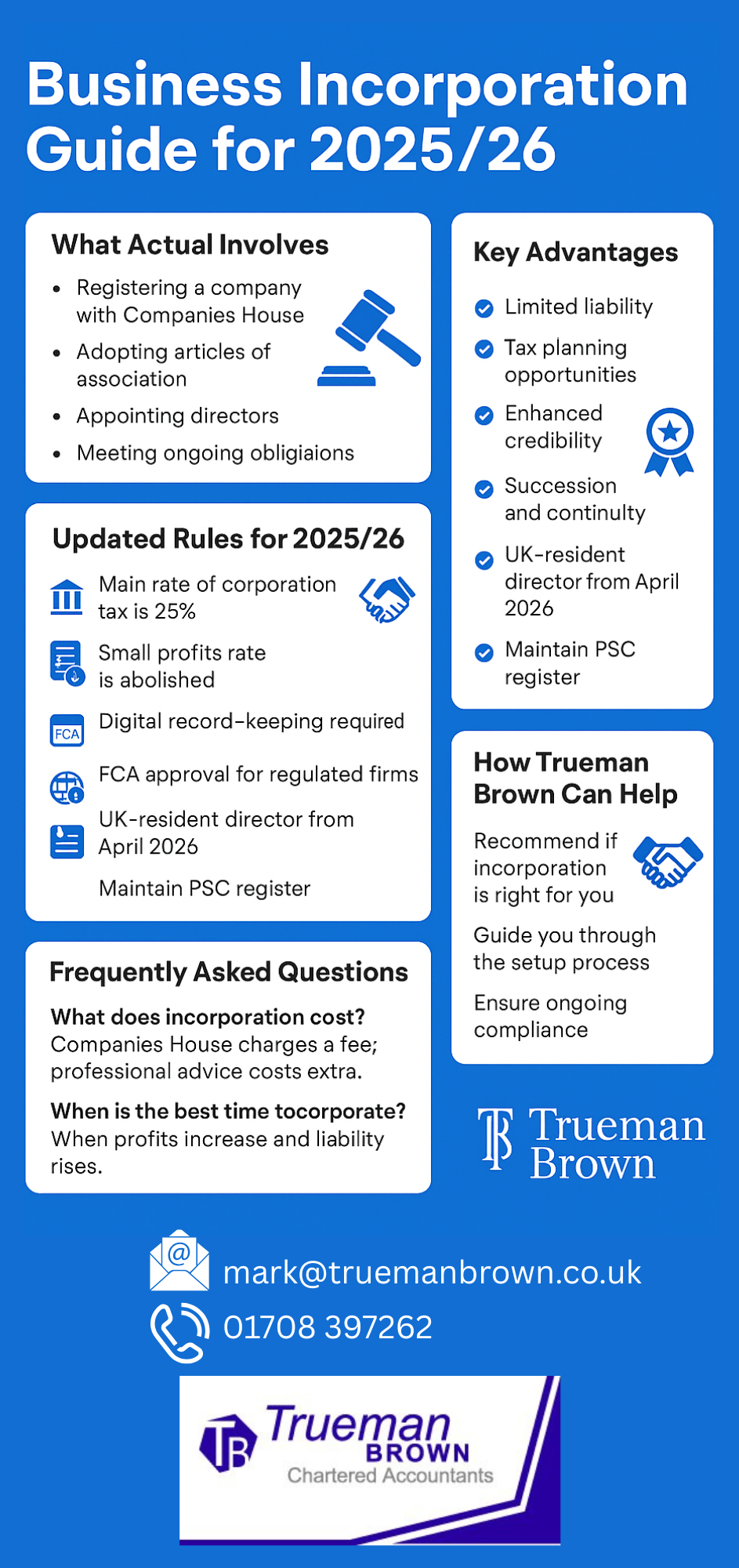
Making the leap from being a sole trader or partnership to a fully formed limited company brings benefits such as limited liability protection, tax planning opportunities and increased credibility.
With the rules for 2025/26 evolving, early consideration of business incorporation is more important than ever.
What business incorporation actually involves
The process of business incorporation means registering a legal entity (typically a private company limited by shares in the UK) with Companies House, adopting a set of articles of association, appointing directors, and meeting ongoing obligations (such as annual accounts and confirmation statements).
It sets your enterprise up as a distinct legal vehicle which can hold assets, enter contracts, and incur liabilities in its own name.
Key advantages of business incorporation
There are several reasons many founders opt for business incorporation:
-
Limited liability: In most cases, shareholders’ personal risk is limited to the amount unpaid on their shares.
-
Tax planning potential: With corporation tax, dividends, and pension contributions all in play, incorporation provides more flexibility.
-
Professional perception: Operating as a company often enhances credibility with banks, suppliers and customers.
-
Succession and continuity: A company structure makes it easier to transfer ownership or bring in investors.
-
Growth-ready structure: If you plan to scale, raise finance or trade internationally, a company typically fits better.
Understanding the updated rules for 2025/26 business incorporation
As we move through 2025/26 you should be aware of the following updates when considering business incorporation:
-
The main rate of corporation tax remains at 25% (for companies with profits over the upper limit) — previously companies with profits under £50,000 enjoyed a lower rate; so you’ll need to assess the full impact on after-tax profits.
-
The small profits rate (which had applied for companies with profits between £50,000 and £250,000) was abolished, meaning all profits are taxed at the main rate unless exemptions apply.
-
Reporting obligations remain rigorous: companies must still file annual accounts and a confirmation statement with Companies House, and new rules for digital record-keeping mean records must be kept in a digital form accessible by HMRC.
-
From April 2026, the requirement for all UK companies to appoint at least one director who is a UK resident will be fully enforced—so non-resident directors should consider implications when incorporating.
-
The Financial Conduct Authority (FCA) continues to require firms in regulated sectors to apply for authorisation; if your incorporated business will conduct regulated activities, you must secure authorisation before trading.
-
The beneficial ownership register (PSC register) must be maintained properly. When you set up for business incorporation, you must register “persons with significant control” and keep it updated.
When should you consider business incorporation?
Deciding when to do your business incorporation depends on several factors:
-
If your business is generating significant profit (after tax) and you’re paying higher personal tax rates, incorporation may deliver tax advantages.
-
If you want to separate business risk from personal assets (for example, if you are engaging in contracts that may incur liability) then the incorporated structure can help.
-
If you want to attract outside investors, grant share options, or eventually sell the business — these are all easier when you’ve already done your business incorporation.
-
If you’re moving from small-scale operations to a larger scale or hiring multiple staff, setting up the incorporated entity from the start can save complication later.
However, incorporation also brings extra compliance costs (audit may become necessary in some cases, increased admin, potential IR35 issues for contractor/director roles) — so consider these before committing.
Potential drawbacks and what to watch out for
Business incorporation isn’t the right choice in every scenario. Some points to weigh include:
-
More paperwork: you’ll need regular company filings, minutes of board meetings, maintaining statutory records, and possibly audit requirements depending on size.
-
Tax implications: If you plan to draw all profits as salary rather than dividends, you might lose advantage. Also, benefits-in-kind and director’s loans can complicate things.
-
Costs: Setting up the company, registering with Companies House, obtaining professional advice, and ongoing compliance (accountants, tax returns) all represent additional expenses compared to operating as a sole trader.
-
Losses: If your business is making a loss or very low margin, incorporation may not yet deliver benefit. Until you’re profit-generating it may be simpler to operate unincorporated.
-
Complexity of exit: When you want to close or sell, incorporated structures bring layers of tax (capital gains, disposal of shares) and legal formalities to manage.
How Trueman Brown can support your business incorporation journey
If you’re thinking about business incorporation — or already have and want expert support — the team at Trueman Brown are ready to assist.
We’ll help you evaluate whether business incorporation is the right move, guide you through registering with Companies House, set up your statutory records, prepare your company’s accounts for the 2025/26 tax year and beyond, and ensure ongoing compliance with the evolving rules.
For personalised advice, contact us at mark@truemanbrown.co.uk or call 01708 397262 today.
Let us help you take the stress out of business incorporation and focus on growing your venture.
Frequently Asked Questions (FAQ)
Q. What does business incorporation cost?
A. The standard online registration fee to Companies House is modest (currently around £12 for digital submission), but professional advice (legal, accounting) will increase costs — budget for setup plus ongoing compliance.
Q. When is the best time to incorporate?
A. Typically when profits are sufficient, or liability risk increases, or you’re planning growth/investment. However, some prefer to incorporate at inception to simplify later.
Q. Will I still get personal tax reliefs if I incorporate?
A. Yes, but how you extract profits changes — salary, dividends, pension contributions all play roles. Good advice is vital.
Q. Do I need a UK-resident director for business incorporation?
A. From April 2026, yes — at least one director must be resident in the UK. If you’re non-resident, plan ahead.
Q. Are there ongoing obligations after business incorporation?
A. Yes — annual accounts, confirmation statement with Companies House, corporation tax return, maintaining the PSC register, keeping digital records, and possibly audit depending on size.
Q. What happens if I choose not to incorporate?
A. You could continue as a sole trader or partnership, which offers fewer compliance obligations but also fewer protections (liability, tax flexibility) — so it’s a trade-off.
Recent Comments