
Reducing Self Assessment Payments on Account: What You Should Know
If you think your tax bill for the coming year will be lower than last year’s, reducing self assessment payments on account could help you ease cash-flow pressures.
Many taxpayers do not realise that if their income is falling — for example, due to a drop in business profits, fewer dividends, or winding down a side hustle — you can ask HMRC to lower your payments on account rather than overpaying.
In this post we explain how payments on account work, when you can apply to reduce them, what the risks are, and how you can go about making the request.
What are payments on account — and who pays them?
Under the UK self-assessment system, “payments on account” are advance payments towards your future income tax (and, if self-employed, Class 4 National Insurance contributions).
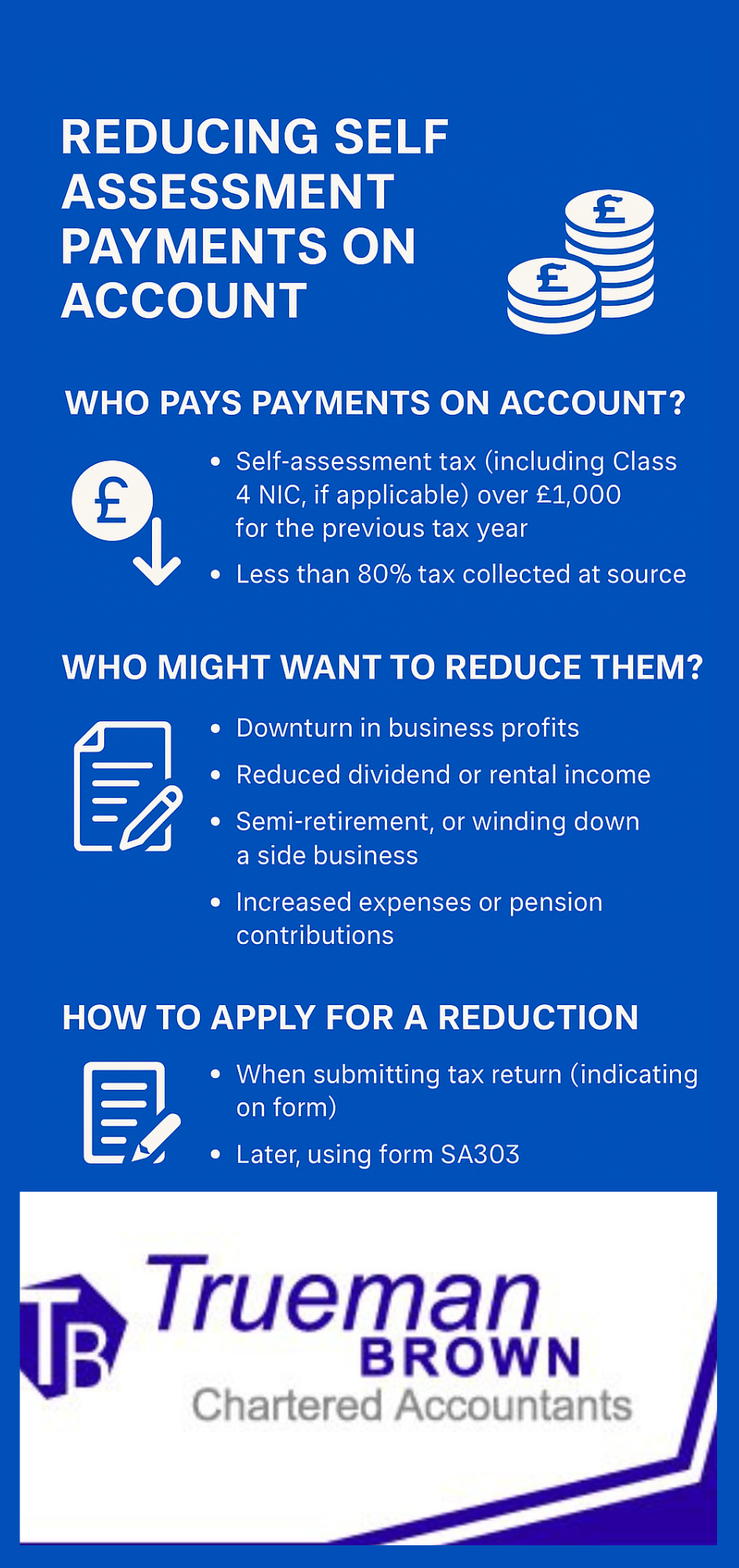
You will normally be asked to make payments on account if, for the previous tax year:
-
Your self-assessment tax bill (including Class 4 NIC if applicable) was more than £1,000; and
-
Less than 80% of your tax liability was collected at source (for example via PAYE).
Each “payment on account” is usually half of your previous year’s tax bill (income tax + Class 4 NIC).
When are payments on account due?
Payments on account are due in two instalments:
-
The first by 31 January (the same date as the balancing payment for the previous year).
-
The second by 31 July.
For the 2025/26 tax year (which ends on 5 April 2026) the deadlines remain the same — first payment 31 January 2026, second 31 July 2026.
When and why you might consider reducing self assessment payments on account
You may wish to consider reducing self assessment payments on account if you know — or reasonably expect — that your income (and hence your eventual tax bill) will be lower than the previous year’s. Common situations include:
-
A downturn in business profits (fewer clients, reduced trading activity)
-
Reduced dividend income or rental income
-
Retirement, stepping back from self-employment or winding down a side business
-
Increased expenses, pension contributions, or other reliefs reducing taxable profit
If you anticipate a significantly lower tax liability, reducing payments on account can help preserve cash now rather than overpaying and waiting for a refund after you file your return.
How to request a reduction (and key rules for 2025/26)
You can ask to reduce your payments on account at any time before the balancing payment date (usually 31 January of the following year).
There are two common ways to do this:
-
When you submit your self-assessment return, by indicating on the form (or in the additional information section) that you expect a lower bill.
-
Later — using form SA303 (online or paper) via your HMRC account.
When making the request, you need to provide a reasonable estimate of what your tax liability will be. If you estimate too low and your final liability ends up higher, HMRC will charge interest on the shortfall from the date the original payment was due.
2025/26 updates to note
-
The 2025/26 tax year still runs until 5 April 2026.
-
Deadlines remain 31 January and 31 July for payments on account.
-
HMRC urges customers to file early where possible — doing so may help you better estimate your liability and claim a reduction in good time.
As before, reducing payments on account should only be done if you are confident your income will be lower — otherwise the interest charges can add up.
Risks & Consequences — Don’t reduce too far
While reducing self assessment payments on account can ease short-term cash flow, there are dangers if you underestimate. The main risks:
-
If your actual tax liability turns out higher than your estimate, you’ll pay interest on any shortfall from the date the payment was due.
-
If the reduction is considered excessive, HMRC could reject the request or impose a penalty (eg interest + possible fine).
-
Over-reducing may leave you unexpectedly short of cash later when the balancing payment and next year’s first payment arrive.
Therefore it’s important to base your estimate on realistic assumptions — ideally supported by projections or actual income figures for the current year.
Example: How reducing payments on account works
Imagine your 2024/25 self-assessment tax + Class 4 NIC liability was £2,800. That triggers payments on account for 2025/26, so each instalment would be £1,400 by default.
However, you know trade has dipped, and you expect your 2025/26 liability to be nearer £2,200. By applying to reduce your payments on account, you could ask for each payment to be lowered to £1,100 — saving £300 each time.
If you get your estimate right, you’ll avoid overpaying and get better cash flow. If income picks up, you’ll simply pay a balancing amount (plus any applicable interest) after you submit your return.
How Trueman Brown can help with reducing self assessment payments on account
If you’re unsure whether or not you should be reducing self assessment payments on account, the team at Trueman Brown can help you review your income forecasts and submit a tailored application to HMRC.
Contact us via mark@truemanbrown.co.uk or call 01708 397262, and one of our qualified advisers will support you in:
-
Estimating your likely 2025/26 liability
-
Completing form SA303 (or the relevant section of your tax return) correctly
-
Ensuring any reduction is reasonable to minimise risk of interest or penalty
We aim to give you peace of mind — and better cash flow — if the coming year is looking quieter.
Frequently Asked Questions (FAQ) about reducing self assessment payments on account
Q: Who qualifies for payments on account?
A: Typically, self-employed individuals, business owners, landlords or others with untaxed income whose previous-year tax liability (including Class 4 NIC if self-employed) was over £1,000 — and who did not have at least 80% of their tax deducted at source (e.g. via PAYE).
Q: When are the payments on account due for 2025/26?
A: The first instalment is due by 31 January 2026, and the second by 31 July 2026.
Q: Can I ask to reduce payments on account?
A: Yes — if you reasonably expect your tax bill for 2025/26 to be lower than 2024/25. You can request a reduction either when filing your tax return, or at any time before the balancing payment is due, using form SA303.
Q: What happens if I reduce too much and end up owing more?
A: HMRC will charge interest on any shortfall from the payment due date until you settle the full tax. They may also refuse the request or impose a penalty if the reduction is considered excessive.
Q: Is it always worth reducing payments on account?
A: Not necessarily. If your estimates are uncertain (for example, you expect income to bounce back), reducing payments on account could lead to unexpected bills or interest later. It works best when you have reliable evidence that income will fall.
Recent Comments