
Why Self-Invested Pension Plans Could Be Worth Considering in 2025/26
Self-invested pension plans (often referred to as SIPPs) are a flexible UK pension option that gives you control of your retirement investments while still enjoying tax-relieved growth.
For many taxpayers and business owners, taking a more active role in how their pension pot is invested can deliver stronger long-term outcomes than traditional pensions — especially when combined with smart tax planning.
Recent changes in UK pensions policy — including the Autumn Budget 2025 — make it more important than ever to understand how self-invested pension plans work and how they could fit into your broader financial plan.
What Are Self-Invested Pension Plans?
Self-invested pension plans are a type of UK personal pension that let you decide exactly how your retirement savings are invested.
Unlike workplace pensions or standard personal pensions with limited investment choices, SIPPs allow you to hold a much wider range of assets — from stocks and bonds to commercial property, investment funds, and more (subject to HMRC investment rules).
Key characteristics include:
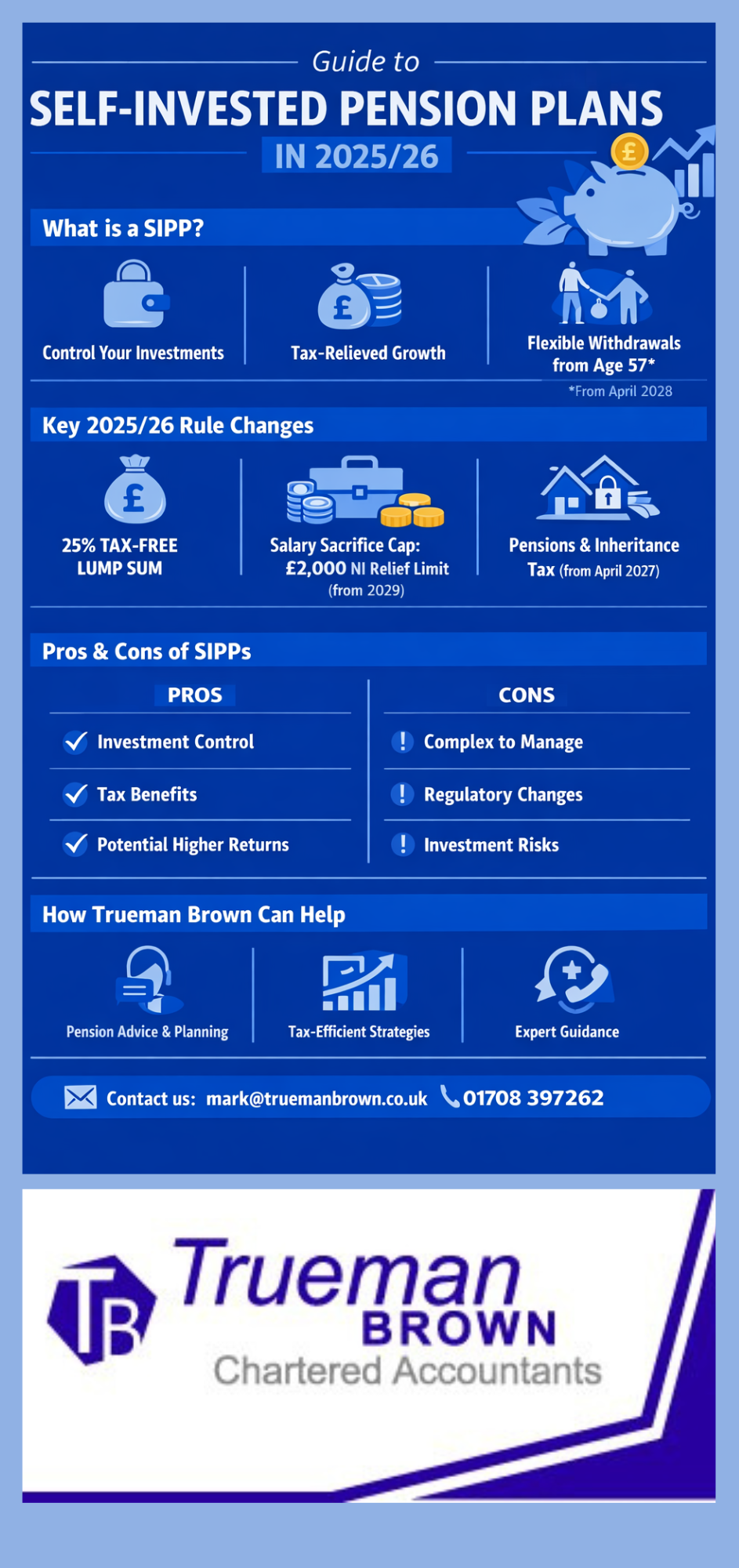
- Greater investment choice — you choose assets, subject to pension rules.
- Tax-relieved contributions up to annual limits.
- Tax-free growth within the pension (no capital gains or income tax).
- Control over withdrawals once you reach the minimum pension age (set to 57 from April 2028).
How Contributions Work in Self-Invested Pension Plans
The government allows you to contribute up to £60,000 per tax year into registered pension schemes, including SIPPs, with tax relief on contributions up to 100% of your earnings or £3,600 (whichever is higher).
Tax relief basics
-
Basic-rate taxpayers receive 20% tax relief automatically.
-
Higher and additional-rate taxpayers can claim extra relief via Self Assessment.
It’s still important to stay within the annual allowance to avoid tax charges, and unused allowance can be carried forward for three years in most circumstances.
Investment Freedom With Self-Invested Pension Plans
One of the biggest selling points of self-invested pension plans is investment flexibility. With a SIPP you can hold:
-
Shares and ETFs
-
Unit trusts and investment funds
-
Commercial property and land (subject to strict HMRC rules)
-
Cash and corporate bonds
All this flexibility allows you to align your pension with your investment strategy — though it also means you need appropriate expertise or advice to avoid costly mistakes.
Important rules: HMRC imposes restrictions on residential property and transactions with connected parties, so professional guidance is essential.
Key 2025/26 Self-Invested Pension Plans Rule Changes
Pension Tax Relief and Allowances
-
There were no fundamental changes to pension tax relief or the annual allowance in the Autumn Budget 2025 — meaning tax relief and contribution limits remain broadly the same for 2025/26.
Tax-Free Lump Sum
-
You can still take 25% of your pension tax-free from the eligible age (currently age 55, rising to age 57 by April 2028).
Salary Sacrifice Changes
-
New rules mean from April 2029, only the first £2,000 of pension contributions via salary sacrifice will receive full National Insurance relief — which could affect how employees and employers structure pension contributions.
Inheritance Tax Changes
-
From 6 April 2027, unused pension funds are likely to be included in inheritance tax calculations, removing the longstanding IHT exemption on pensions — which may impact estate planning for SIPPs.
With these shifts on the horizon, getting independent advice on self-invested pension plans has never been more valuable.
Pros and Cons of Self-Invested Pension Plans
Pros
-
Investment control and choice — tailored to your objectives.
-
Tax advantages — relief on contributions and tax-free growth.
-
Potentially higher long-term returns if well managed.
Cons
-
Complexity — requires informed decision-making or professional support.
-
Regulatory changes (like IHT inclusion) may affect long-term planning.
-
Investment risk — you bear the risk of your chosen assets.
How Trueman Brown Can Help With Self-Invested Pension Plans
If you’re considering self-invested pension plans as part of your retirement strategy, Trueman Brown can support you at every stage.
💡 What we offer:
-
In-depth analysis of your current pension arrangements
-
Advice on SIPP suitability for your goals
-
Structuring contributions tax-efficiently
-
Helping you understand the impact of the latest rules
-
Liaising with pension providers and trustees for smooth set-up
📧 Contact us: mark@truemanbrown.co.uk
📞 Phone: 01708 397262
With expert guidance, you’ll make informed decisions and ensure your pension planning is aligned with both current rules and your long-term financial goals.
Frequently Asked Questions About Self-Invested Pension Plans
1. What exactly are self-invested pension plans?
They are UK pension schemes that give you control over investment choices, subject to HMRC rules, offering more flexibility than standard personal or workplace pensions.
2. Can I take money out of a SIPP before retirement?
No — like all UK pensions, you generally can only access funds once you reach the minimum pension age (increasing to 57 in 2028).
3. Do SIPPs offer better tax relief?
Tax relief on contributions is broadly the same as other pensions, but SIPPs’ investment freedom can enhance overall tax-efficient growth.
4. What about inheritance tax?
From April 2027, unused pension funds — including SIPPs — may be included in inheritance tax calculations.
5. Do I need advice to set up a SIPP?
Given the complexity and investment choices involved, professional advice from a firm like Trueman Brown is highly recommended.
Recent Comments