
Local Accountants and tax advisers, Trueman Brown, warn that smaller businesses are still having problems getting paid by larger companies.
Most small businesses know the feeling – they perform their duties for larger companies and then have to wait to be paid.
The small company could use legal remedies against the debtor but are wary of doing so because of the fear of losing the customer.
INITIATIVES
Various Governments have tried to regulate in this area without much success.
The latest initiative is the Prompt Payment Code (PPC). This is a voluntary commitment, by larger businesses and public bodies, to giving fair and equal treatment of payments between owners and suppliers. So far, more than 1,800 large businesses and public organisations have become signatories to the code.
The Code promotes 30-day payment terms as standard with 60 days allowed as an absolute maximum.
In March 2015, the Government confirmed that signatories to the code would have their names removed if they did not pay their suppliers within a reasonable amount of time. Challenges made against Code Signatories would be investigated and decided upon by a Code Compliance Board. The Board would be made up of members from various business representative bodies.
Despite all of the recent initiatives, a recent survey by the insurance firm, Zurich, stated that small businesses are still owed a massive £255 billion in late payments.
New Measures
Further moves have been made. From 6th April 2017 onwards, all large businesses, whether members of the PPC or not, will have to report on their payment practices annually.
Now, a letter has been sent to PPC signatories including measures that paying invoices within 30 days should become the standard and that payment within 60 days will be a requirement unless there are exceptional circumstances considered on a case-by-case basis.
In our opinion, these measures are not really that helpful!
Only a relatively small number of large companies are members of the PPC. Any sanctions against them are reliant on smaller suppliers informing the PPC of payment delays. There is nothing to stop the PPC Member breaking its trading relationship with the informing supplier.
So, what should business do to ensure that their debts are recovered?
It is vital that a supplier contract, with clearly drafted payment terms, is drafted and agreed with the customer in advance. Get it right at the outset.
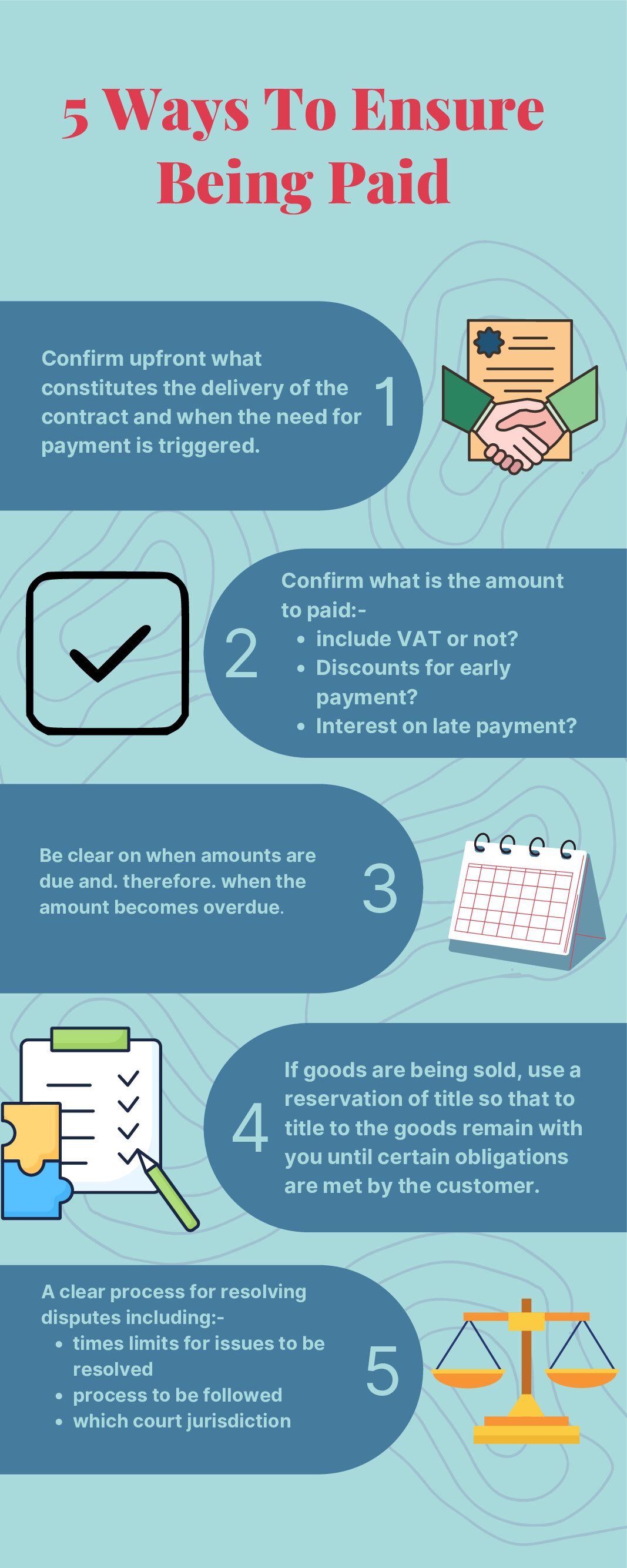
So here are five terms to need to be used in the contract to ensure your business gets paid in a timely basis.
1. A clear definition of what constitutes delivery and triggers the need for a payment on the customer side
The contact should make very clear when the good or service has been delivered and what evidence is required. If the service is: –
- performance based, then how is the performance to be measured and evidenced.
- physical based, then is delivery of goods to be evidenced by a signed delivery note.
2. The amount to be paid, delivery having occurred
The contract should ensure that the following questions are answered: –
- Is the full value to be paid in one payment.
- Are there multiple events, how each event should be defined and agreed.
- Will the amount be VAT inclusive or exclusive.
- Will there be a discount for early payment.
3. The due date for payment
Be clear on when amounts are due and therefore when they become overdue.
4. Retention of title
If you are providing goods, then you should consider inserting a Retention of Title (or Romalpa) clause into the contract.
That is a provision in a contract providing that the title to the goods remains with the seller until certain obligations have been fulfilled by the buyer.
5. A clear process for resolving any disputes
The contract should include: –
- Including time limits for issues to be raised.
- The process to be followed, if arbitration is required.
- The court of jurisdiction in which any actions would be heard.
Local accountants and tax advisers, Trueman Brown, specialise in dealing with small businesses. If you live nearby and require assistance, then please contact us.
Recent Comments