
Making Sense of Unused Residential Finance Costs for Landlords in 2025/26
If you’re a landlord, understanding how unused residential finance costs work is essential for minimising your tax bill and making the most of the relief available under current UK tax rules.
In the 2025/26 tax year, restrictions on residential finance costs remain largely in place, including how unused finance costs are carried forward and utilised against future property profits.
What Are Unused Residential Finance Costs?
Unused residential finance costs arise when, under UK tax law, the amount of finance costs you can claim in a tax year is limited — most commonly because relief on residential mortgage interest and other qualifying costs is restricted to a basic-rate tax reduction rather than a full deduction against rental profits.
For individual landlords of residential properties, the tax deduction for mortgage interest and related finance costs no longer reduces taxable profit directly.
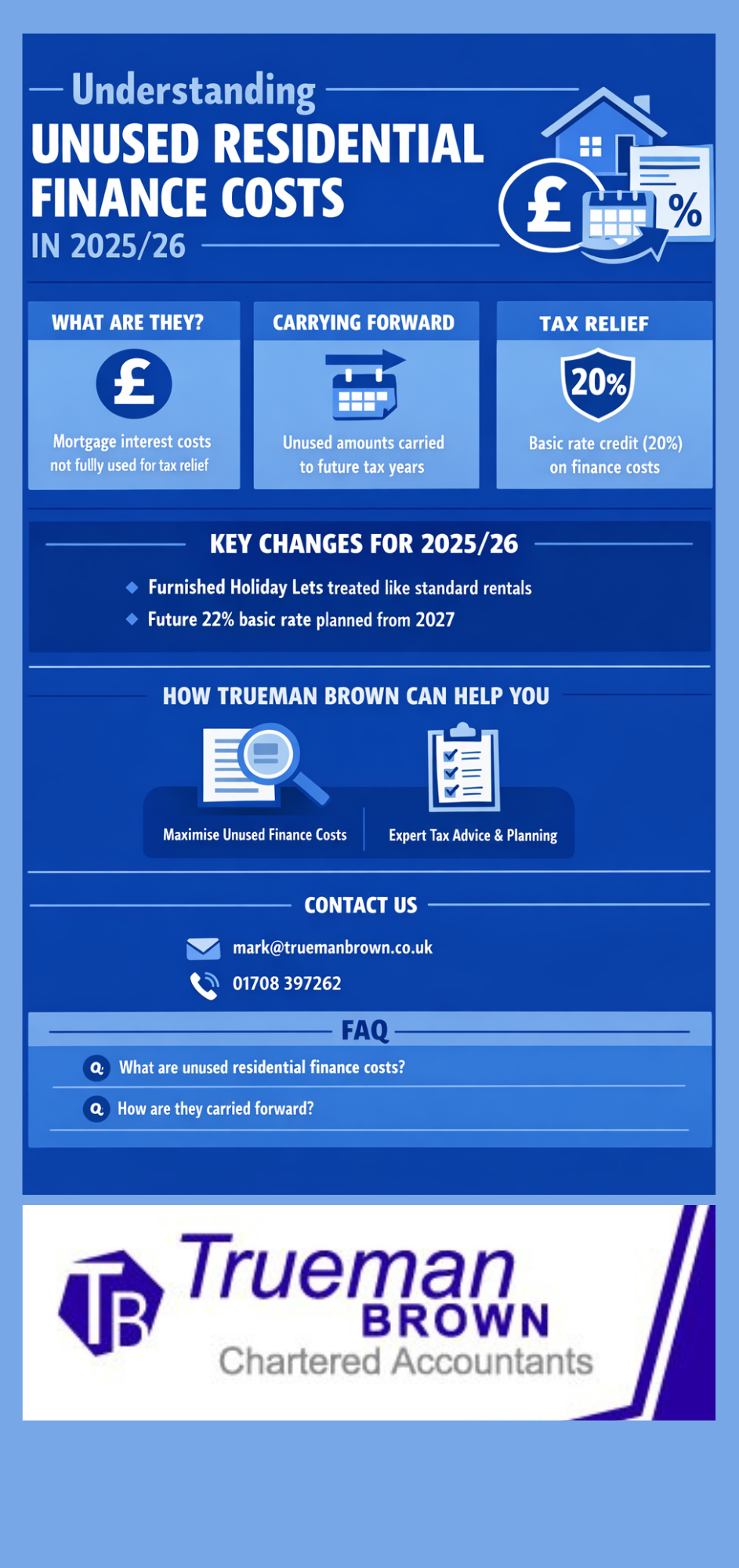
Instead, a basic rate tax credit (20% for the 2025/26 year) is applied to qualifying costs, and any unused residential finance costs not relieved in the current year can be carried forward.
How the Rules Affect Your Taxable Rental Profits
Under current UK rules, residential property finance costs are restricted to basic-rate relief when computing your rental income tax.
This means that:
-
You pay tax on your full rental income before finance costs are taken into account.
-
You then receive a basic-rate tax reduction of 20% (a credit) for qualifying finance costs — including interest on buy-to-let mortgages and other borrowing costs.
If your available finance costs exceed what you can relieve in the current tax year, the excess becomes unused residential finance costs. These unused amounts can be carried forward to be used in later years when they can help reduce future tax liabilities.
When Unused Residential Finance Costs Arise
Unused residential finance costs typically occur when:
-
Your allowable finance costs exceed your property profits after applying restrictions; or
-
Your total adjusted income limits the amount of basic-rate relief available.
In these cases, the portion of interest and similar costs that can’t be relieved in the current year becomes unused residential finance costs and is carried forward.
Rules for Carrying Forward Unused Residential Finance Costs
The way you carry forward unused residential finance costs has specific HMRC rules:
-
Unused amounts must be declared on your tax return (e.g., Box 45 of the UK property pages).
-
They are carried forward and added to the finance costs of the following year.
-
The tax reduction for future years calculates relief first using current year costs and then brought-forward amounts.
Because the relief is a basic-rate tax credit, you cannot use unused finance costs to create a tax refund, only to reduce future tax liabilities.
Practical Example: Using Unused Residential Finance Costs
Suppose in Tax Year 2025/26:
-
Your rental profits (after allowable expenses) are modest, and
-
Your total finance costs (including interest) are higher.
You may find that not all of your residential finance costs are relieved as basic-rate tax credits in that year.
The difference becomes unused residential finance costs, which you can carry forward and apply against future profits — helping to reduce future tax bills.
Key Changes for 2025/26 to Be Aware Of
While the general restriction on residential finance costs continues, a few important developments for the 2025/26 tax year include:
-
The basic rate tax credit remains the core relief mechanism for residential finance costs.
-
From 6 April 2025, Furnished Holiday Lets (FHLs) are treated more like standard residential lets for tax relief on finance costs, removing prior special deductions and aligning them with residential tax credit treatment — potentially increasing the amount of unused residential finance costs that arise.
-
Looking ahead, planned changes from 2027 (separate property income tax rates, including separate basic rate at 22%) will affect how property income and finance cost relief is calculated, though the principle of carrying forward unused residential finance costs continues under these evolving rules.
How Trueman Brown Can Help with Your Unused Residential Finance Costs
Understanding and making the most of unused residential finance costs can be complex — especially under the updated 2025/26 tax regime. At Trueman Brown, we specialise in supporting landlords to:
-
Analyse your rental profits and finance cost position
-
Maximise the use of unused residential finance costs carried forward
-
Prepare accurate Self Assessment returns that properly reflect carried-forward amounts
-
Plan proactively for upcoming changes to property tax rules
📧 Email: mark@truemanbrown.co.uk
📞 Phone: 01708 397262
If you’re unsure how the latest rules affect you, or need help navigating complex finance cost reliefs, get in touch. We can provide tailored advice to help make tax-efficient decisions for your property business.
Frequently Asked Questions (FAQ)
Q: What exactly are unused residential finance costs?
A: These are the portion of residential property finance costs (like mortgage interest) that you couldn’t relieve in a given tax year because relief is limited to a basic-rate tax credit — and that amount can be carried forward for future relief.
Q: Can I get a refund from unused residential finance costs?
A: No — unused amounts carried forward can only reduce future tax liability; they don’t result in a refund for past years.
Q: How do I claim unused residential finance costs
A: You must report them on your UK property pages of the Self Assessment tax return — typically via the designated box for carried-forward finance costs.
Q: Do these rules apply to company landlords?
A: No — if your property is owned through a company, full deduction of finance costs usually remains available under corporation tax rules, and the basic-rate restriction doesn’t apply in the same way.
Q: Will future changes affect unused residential finance costs?
A: Yes — the introduction of separate property income tax rates (e.g., a 22% basic rate from April 2027) and evolving tax legislation may affect how relief is computed and carried forward, so planning ahead is important.
Recent Comments