
SDLT implications on transferring property to spouse: What you need to know
Transferring property into joint names or from one spouse to another can raise important tax considerations—especially when it comes to the (SDLT) implications on transferring property to spouse.
In this article we explain how SDLT may apply when you transfer property to your spouse or civil partner, highlight key rule-changes coming into effect for the 2025/26 tax year, and show how we at Trueman Brown can help you navigate the process.
When do SDLT implications on transferring property to spouse arise?
If you transfer an interest in a property to your spouse (or civil partner) then the question of SDLT arises if there is consideration in the transaction.
By “consideration”, HMRC means anything of monetary value given in exchange for the transfer, which may include:
-
A cash payment from the spouse receiving the interest.
-
The assumption by the transferee spouse of an existing mortgage or debt attached to the property.
Even though marital transfers are commonplace and may feel very straightforward, the fact is that there is no automatic relief simply because the parties are married or civil partners.
-
one typical scenario: you own a property, you decide to add your spouse to the title (or transfer wholly to them) perhaps to plan for tax, estate or asset protection purposes. At that point, you must check whether SDLT is triggered, what rate applies, and whether higher-rate or additional property surcharges apply.
Understanding the key features of SDLT implications on transferring property to spouse
Here are the main points to check:
-
Chargeable consideration includes mortgages: If the transferee spouse takes on an existing mortgage or part of it, that count as consideration. For example, if someone transfers a share and their spouse becomes liable for part of the outstanding debt, that amount forms part of the “price” for SDLT.
-
Thresholds matter: SDLT is only payable if the chargeable consideration exceeds the applicable nil-rate threshold. From 1 April 2025 the nil-rate threshold for a standard residential purchase (and many transfers) is £125,000.
-
Higher/additional rates for additional properties: If the transferee spouse will own more than one residential property, the higher-rate surcharge may apply—though transfers between spouses living together are generally disregarded for the purposes of the higher-rate surcharge.
-
Return still required even if nil tax: Even if no SDLT is payable (because consideration is below the threshold), you may still need to submit an SDLT return to HMRC and register the change.
-
Divorce/separation exception: Transfers as part of a formal divorce settlement or separation are exempt from SDLT.
In short: the SDLT implications on transferring property to spouse are real and tangible, and you must take professional advice to check all aspects
What’s changed for 2025/26 – updated rules you must know
With the new tax year, the rules around SDLT have been adjusted and it’s crucial to factor these into any decision to transfer property. Key updates include:
-
From 1 April 2025 the nil-rate threshold for most residential property is back to £125,000 (from the higher temporary level of £250,000).
-
For first-time buyers only, a nil-rate threshold of £300,000 applies, and 5% on the portion from £300,001 to £500,000; beyond £500,000 the standard rates apply.
-
For additional residential properties (or where the transferee spouse already owns property), the surcharge regime changed: up to £125,000 is at the base additional rate, £125,001-£250,000 at higher rate, etc.
-
Deadlines: An SDLT return and payment must be made within 14 days of the effective date of the transaction (usually completion) even in a transfer‐situation.
-
The changes reiterate that the “consideration” basis remains central. Transferring property to spouse before incurring significant debt or mortgage assumption may reduce the risk of exceeding thresholds.
Because of these changes, any transfer you undertake now or later in 2025/26 must be planned with the updated bands and thresholds in mind.
Practical steps – how to minimise risk when dealing with SDLT implications on transferring property to spouse
When you are considering transferring property to your spouse, here are some practical steps to reduce the risk of unexpected SDLT:
-
Assess the chargeable consideration: Identify cash paid, mortgage debt assumed, any other liabilities.
-
Check the thresholds: Use the new thresholds (nil-rate £125k for many transfers) to see if SDLT will be triggered.
-
Consider timing: If reducing mortgage debt (or paying off part) before the transfer will reduce the consideration and maybe keep it below the nil-rate band, that may help.
-
Ensure the higher-rate surcharge rule is understood: Transfers between spouses living together generally avoid the surcharge, but if other ownership interests are involved (e.g., business partner, third party) the surcharge may apply.
-
Submit a return even if nil tax: If you transfer a share and consideration is below threshold, you still need to notify HMRC via an SDLT return.
-
Review overall tax impacts: In addition to SDLT, consider other potential tax consequences (e.g., capital gains tax, inheritance tax) – though transfers between spouses may benefit from reliefs there.
-
Architecture of ownership: Decide whether full transfer or adding spouse as joint owner is most appropriate depending on your goals (asset protection, estate planning, tax planning).
By taking these steps you can manage the SDLT implications on transferring property to spouse in a controlled way.
How Trueman Brown can help with SDLT implications on transferring property to spouse
If you’re planning a property transfer to your spouse and want to be confident you’ve covered the SDLT implications on transferring property to spouse, we at Trueman Brown can assist.
We offer tailored advice around property transfers, ownership structure, tax implications and compliance.
To speak to our team please reach out to Mark at mark@truemanbrown.co.uk or call 01708 397262.
We’ll walk through:
-
The calculation of chargeable consideration in your specific scenario.
-
Identifying whether the transfer will exceed the nil-rate threshold or trigger the higher-rate surcharge.
-
Preparing the correct documentation (e.g., Transfer of Equity, TR1 form, SDLT return) and liaising with your conveyancer or legal team.
-
Ensuring the timing and structure of any transfer takes account of the 2025/26 SDLT changes.
-
Coordinating with your accountant or tax advisor to align with overall tax planning (CGT, IHT, etc.).
With our involvement you can proceed with your property plan knowing you’ve addressed the SDLT implications on transferring property to spouse appropriately.
FAQ – Your questions answered
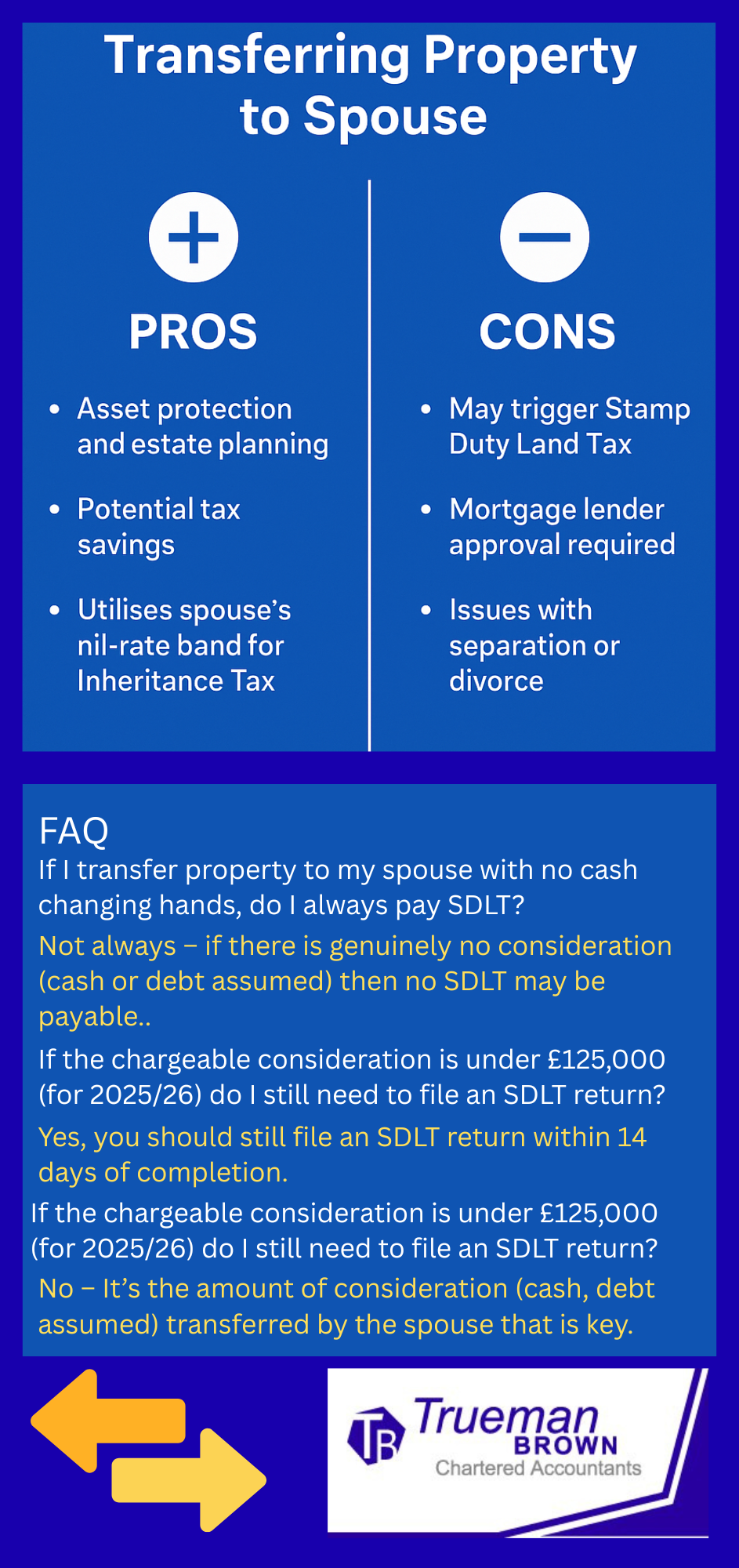
Q1: If I transfer property to my spouse with no cash changing hands, do I always pay SDLT?
Not always – if there is genuinely no consideration (cash or debt assumed) then no SDLT may be payable. However if your spouse takes on a mortgage or debt, then that constitutes consideration and SDLT may be payable.
Q2: Does the fact that we’re married mean the higher-rate SDLT surcharge on additional properties doesn’t apply?
Generally yes: transfers between spouses or civil partners who live together are disregarded for the higher-rate surcharge for additional dwellings. But you must ensure no other person acquires an interest and the transferee spouse isn’t counted as acquiring a property outside that rule.
Q3: If the chargeable consideration is under £125,000 (for 2025/26) do I still need to file an SDLT return?
Yes, you should still file an SDLT return within 14 days of completion even if no tax is payable, to ensure HMRC’s records are correct and to preserve a clear record.
Q4: Does the property value itself determine SDLT in a spouse transfer?
No – it’s not the full market value of the property that matters (unless the transaction is between unconnected parties). It’s the amount of consideration (cash, debt assumed) transferred by the spouse that is key.
Q5: What if the transfer occurs as part of a divorce agreement or court order?
If the transfer is made pursuant to a formal divorce order, dissolution of civil partnership or legal separation then SDLT is generally exempt.
Q6: Are there any other taxes I should consider when transferring property to spouse?
Yes – while SDLT is key, you should also consider:
-
Capital Gains Tax (CGT) – transfers between spouses are usually no gain/no loss but future sale may trigger CGT.
-
Inheritance Tax (IHT) – transfers between spouses are generally exempt for IHT, but changing the beneficial ownership may affect your estate planning.
-
Mortgage lender issues – the lender must approve any change in ownership or borrower liability.
If you’d like to discuss your specific situation or get a tailored estimate of potential SDLT on your planned transfer, please contact us at mark@truemanbrown.co.uk or call 01708 397262.
Recent Comments