
How to Use Spouse’s Losses to Reduce CGT: A Guide for Couples
When you own assets jointly or individually, you may be able to use spouse’s losses to reduce CGT by carrying out a spouse CGT loss transfer — transferring part or all of an asset to your spouse before disposal, to take advantage of any unused losses or allowances.
What the Rules Say in 2025/26
-
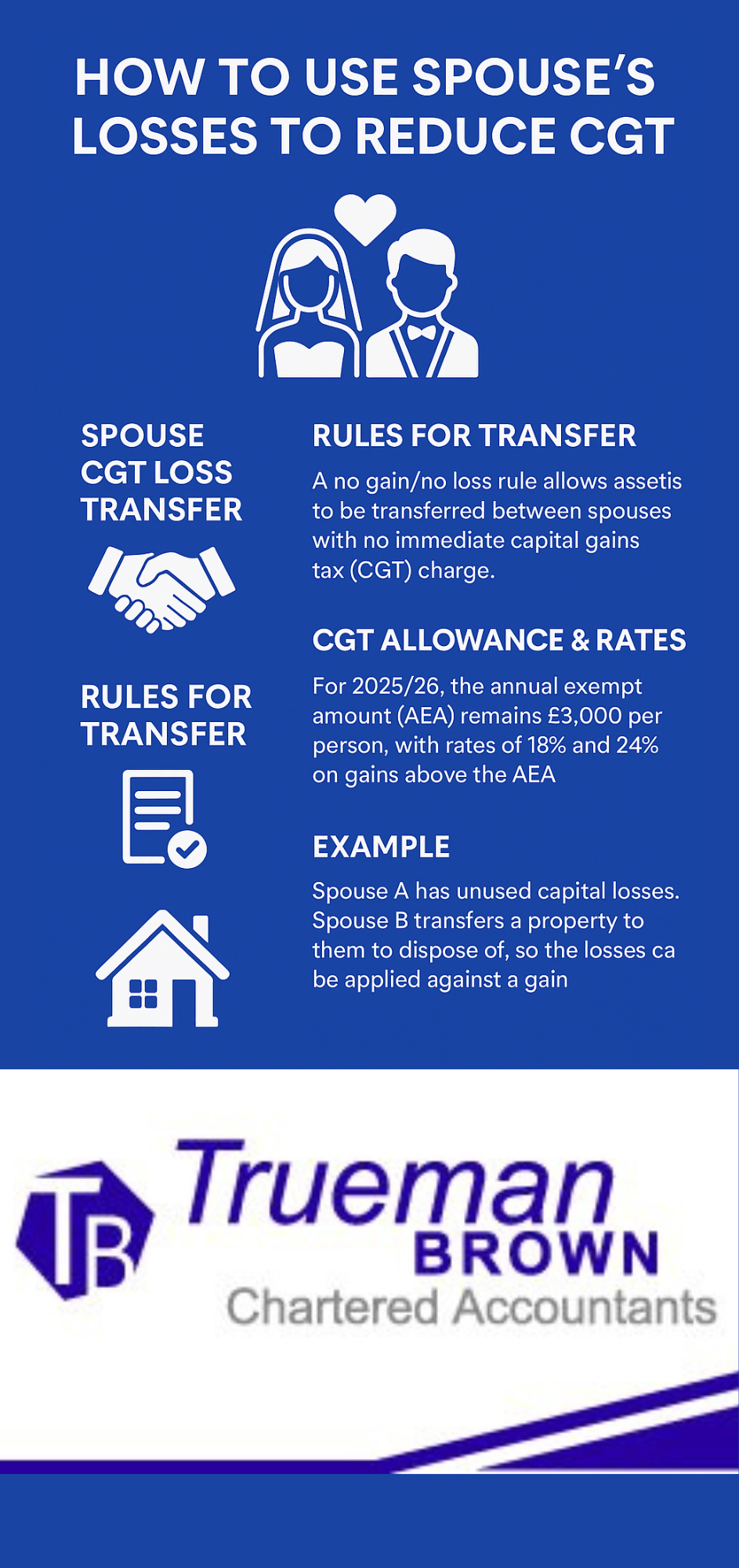
Under current UK tax law, spouses or civil partners living together can transfer assets between them on a no gain/no loss basis.
-
For the tax year 2025/26, the annual exempt amount (AEA) for CGT remains at £3,000 per person.
-
CGT rates for disposals remain at 18% for basic-rate taxpayers and 24% for higher-rate taxpayers for gains above the AEA.
-
If one spouse has carried forward unused capital losses from previous years, a “spouse CGT loss transfer” strategy may allow those losses to reduce gains more effectively, provided the asset is transferred to that spouse before disposal.
Why Use Spouse’s Losses to Reduce CGT?
Each individual can use their own CGT allowance and losses — so transferring assets to the spouse who has unused losses or a lower income rate can save tax overall.
This gives couples more flexibility to manage CGT liability, particularly where one spouse has substantial carried-forward losses.
Splitting gains between spouses via a proper transfer can effectively make use of both allowances and any losses, reducing the total CGT bill compared with one spouse disposing alone.
When a Spouse CGT Loss Transfer Works — Example
Suppose:
-
Spouse A has unused capital losses from prior disposals;
-
Spouse B owns an asset that is about to be sold at a gain.
By transferring the asset (or part of it) to Spouse A on a no gain/no loss basis, the base cost transfers too. When Spouse A sells, they apply their losses (and their AEA) to the gain — reducing the taxable profit.
This is exactly the idea behind using spouse’s losses to reduce CGT: although losses can’t be directly “passed,” the asset transfer allows the spouse with losses to benefit. That is the essence of a spouse CGT loss transfer.
What’s Changed (or Continued) for 2025/26
-
The AEA remains at £3,000 — so couples might double up to £6,000 between them if both allowances are used.
-
The “no gain/no loss” transfer rule between spouses continues unchanged.
-
The CGT rates remain 18% / 24% for basic- and higher-rate taxpayers respectively when gains exceed the AEA.
-
For separating or divorcing couples: transfers remain no-gain/no-loss if made within the allowed “window” — usually up to three tax years after separation (or indefinitely if under a formal divorce agreement).
When the Strategy Doesn’t Work
-
You can’t directly assign capital losses to your spouse — you must transfer the asset (or part of it) under the no gain/no loss rule, then have your spouse dispose of it.
-
If you’re separated or divorced and transfer outside the permitted window (or outside a formal agreement), the transfer may be treated as a disposal — triggering CGT.
-
If the asset is your main home and you rely on main-residence relief, other special rules may apply — transferring incorrectly could distort your relief entitlement.
How Trueman Brown Can Help You Use Spouse’s Losses To Reduce CGT
At Trueman Brown, we specialise in helping couples and individuals structure asset disposals to legally use spouse’s losses to reduce CGT.
Our team can advise whether a spouse CGT loss transfer makes sense in your circumstances, and help you:
-
Review your history of capital gains and losses;
-
Identify which spouse should hold the asset pre-sale;
-
Complete any required paperwork correctly;
-
Timing disposals to maximise use of allowances and losses.
If you’d like a tailored review or help with planning, please contact us at mark@truemanbrown.co.uk or call 01708 397262.
We’d be happy to talk you through your options.
FAQ – Use Spouse’s Losses To Reduce CGT
Q: Can I simply give my losses to my spouse?
A: No. You cannot directly transfer or gift capital losses. Instead, you transfer the asset (or a share of it) to your spouse under the no gain/no loss rule; then your spouse sells and uses the losses. That is effectively a spouse CGT loss transfer.
Q: What if we’re separating or divorcing — does the rule still apply?
A: Yes — but only if the transfer is made within the permitted time window (up to three tax years after the end of the tax year you separated) or as part of a formal court-approved divorce agreement. Outside that, the transfer may trigger an immediate CGT disposal.
Q: What’s the CGT allowance and rates for 2025/26?
A: For 2025/26, each person’s CGT annual exempt amount is £3,000. Gains above that are taxed at 18% for basic-rate taxpayers and 24% for higher-rate taxpayers.
Q: Does transferring part of a property — e.g. 50% — work to reduce CGT?
A: Yes — provided the transfer is done on a no gain/no loss basis. The receiving spouse inherits the original base cost for their share. On sale, each spouse’s gain is calculated separately; losses or allowances are applied to each share accordingly.
Q: Are there risks with this strategy?
A: The main risks are getting the timing or documentation wrong — e.g. transferring after separation beyond the allowed window, or not completing a proper no gain/no loss transfer. Also, if the receiving spouse later has higher income or tax rate, the benefit may be less. That’s why professional advice (such as from Trueman Brown) is often essential.
Recent Comments