
Making use of the property allowance
It is possible to enjoy tax-free income from property via the property allowance, even if you have already used up your personal allowance.
The property allowance allows you to receive annual gross property income of up to £1,000 without needing to tell HM Revenue & Customs about it (provided certain conditions apply).
If your gross rental income is more than £1,000, you may still benefit from the property allowance by deducting it when calculating taxable profits.
What the property allowance means in 2025/26
For the tax year beginning 6 April 2025 (2025/26) the property allowance remains at £1,000.
This means:
-
If your total gross property income (before expenses) is £1,000 or less, you will not be required to declare it to HMRC and it will be fully exempt via the property allowance.
-
If your gross property income is more than £1,000, you can make a choice: either deduct the £1,000 property allowance or compute profits in the normal way by deducting actual allowable expenses.
-
If you opt for the property allowance (i.e., the deduction), you cannot also claim actual expenses for that property income for that tax year.
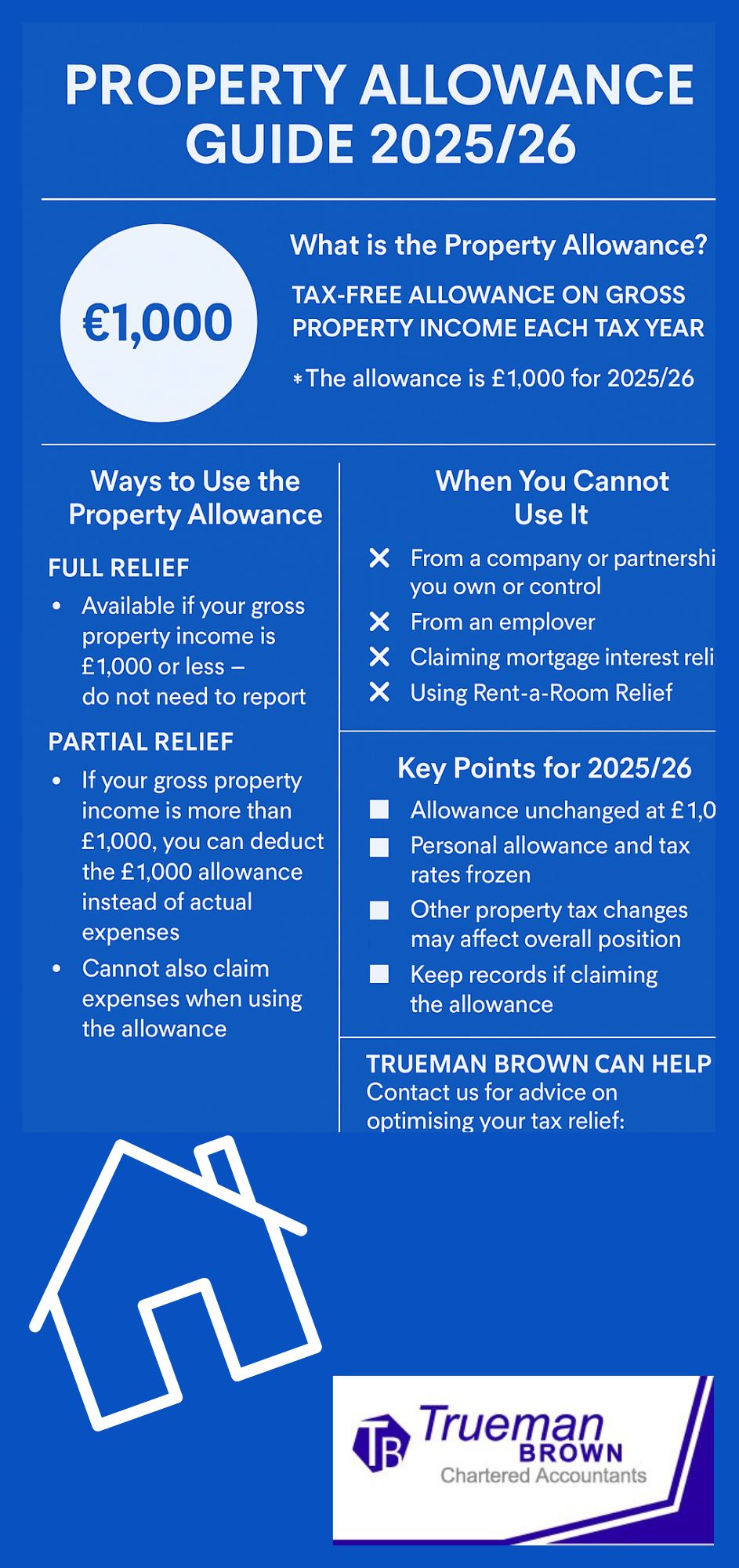
Full relief under the property allowance
If your annual gross property income is £1,000 or less, full relief under the allowance applies and you will not need to report that income to HMRC (assuming no other complicating factors).
You must still keep records of the income, but you are not required to include it in a self-assessment return if that is your only income of the type.
Partial relief under the property allowance
If your annual gross property income exceeds £1,000, then you may choose partial relief by deducting the allowance from your gross income instead of claiming actual expenses.
For example: if gross rental income is £1,500 and expenses would only be £100, then claiming the £1,000 allowance means taxable profit is £500. (Whereas if you claimed actual expenses you would have a taxable profit of £1,400).
In this scenario using the allowance could reduce your tax bill. But if your actual expenses are higher than £1,000 or result in a loss, you may be better off claiming actual expenses rather than the property allowance.
Jointly owned property & multiple property businesses
-
If a property is jointly owned (for example with your spouse or civil partner), each person is separately entitled to the property allowance against their share of the gross rental income.
-
If you run more than one property business (i.e., you have multiple letting portfolios), the allowance is available per individual rather than per business. That means you can only deduct the allowance once across your property income and if you opt for the allowance you cannot deduct actual expenses across a different property business.
When you cannot use the property allowance
There are several circumstances in which the property allowance is not available:
-
If the property income is from a company you (or someone connected to you) own or control.
-
If the property income is from a partnership in which you (or someone connected to you) are a partner.
-
If you are receiving property income from your employer (or your spouse’s or civil partner’s employer).
-
If you are claiming tax relief for interest and finance costs (e.g., mortgage interest) on the property, you cannot use the property allowance for that income.
-
If you are using the Rent‑a‑Room Relief (for letting a room in your own home) you cannot also use the property allowance on that same income.
Key changes for the 2025/26 tax year
When considering the property allowance and your wider property tax position for 2025/26, take note of the following:
-
The property allowance remains at £1,000 for 2025/26.
-
Income tax rates and personal allowance thresholds remain unchanged: the personal allowance remains £12,570, the basic rate band up to £50,270, higher rate 40% and additional rate 45%.
-
The rules for claiming the property allowance (full relief and partial relief) are reaffirmed in HMRC guidance for 2025/26.
-
Although not directly part of the property allowance, there are other property-related tax and regulatory changes from 2025/26 (for example, around furnished holiday lettings, capital allowances and plant & machinery) which may impact your overall tax position.
How Trueman Brown can help
If you’re uncertain whether to claim the property allowance or calculate actual expenses, the team at Trueman Brown Chartered Accountants can clarify your options and optimise your tax position.
We can:
-
Review your property income, expenses and portfolio structure
-
Advise whether you should claim the allowance or deduct actual expenses
-
Ensure you meet reporting and record-keeping requirements
-
Assist with your self-assessment return, liaising with HMRC where necessary
For tailored advice, please contact Mark at mark@truemanbrown.co.uk or call 01708 397262.
We’re ready to help you navigate the property allowance and other tax matters confidently.
Frequently Asked Questions (FAQ)
Q: What exactly is the property allowance?
A: The property allowance is a tax relief that allows individuals to receive up to £1,000 of gross property (rental) income tax-free for the tax year 2025/26 without needing to report it to HMRC (assuming eligibility). If gross property income exceeds £1,000 you can instead deduct the allowance rather than actual expenses.
Q: If my expenses are very low, does it always make sense to use the property allowance?
A: Not always, but often. If your actual allowable expenses are less than the £1,000 allowance, opting for the allowance may reduce your taxable profit more. But if your actual expenses are higher (or you expect future losses you wish to carry forward) then claiming actual expenses may be better.
Q: Can I claim the property allowance and also deduct my actual expenses?
A: No. If you claim the allowance in respect of your property income for a tax year you cannot also deduct actual expenses for that same property income. You must choose either the allowance or actual expense method.
Q: Do I need to tell HMRC if my gross property income is under £1,000 and I’m using the allowance?
A: If your gross property income is £1,000 or less and no other circumstances mean you must complete a self-assessment return, you do not need to report the income. However you should keep records.
Q: Are there situations where the property allowance is not available?
A: Yes. Examples: if the income comes from a company you own, from a partnership you are a partner in, from your employer, or if you are claiming relief for mortgage interest or finance costs on the property. Also it cannot be used in conjunction with Rent-a-Room relief.
Q: Will the property allowance amount change in future years?
A: For the 2025/26 tax year it remains at £1,000. Any future change would depend on future legislation or budget announcements. Always check the latest guidance at the time.
Recent Comments