
Cash Basis Extension – Simplifying Tax for Sole Traders & Partnerships
If you run an unincorporated business either as a sole trader or in a partnership of individuals, the new Cash Basis Extension brings welcome clarity to how your taxable profits are calculated.
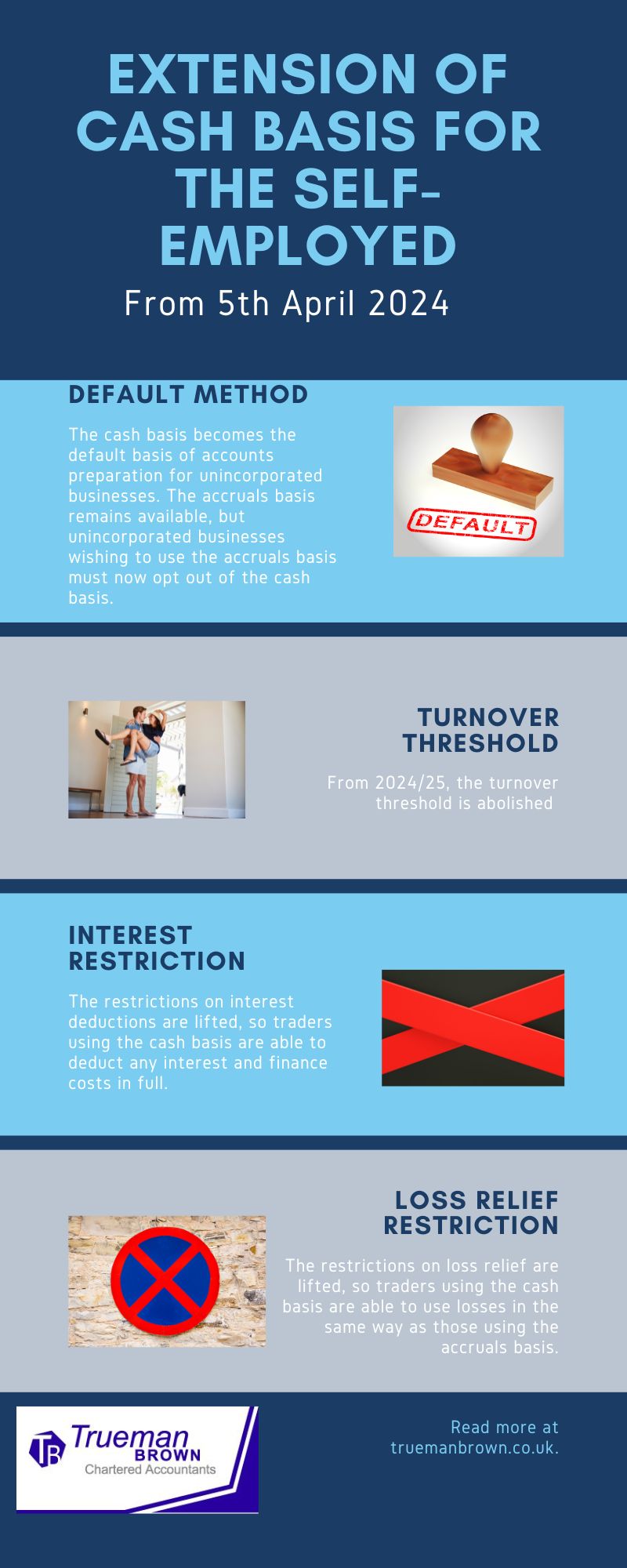
From 6 April 2024 the cash basis becomes the default method of accounting for eligible unincorporated businesses (subject to certain exclusions).
What is the Cash Basis Extension?
Under the Cash Basis Extension, the simplified “cash basis” method of accounting becomes the standard for most unincorporated businesses.
Income is recognised when it is actually received, and deductible expenses when they are paid.
Debtors, creditors, prepayments and accruals are no longer required under this method.
Before this extension, only businesses whose turnover (under the cash basis rules) did not exceed £150,000 could use the scheme—and they had to elect to do so.
With the Cash Basis Extension:
-
The turnover threshold is abolished entirely from 6 April 2024.
-
The scheme becomes the default, meaning that unless you actively opt-out you’ll automatically use the cash basis.
-
Restrictions on interest deductions (previously capped at £500) and on loss relief (e.g., sideways relief and carry-back of losses) are removed.
Why the Cash Basis Extension Matters
-
Simplicity – Fewer adjustments, no need for debtors/creditors matching, making accounting easier for many small businesses.
-
Timing benefits – Only income actually received is taxed; only expenses actually paid are deductible. This can help with cash flow planning.
-
Growth-friendly – Since turnover limits have gone, growing businesses don’t automatically lose eligibility.
-
More flexibility – With restrictions on interest and losses removed, the cash basis is now more accessible.
Who Can Use the Cash Basis Extension?
Eligible businesses include:
-
Sole traders and partnerships composed only of individuals (no corporate partners).
-
Unincorporated businesses trading for income-tax purposes (i.e., not limited companies or LLPs).
However, the following remain excluded: -
Limited companies and LLPs.
-
Partnerships with a corporate member.
-
Businesses using the “herd basis” election (farming), or those that claim averaging relief (artists/farmers).
-
Some trades such as mineral extraction, Lloyd’s underwriters etc.
How the Cash Basis Extension Works in Practice
-
Income and expenses – Under the cash basis, trading income is included when it is received; expenses when paid. No need for accruals or prepayments.
-
Capital expenditure – Normal capital allowances rules under the accruals basis are replaced: often under the cash basis you deduct the cost (with some exceptions) in the year of payment. However, certain items remain restricted (e.g., cars/land/buildings) depending on circumstances.
-
Loss relief & interest deduction – Under the extension, businesses using the cash basis can now deduct interest and finance costs in full (no £500 cap) and use losses in the same way as accrual basis businesses.
-
Becoming the default basis – If you do nothing, from tax year 2024/25 you will automatically be using the cash basis unless you opt-out to accruals.
Transitioning to the Cash Basis Extension – What You Should Do
-
If you were using the accruals basis prior to 6 April 2024 (tax year 2023/24), you may need to make transitional adjustments to avoid double taxation or missing deductions in 2024/25 onward.
-
Consider your business accounting period end date: under the new tax year basis (which also changed from 6 April 2024), if your year-end is other than 31 March or 5 April (or any in-between), you may need to time-apportion profits.
-
Review your business structure: if you have an exclusion (LLP, corporate partner, herd basis etc) then the cash basis may not apply.
-
Decide whether the cash basis is appropriate: despite its simplicity, some businesses may prefer the accruals basis (especially if you carry significant stock, work in progress, or need bank financing).
-
If you wish to stay on the accruals basis, you must opt-out of the cash basis from tax year 2024/25 onward.
Why Choose the Cash Basis Extension (And When It Might Not Be Right)
When it is a good fit:
-
You run a straightforward service-based business, little to no stock, and income/expenses align closely with cash flows.
-
You want simpler bookkeeping and fewer year-end adjustments.
-
You wish to benefit from income being taxed when received, giving flexibility in timing.
When it may not be ideal:
-
You hold significant stock or work in progress which is better captured under accruals.
-
You’re seeking external financing: banks may prefer traditional accrual-based accounts showing debtors and creditors.
-
Your year-end is unusual and the apportionment to the tax year basis is complex.
-
You’re in a trade that is excluded, or you expect complex capital expenditure treatment.
Recent Comments