
Disincorporate business: Should You Step Back from a Limited Company Structure?
If you’re running a limited company and considering whether to disincorporate business, you’re likely navigating a range of tax, administrative and structural issues.
At Trueman Brown we’ve seen first-hand how the shift from a company to sole trader or partnership can make sense — but also how the process requires careful planning to avoid unintended tax or legal surprises.
Why you might want to disincorporate business
But things have changed.
With increasing regulatory burdens and shifting tax landscapes, many business owners are asking: does it still make sense to disincorporate business and revert to a simpler structure?
Key triggers include:
-
Smaller profits where corporate tax plus extraction (dividend or salary) no longer gives a clear edge.
-
Administrative burden: Companies House filings, confirmation statements, corporation tax, and dividend paperwork.
-
Disclosure of company financials and public registers (see changes under the Economic Crime and Corporate Transparency Act 2023).
-
Desire for simpler bookkeeping, simpler tax treatment, greater flexibility.
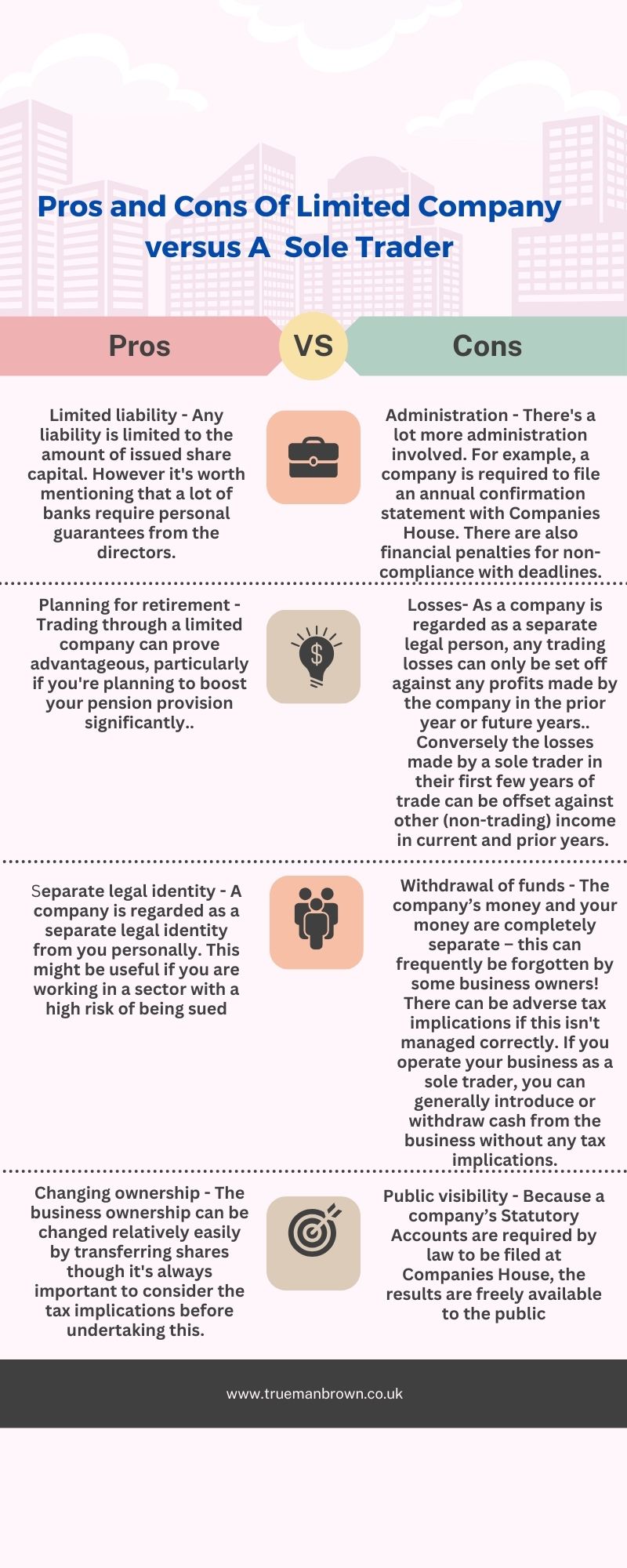
If you’re wondering whether to disincorporate business, you’re on a path that needs careful consideration of both the benefits and the downsides.
What does it mean to disincorporate business?
To disincorporate business means you stop trading via the limited company and transfer the business operations — assets, liabilities, goodwill, stock, plant & machinery — to yourself (or another) as a sole trader or partner.
The legal entity (the company) is wound up or struck off, and business is carried on outside the company structure.
Usually the steps include:
-
Assessing the company’s assets and liabilities and dealing with any retained profits or cash.
-
Transferring trades and assets, often under “transfer of a going concern” (TOGC) if applicable.
-
Ensuring VAT registration or deregistration is properly handled.
-
Considering capital gains, corporation tax on cessation, and how you as an individual will extract or continue the business.
Pros of choosing to disincorporate business
Here are some of the advantages you may realise when you decide to disincorporate business:
-
Simplified administration – no more Companies House filings, no confirmation statements, fewer corporation tax complexities.
-
Lower accountancy and compliance costs – fewer returns, simpler bookkeeping.
-
More direct access to income – as a sole trader or partner you may find it easier to draw profits and manage tax and National Insurance.
-
Less public exposure – company accounts are publicly filed; unincorporated structures carry fewer disclosure obligations.
-
Focus on trading rather than corporate form – if your business size or risk profile means the limited company structure no longer gives meaningful benefit, you may be better off shifting.
Key considerations before you disincorporate business
While there are clear advantages, the decision to disincorporate business is not one to take lightly. You must weigh the following:
-
Loss of limited liability protection – as a sole trader or partner you are personally liable for business debts.
-
Tax implications – transferring assets may trigger corporation tax, capital gains tax (CGT) and other charges. For example, the company may face corporation tax on gains from asset transfers, and you as the individual may face distributions taxed at your highest rate.
-
VAT and TOGC issues – If the business is VAT-registered, to avoid VAT on transfers you may need to meet TOGC conditions. Failure to do so may create unexpected VAT liabilities.
-
Capital allowances and equipment write-downs – Ceasing the company means some allowances stop, balancing adjustments may apply.
-
Future growth and credibility – Some contracts or clients may prefer or require a limited company; stepping away may affect perception or opportunities.
-
Timing and planning – Mistiming the switch could trigger unnecessary tax or loss of reliefs. For example, the rules for Business Asset Disposal Relief (formerly Entrepreneurs’ Relief) still apply to disposals made after 6 April 2025.
What’s new for 2025/26 and how it affects your decision to disincorporate business
Given the 2025/26 tax year, here are some updated rule changes and how they affect your plan to disincorporate business:
-
Business Asset Disposal Relief remains available for eligible gains, with updated limits and claims guidance published 6 April 2025.
-
The Economic Crime and Corporate Transparency Act 2023 is driving greater transparency for companies, which may increase the appeal of moving to an unincorporated structure.
-
VAT TOGC and asset transfers continue to be critical: ensure that when disincorporating business you meet the conditions for transfer of a going concern to avoid VAT surprises.
-
Capital gains and corporation tax exposures remain prominent: when you choose to disincorporate business, you must evaluate both company tax liabilities on cessation and your personal tax position.
-
For smaller businesses, the threshold changes and reporting requirements for ‘micro-companies’ and ‘small companies’ may influence whether staying incorporated remains the best choice.
How Trueman Brown can help you disincorporate business
If you’re seriously considering to disincorporate business, then the team at Trueman Brown is ready to assist. We will review your entire structure — company and unincorporated options — and map out the tax, VAT, asset and liability implications.
Contact us today:
-
Email: mark@truemanbrown.co.uk
-
Phone: 01708 397262
We’ll guide you step-by-step through the process, including: -
Modelling the tax outcomes of remaining incorporated vs. disincorporating business
-
Handling the transfer of assets, VAT registration/deregistration, and TOGC eligibility
-
Ensuring your company cessation or continuing business as a sole trader/partnership is executed in a tax-efficient and compliant manner
Don’t leave a decision this significant to chance — proper planning avoids surprises and ensures the move to disincorporate business is effective and aligned with your future trading goals.
FAQ: Frequently Asked Questions
Q1. What is the exact meaning of “disincorporate business”?
A: It means transferring your business operations from a limited company to an unincorporated structure (sole trader or partnership). You cease trading via the company and continue the business in your personal capacity.
Q2. How will disincorporating business affect my tax position?
A: Several effects: the company may face corporation tax on asset transfers and final trading profits; you may face capital gains tax or income tax on distributions; as a sole trader you will pay income tax and Class 2/4 National Insurance rather than corporation tax and dividend tax. Planning models are essential.
Q3. Will I need to pay VAT when I disincorporate business?
A: Only if the conditions for a transfer of a going concern (TOGC) are not met. If you satisfy them, the asset transfer may not trigger VAT. If you don’t, VAT may be charged on stock/assets.
Q4. Is there a relief called Disincorporation Relief?
A: Historically yes, but “Disincorporation Relief” as a distinct relief was abolished years ago. However, other reliefs like Business Asset Disposal Relief may apply when you cease a business or sell assets.
Q5. What are the risks of deciding to disincorporate business?
A: Risks include losing limited liability protection, triggering tax and VAT unexpectedly, loss of company-specific tax advantages, damage to business credibility, and missing opportunities to reinvest within the company framework.
Q6. When is the right time to disincorporate business?
A: There’s no universal “right” time. It tends to make sense when profits are modest, administrative burden is high, growth plans are limited, and the benefits of limited company status have diminished. You’ll need a tailored model for your circumstances.
If you’d like us to prepare a detailed comparison model specifically for your business and run through your numbers, we’d be delighted to help at Trueman Brown — email mark@truemanbrown.co.uk or call 01708 397262 to book a chat.
Disclaimer: This article is for general guidance only and does not constitute professional advice. Tax rules may change and your personal circumstances must be considered. For tailored advice please contact Trueman Brown.
Recent Comments