
Should you withdraw your pension ahead of the pension IHT changes?
With the recent announcements around pension IHT changes, many pension savers are wondering whether they should withdraw their pension to avoid a future inheritance tax charge.
The short answer is: not necessarily.
While the proposed reforms will bring unused pension savings into the scope of inheritance tax (IHT), the legislation is not yet law and does not take effect until 6 April 2027.
So, rushing to withdraw your pension may create unintended tax costs and other drawbacks.
How the current rules apply for 2025/26
Under the current regime (2025/26), pensions held in a money-purchase scheme (often known as defined contribution) are generally outside your estate for IHT purposes.
This means the remaining pension pot is not included when calculating your estate value for IHT.
If you have reached the minimum access age (which is currently age 55, rising to age 57 from 6 April 2028) you may take a 25% tax-free lump sum (capped at £268,275) and then additional withdrawals are taxed at your marginal rate.
It is important to note that accessing your pension early
(before age 55 or 57) would trigger an unauthorised payment charge of up to 55%.
So for 2025/26, you still enjoy the benefit that the pension pot is excluded from the IHT estate (assuming you leave it untouched).
What exactly are the pension IHT changes being introduced?
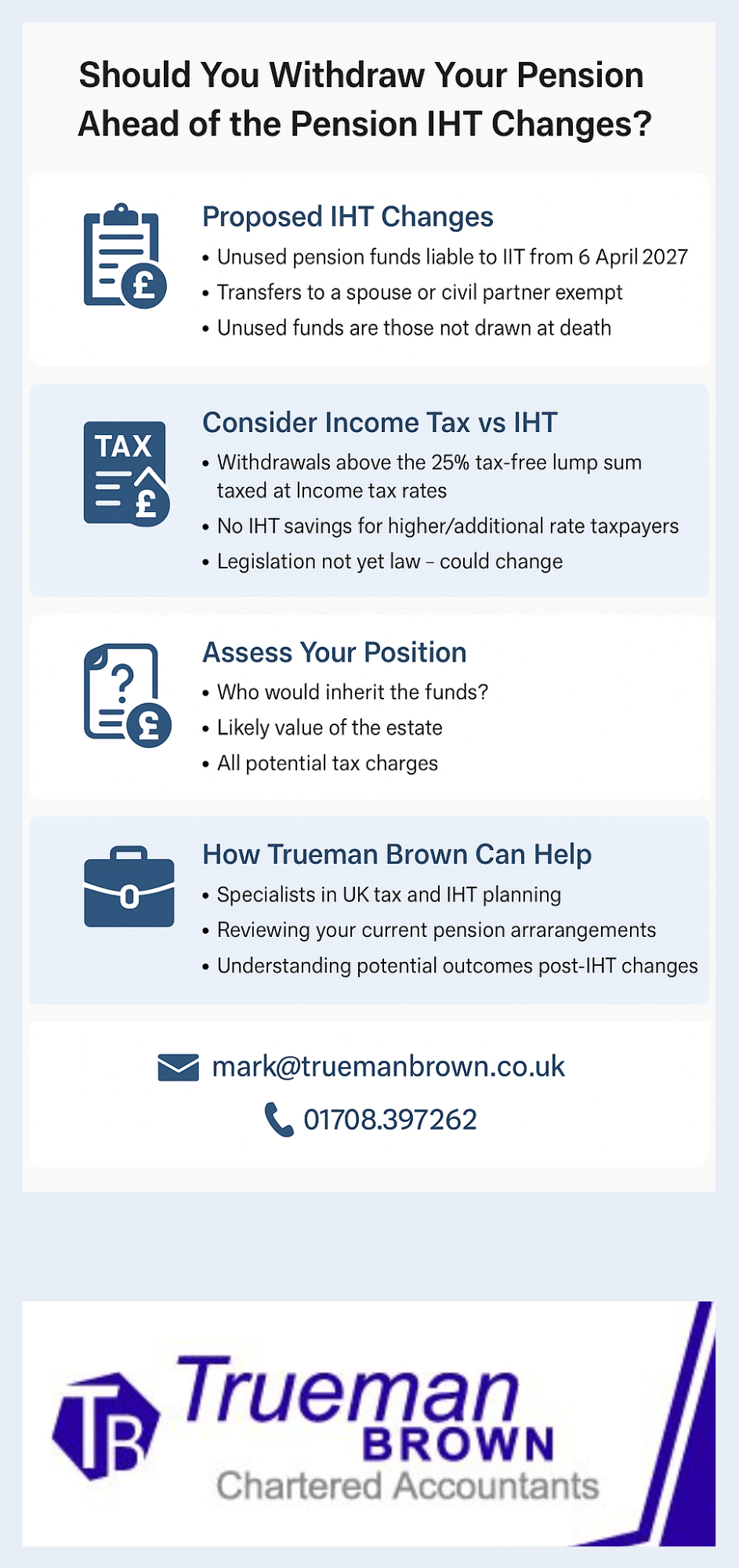
The term pension IHT changes refers to the plan announced by the UK Government (via the Autumn Budget 2024) to bring most unused pension funds and certain pension death benefits into the deceased’s estate for IHT purposes from 6 April 2027.
Key points include:
-
The value of unused pension funds (and death benefits) will be included in the estate on death for estates of individuals dying on or after 6 April 2027.
-
The existing spousal/civil partner IHT exemptions will continue to apply (i.e., pension funds passed to a spouse/civil partner still escape IHT).
-
“Unused” generally means funds not drawn down (or used to secure a guaranteed income) at death.
-
The nil-rate band (£325,000) and residence nil-rate band (£175,000) remain frozen until at least 2030, meaning more estates face IHT pressure.
-
For non-UK domiciled individuals, from April 2025 the IHT regime becomes residency-based rather than purely domicile-based, so this interacts with pension IHT changes for some.
Should you consider withdrawing your pension now because of the pension IHT changes?
With the pension IHT changes on the horizon, it’s understandable to consider withdrawing your pension early to avoid the 40% IHT that could apply in future.
But you must carefully weigh this decision:
Pros of early withdrawal
-
You might reduce the size of the pension pot that could fall into the taxable estate after April 2027.
-
You gain control of the funds now and perhaps can gift or invest them in more IHT-efficient ways.
Cons of early withdrawal
-
Any amount you withdraw above the tax-free 25% lump sum will be taxed at your income tax rate now, which for higher-rate taxpayers (40% or 45%) often means greater tax than the future 40% IHT.
-
Once you access the pension, you reduce your ability to make future contributions (the Money Purchase Annual Allowance is £10,000 if you’ve taken flexible benefits).
-
You lose the benefit of the pension wrapper (tax-efficient growth, outside the estate for now).
-
The legislation is not yet law; you risk acting too early and paying tax prematurely when the change might be tweaked.
-
If your estate value (including pension) is already below IHT thresholds, withdrawing may create a tax exposure that did not otherwise exist.
Bottom line: Only for very specific circumstances might early withdrawal make sense; for the majority of savers, waiting and reviewing closer to 2027 is the prudent approach.
Practical planning considerations under pension IHT changes
When thinking about the pension IHT changes, here are the key factors to review in your personal planning:
-
Beneficiary type: If the nominated beneficiary is your spouse or civil partner, the pension still passes free of IHT under the spousal exemption. With a spouse as beneficiary, the IHT risk is minimal.
-
Estate value including pension: If your total estate (assets + unused pension pot) is comfortably below the nil-rate bands, the IHT charge may not bite.
-
Access status of the pension: If you are already drawing income (and have little “unused” pot at death), the change may have limited impact.
-
Timing of death: The new rules only apply for deaths from 6 April 2027. Until then the current favourable pension treatment remains.
-
Alternative actions: You might consider taking the 25% tax-free lump sum and gifting or investing it; making gifts out of surplus income; reviewing your estate planning nominations; or even using part of your pension to purchase an annuity or income stream before the change.
-
Stay flexible: Because the rules are pending, a “wait and plan” approach often makes sense rather than making irreversible moves now.
🤝How Trueman Brown can help you
When it comes to navigating the emerging pension IHT changes, specialist advice is important. At Trueman Brown, we can assist you with:
-
Reviewing your current pension arrangements and estate exposure.
-
Modelling potential outcomes post-changes (6 April 2027) and helping you understand if early action might make sense.
-
Advising on optimal beneficiary nominations, gifting strategies, utilisation of allowances and inter-spousal transfers.
-
Helping you structure pension access or lifetime gifting that aligns with your broader retirement and legacy objectives.
If you’d like to talk this through, please contact us: mark@truemanbrown.co.uk or call 01708 397262.
We will work with you to build a plan tailored to your circumstances, taking account of both current and future pension IHT changes.
❓ FAQ – Frequently Asked Questions about pension IHT changes
Q1. When do the pension IHT changes take effect?
A. The changes are planned to apply to deaths on or after 6 April 2027.
Q2. Will the pension IHT changes apply to all types of pension schemes?
A. They apply primarily to unused pension funds from money-purchase (defined contribution) schemes and certain death benefits, regardless of whether scheme trustees have discretion. Defined benefit pensions or annuities already in payment may not be affected in the same way.
Q3. What is “unused” pension in the context of these changes?
A. “Unused” generally refers to pension funds not drawn down or used to secure an income at the time of death — i.e., a pot still sitting intact.
Q4. Does the spousal exemption still apply under the pension IHT changes?
A. Yes — transfers to a spouse or civil partner remain exempt from IHT, including pension-fund transfers in this context.
Q5. Should I withdraw my pension now to avoid IHT?
A. For most people, the answer is no. Withdrawing prematurely may trigger higher income tax, reduce future contribution allowances and lose tax-efficient pension growth. Only in specific cases (large unused pension pot, high estate value, non-spouse beneficiary) might early action be warranted.
Q6. What other changes are affecting IHT concurrently with the pension IHT changes?
A. Yes — for example: from April 2025 the IHT system moves to a residency-based test for long-term UK residents rather than purely domicile-based. SN Financial+1 Also, the nil-rate bands remain frozen until 2030, increasing pressure on estates.
Q7. What should I do now?
A. You should review your pension and estate planning now, but you do not need to make hasty decisions. Make sure your pension nominations are up to date, consider whether you might need to draw income or gift now, and seek independent advice. Closer to 2027 you can refine your plan.
Final thought
Whilst the upcoming pension IHT changes represent a significant shift for estate planning, acting too early without careful analysis could prove costly.
The best approach for most is to stay informed, review your position now, and take action only when it’s sensible, ideally with
Recent Comments